


Taoyuan leads in public approval of its education policies and its emphasis on education, while Taipei and Kaohsiung came in last respectively, a survey released yesterday by the Professor Huang Kun-Huei Education Foundation showed.
In the category of mayors placing sufficient emphasis on education, respondents rated Taoyuan Mayor Cheng Wen-tsan (鄭文燦) the highest, with 77.6 percent approval, while former Kaohsiung mayor Han Kuo-yu (韓國瑜) had the lowest approval rating at 44.3 percent, foundation polling committee member Feng Ching-huang (馮清皇) said.
In the same category, Lienchiang County led other cities and counties outside of the six special municipalities, with 87.6 percent approval, while Hualien and Pingtung counties and Hsinchu City received more than 75 percent approval, Feng said.
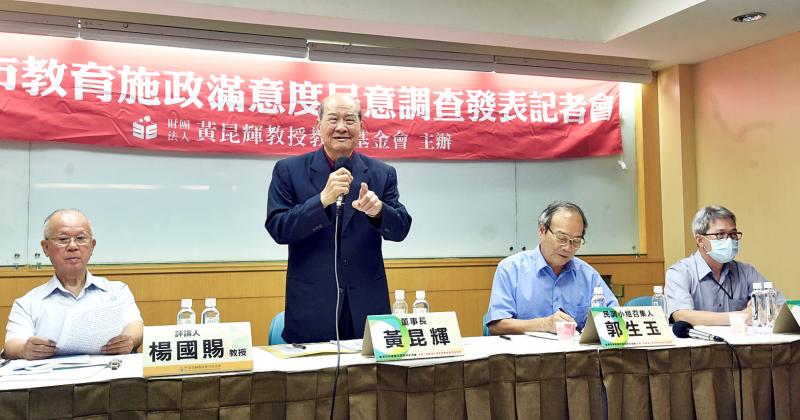
Photo: Liu Hsin-de, Taipei Times
Hsinchu, Changhua and Miaoli counties all received less than 59 percent approval, Feng added.
Regarding approval of a city or county’s education policies and their effectiveness, the survey ranked Taoyuan the highest of the six special municipalities, followed by New Taipei City, Tainan, Taichung, Kaohsiung and Taipei.
Outside of the special municipalities, Taitung, Pingtung and Hualien counties received the highest ratings, and Miaoli, Hsinchu and Yunlin counties received the lowest, it said.
Regarding overall performance, Pingtung, Chiayi and Taitung ranked as the three highest-scoring counties, while Miaoli and Hsinchu counties and Keelung scored the lowest, it said.
Education is the fundamental driving force of social progress, and the poll seeks to understand what residents think of education in their respective cities and counties, as city mayors and county commissioners oversee education programs, foundation chairman Huang Kun-huei (黃昆輝) said.
The nation’s education system is showing signs that it is falling behind, unable to keep up with the rapid development of the economy and technology, he said.
Critical thinking, creativity, collaboration and communication are the four core skills that the nation’s talent pool should possess, yet the education model does not teach them, Huang said.
The US, Japan, South Korea and Singapore are beginning to enact education reforms to meet this challenge, and even Vietnam and the Philippines are starting to make changes, while Taiwan’s national education program remains focused on achieving high scores for the next level of education, he said.
Citing the results of this year’s Comprehensive Assessment Program for Junior High School Students, Huang said it is worrying that more than 40 percent of examinees received a zero in math questions that were not multiple choice.
He said the foundation hoped the poll would help city and county leaders place more emphasis on education and reform.
The poll was conducted from Feb. 11 to April 29, primarily using landline and cellphone sampling. It received 21,597 valid responses from people aged 25 to 65, with education levels from elementary school to junior colleges and above.

UNREASONABLE SURVEILLANCE: A camera targeted on an road by a neighbor captured a man’s habitual unsignaled turn into home, netting him dozens of tickets The Taichung High Administrative Court has canceled all 45 tickets given to a man for failing to use a turn signal while driving, as it considered long-term surveillance of his privacy more problematic than the traffic violations. The man, surnamed Tseng (曾), lives in Changhua County and was reported 45 times within a month for failing to signal while driving when he turned into the alley where his residence is. The reports were filed by his neighbor, who set up security cameras that constantly monitored not only the alley but also the door and yard of Tseng’s house. The surveillance occurred from July

A Japan Self-Defense Forces vessel entered the Taiwan Strait yesterday, Japanese media reported. After passing through the Taiwan Strait, the Ikazuchi was to proceed to the South China Sea to take part in a joint military exercise with the US and the Philippines, the reports said. Japan Self-Defense Force vessels were first reported to have passed through the strait in September, 2024, with two further transits taking place in February and June last year, the Asahi Shimbun reported. Yesterday’s transit also marked the first time since Japanese Prime Minister Sanae Takaichi took office that a Japanese warship has been sent through the Taiwan

SECURITY: Starlink owner Elon Musk has taken pro-Beijing positions, and allowing pro-China companies to control Taiwan’s critical infrastructure is risky, a legislator said Starlink was reluctant to offer services in Taiwan because of the nation’s extremely high penetration rates in 4G and 5G services, the Ministry of Digital Affairs said yesterday. The ministry made the comments at a meeting of the legislature’s Transportation Committee, which reviewed amendments to Article 36 of the Telecommunications Management Act (電信管理法). Article 36 bans foreigners from holding more than 49 percent of shares in public telecommunications networks, while shares foreigners directly and indirectly hold are also capped at 60 percent of the total, unless specified otherwise by law. The amendments, sponsored by Chinese Nationalist Party (KMT) Legislator Ko

‘SAME OLD TRICK’: Even if Beijing resumes individual travel to Taiwan, it would only benefit Chinese tourism companies, the Economic Democracy Union convener said China’s 10 new “incentives” are “sugar-coated poison,” an official said yesterday, adding that Taiwanese businesses see them clearly for what they are, but that Beijing would inevitably find some local collaborators to try to drums up support. The official, speaking on condition of anonymity, made the remark ahead of a news conference the General Chamber of Commerce is to hold today. The event, titled “Industry Perspectives on China’s Recent Pro-Taiwan Policies,” is expected to include representatives from industry associations — such as those in travel, hotels, food and agriculture — to request the government cooperate with China’s new measures, people familiar with


 RSS
RSS