

The Taipei Market Administration Office yesterday introduced touchscreen kiosks at Xihu Market (西湖市場) that allow customers to order meals in the food court by using their smartphone to scan a quick response code.
The system was unveiled for the Taipei Traditional Market Festival, which opened at Xihu Market.
Taipei Deputy Mayor Vivian Huang (黃珊珊) said that as the market shares a building with MRT Xihu Station and receives ample foot traffic, the office last year budgeted funding to renovate the market in the hopes of attracting more visitors and making the market a tourist attraction in Neihu District (內湖).
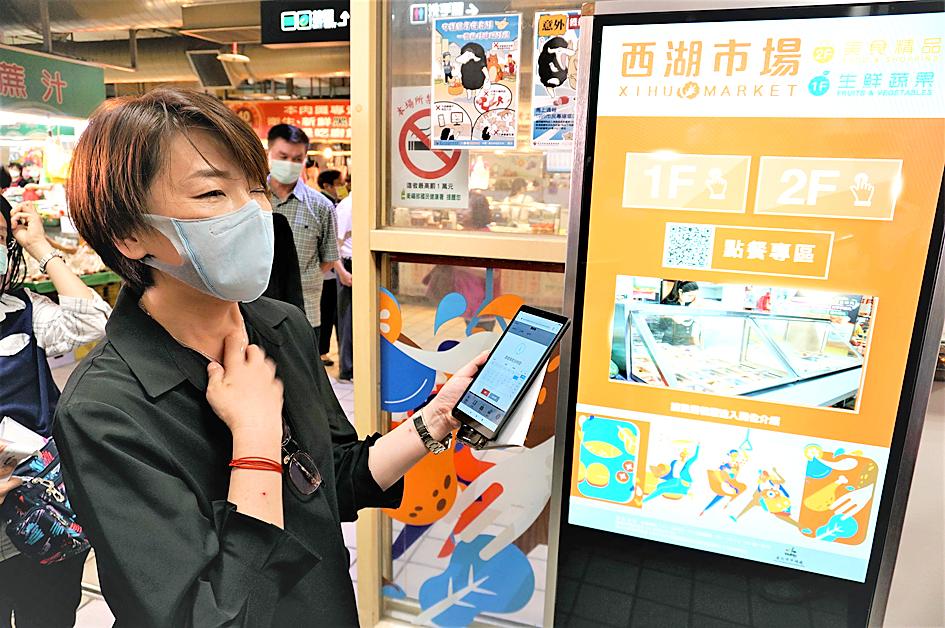
Photo: CNA
The renovation included changing floor tiles, tables and chairs at the market’s second-floor food court; improving entry, exit and information signs and layout maps; and remodeling 15 stalls, the office said.
Five touchscreen kiosks, which were installed near entrances this week, display products sold at each food stall and provide codes that customers can scan to order meals, it said.
The market is near Neihu Technology Park (內湖科技園區) and many of the park’s workers frequent its food court, the office said, adding that it collaborated with two technology companies to introduce the point-of-sale kiosks in the hopes of making food orders more convenient and less time-consuming.
The office said that it plans to introduce the system at three other traditional markets in the second half of this year.
With the Central Epidemic Command Center easing disease prevention measures and the city’s public facilities beginning to gradually reopen to the public today, people can choose not to wear a mask if they can maintain social distancing on public transportation, Huang said.
However, vendors and visitors at the city’s public markets are still required to wear masks, she said.

NATURE TAKES ITS COURSE: The agency’s head said he felt a sense of loss watching red-banded snakes eat the babies, as they had decided on non-intervention The Forestry and Nature Conservation Agency yesterday released a documentary on a hundred-pace viper that had incubated 16 eggs, all of which hatched, but only a baby viper escaped after they were attacked by red-banded snakes. The agency’s Taichung branch last year launched the viper reproduction monitoring project soon after forest rangers Lin Chun-yu (林俊佑) and Chou Chia-cheng (周家成) spotted a pregnant hundred-pace viper in a grass-covered burrow near a parking lot in Tbulan Village (松鶴部落). The Atayal village, in Taichung’s Heping District (和平), is headed by Ecyang Yapu, who was positive about the project and assisted in access control and power

The Coast Guard Administration (CGA) yesterday said that it had deployed vessels to “monitor” Chinese ships operating in waters off the east coast. The CGA said it dispatched vessels in response to a China Coast Guard announcement that it had carried out another “routine law-enforcement patrol” in waters off the east coast. “The CGA firmly rejects China’s cognitive warfare campaign of ‘law enforcement in name, jurisdictional expansion in practice,’” it said on X. As of 11am yesterday, two China Coast Guard ships were “loitering and drifting” about 105 nautical miles (195km) and 74 nautical miles east of Green Island (綠島) respectively, it said. It

A Straits Exchange Foundation official today warned that yielding to political pressure in exchange for access to China’s entertainment industry rarely ends well, amid rumors that China is seeking to lure Taiwanese K-pop star Chou Tzu-yu (周子瑜). Chou, more commonly known as Tzuyu, is the only Taiwanese member of the girl group Twice. Her contract with JYP Entertainment is set to expire at the end of this year, and there have been widespread reports that she would not renew it. She is reportedly planning to pursue solo activities under her parents’ agency, Yu Hai Entertainment (瑜海娛樂), although China has also reportedly offered

A sharp rise in compensation to be paid by air force officers who leave before completing their required service could indicate an increase in pilots leaving the military early, an analyst said on Friday, warning that the trend could worsen a shortage of experienced personnel. Chieh Chung (揭仲), a researcher at the Association for Strategic Foresight, issued the warning even though the number of volunteer military personnel is expected to increase next year. The planned headcount for volunteer military personnel, covering officers, noncommissioned officers (NCO) and enlisted soldiers, is 158,223 for next year, up 4,258 from 153,965 this year, Chieh said. The increase


 RSS
RSS