


Someone in Taiwan is diagnosed with cancer every 4 minutes, 42 seconds, the Health Promotion Administration (HPA) said yesterday, adding that colon cancer was the most common cancer diagnosis in 2017, for the 12th straight year.
The 2017 Cancer Registry Annual Report released yesterday by the agency showed 111,684 new cancer cases that year, up by 5,852 from a year earlier.
The median age of diagnosis in 2017 was 63 years old, the same as a year earlier, but the median age of diagnosis for some types of cancer was lower, such as for esophageal cancer (58), oral cancer (57), breast cancer (55) and thyroid cancer (50), the agency said.
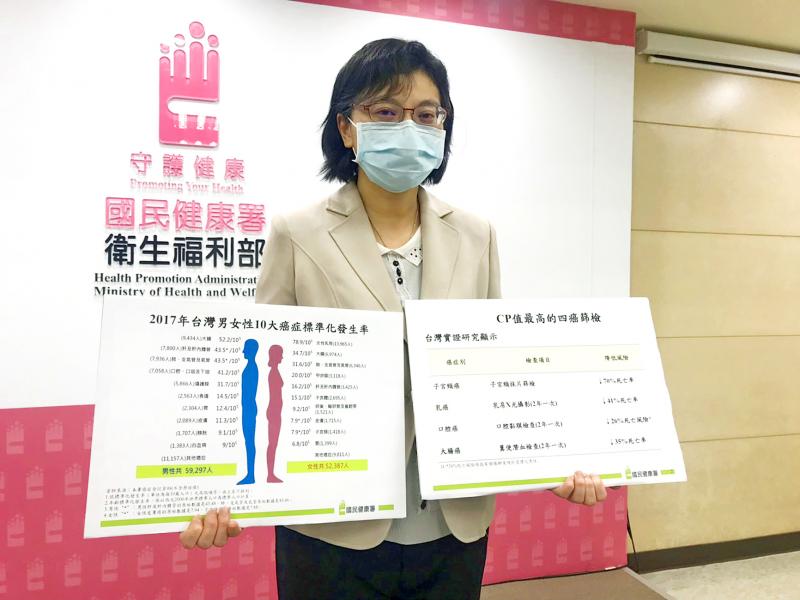
Photo: CNA
A new case of cancer was diagnosed every 4 minutes, 42 seconds — which was 16 seconds faster than a year earlier, HPA data showed.
The 10 most common types of cancer in 2017 were colon cancer, lung cancer, female breast cancer, liver cancer, oral cancer (including oropharyngeal and hypopharyngeal cancers), prostate cancer, thyroid cancer, skin cancer, gastric cancer and esophageal cancer.
The list was the same as a year earlier, except that skin cancer and gastric cancer switched places.
The age-standardized incidence rate was 305.4 cancers per 100,000 population, or 8.7 higher than a year earlier, Cancer Prevention and Control Division Director Lin Li-ju (林莉茹) said.
The standardized incidence rate, types of female cancer and colon cancer increased more than other types, she said, adding that 16,408 people were diagnosed with colon cancer, making it the most common type of cancer for a 12th consecutive year.
The three most common types of cancer in women were breast cancer, colon cancer and lung cancer, with 52,387 women being diagnosed, HPA data showed.
The number of breast cancer screenings in 2017 rose by 48,000, while colon cancer screenings increased by about 22,000, Lin said, adding that most of the new breast cancer and colon cancer cases were caught at stage 0 or stage 1, meaning that increased awareness helped detect cancer earlier.
Cancer is often detected after years of unhealthy habits, while the WHO has said that 30 to 50 percent of cancers are preventable, Lin said.
The HPA recommends that people avoid smoking tobacco, chewing betel nut and drinking alcohol, and that they eat a balanced diet, exercise regularly, keep a healthy body weight and get screened for cancer regularly, she added.
Getting regular pap smears can lower the mortality rate of cervical cancer by 70 percent, while getting a mammogram every other year can reduce the mortality rate of breast cancer by 41 percent and a fecal occult blood test every other year can reduce the mortality rate of colon cancer by 35 percent, the agency said, citing National Health Insurance Administration statistics.

A magnitude 6.1 earthquake struck off the coast of Yilan County at 8:39pm tonight, the Central Weather Administration (CWA) said, with no immediate reports of damage or injuries. The epicenter was 38.7km east-northeast of Yilan County Hall at a focal depth of 98.3km, the CWA’s Seismological Center said. The quake’s maximum intensity, which gauges the actual physical effect of a seismic event, was a level 4 on Taiwan’s 7-tier intensity scale, the center said. That intensity level was recorded in Yilan County’s Nanao Township (南澳), Hsinchu County’s Guansi Township (關西), Nantou County’s Hehuanshan (合歡山) and Hualien County’s Yanliao (鹽寮). An intensity of 3 was

Instead of focusing solely on the threat of a full-scale military invasion, the US and its allies must prepare for a potential Chinese “quarantine” of Taiwan enforced through customs inspections, Stanford University Hoover fellow Eyck Freymann said in a Foreign Affairs article published on Wednesday. China could use various “gray zone” tactics in “reconfiguring the regional and ultimately the global economic order without a war,” said Freymann, who is also a nonresident research fellow at the US Naval War College. China might seize control of Taiwan’s links to the outside world by requiring all flights and ships entering or leaving Taiwan
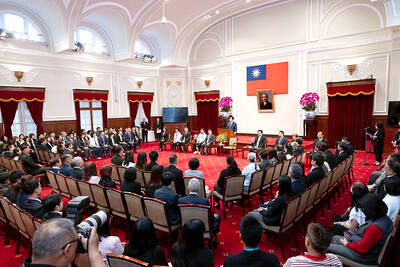
The next minimum wage hike is expected to exceed NT$30,000, President William Lai (賴清德) said yesterday during an award ceremony honoring “model workers,” including migrant workers, at the Presidential Office ahead of Workers’ Day today. Lai said he wished to thank the awardees on behalf of the nation and extend his most sincere respect for their hard work, on which Taiwan’s prosperity has been built. Lai specifically thanked 10 migrant workers selected for the award, saying that although they left their home countries to further their own goals, their efforts have benefited Taiwan as well. The nation’s industrial sector and small businesses lay
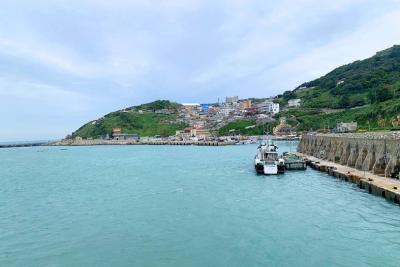
Taiwan has activated backup communications for its northernmost territory, the remote and strategically located island of Dongyin (東引), after poor weather conditions apparently shifted the wreckage of a ship onto an undersea cable causing it to break. The vulnerability of undersea communication cables linking Taiwan with its outlying islands has been a persistent cause of concern for Taipei, whose government has on several occasions blamed Chinese ships for intentionally causing damage. Dongyin, home to about 1,500 people, sits in a strategic position at the top of the Taiwan Strait and the island has a heavy military presence. It does not have an


 RSS
RSS