


The nation’s last evening newspaper closed after publishing its final edition yesterday.
The Chinese-language United Evening News said in a statement that it decided to end publication due to the “changing habits of readers, development of digital media and the COVID-19 outbreak.”
“The decision to cease publication starting [today] was finalized this [yesterday] morning, but we had been evaluating that option over the past few years,” managing editor Wang Mao-chen (王茂臻) said.
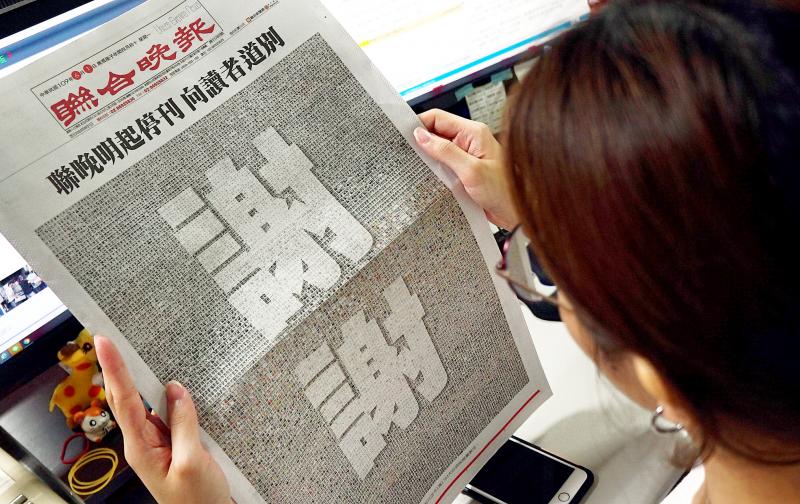
Photo: CNA
Wang said that the newspaper’s circulation had been declining annually, as have other print media in the nation.
“However, we cannot break even anymore with the circulation we have at the moment,” he said.
It said it would offer subscribers a refund or allow them to transfer their subscription to another United Daily News Group (UDN) publication, and it would retain all of its reporters.
The front page of its final edition featured images of its 11,783 front pages published over the past 32 years and three months with the text “thank you” in Mandarin in large font.
UDN founder Wang Tiwu (王惕吾) established the newspaper on Feb. 22, 1988, shortly after the government on Jan. 1, 1988, lifted a newspaper ban.
It was the nation’s first Chinese-language paper to print in landscape orientation.
“As the only evening newspaper in the nation, the United Evening News has accomplished its purpose in the nation’s history of development. We thank our readers for their support, which has helped sustain us for more than 10,000 days,” it said.
In February, Chinese-language weekly tabloid Next Magazine folded its online publication after ending its print edition in 2018.
In addition to the United Evening News, the nation previously had two other evening newspapers: China Times Express and Independent Evening Post, founded in 1988 and 1947 respectively.
The China Times Express ended publication on Oct. 31, 2005, due to shortfalls in advertising revenue as 24-hour cable TV news rose in popularity.
It also experienced a sharp decline of subscribers following an economic slump, the rising influence of online news and the Taiwan Stock Exchange’s decision to extend trading until 1:30pm.
Its management tried unsuccessfully to negotiate a merger with United Evening News.
The Independent Evening Post distinguished itself as unaffiliated with political parties.
It ceased publication on Oct. 2, 2001, after years of financial losses and management changes.

More than half of the bamboo vipers captured in Tainan in the past few years were found in the city’s Sinhua District (新化), while other districts had smaller catches or none at all. Every year, Tainan captures about 6,000 snakes which have made their way into people’s homes. Of the six major venomous snakes in Taiwan, the cobra, the many-banded krait, the brown-spotted pit viper and the bamboo viper are the most frequently captured. The high concentration of bamboo vipers captured in Sinhua District is puzzling. Tainan Agriculture Bureau Forestry and Nature Conservation Division head Chu Chien-ming (朱健明) earlier this week said that the

NAMING SPAT: The foreign ministry called on Denmark to propose an acceptable solution to the erroneous nationality used for Taiwanese on residence permits Taiwan has revoked some privileges for Danish diplomatic staff over a Danish permit that lists “Taiwan” as “China,” Eric Huang (黃鈞耀), head of the Ministry of Foreign Affairs’ Department of European Affairs, told a news conference in Taipei yesterday. Reporters asked Huang whether the Danish government had responded to the ministry’s request that it correct the nationality on Danish residence permits of Taiwanese, which has been listed as “China” since 2024. Taiwan’s representative office in Denmark continues to communicate with the Danish government, and the ministry has revoked some privileges previously granted to Danish representatives in Taiwan and would continue to review
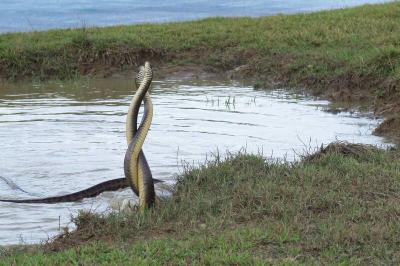
Kenting National Park service technician Yang Jien-fon (楊政峰) won a silver award in World Grand Prix Photography Awards Spring Season for his photograph of two male rat snakes intertwined in combat. Yang’s colleagues at Kenting National Park said he is a master of nature photography who has been held back by his job in civil service. The awards accept entries in all four seasons across six categories: architectural and urban photography, black-and-white and fine art photography, commercial and fashion photography, documentary and people photography, nature and experimental photography, and mobile photography. Awards are ranked according to scores and divided into platinum, gold and
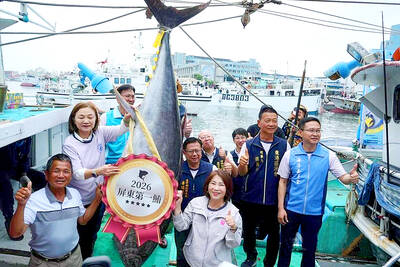
The first bluefin tuna of the season, brought to shore in Pingtung County and weighing 190kg, was yesterday auctioned for NT$10,600 (US$333.5) per kilogram, setting a record high for the local market. The auction was held at the fish market in Donggang Fishing Harbor, where the Siaoliouciou Island-registered fishing vessel Fu Yu Ching No. 2 delivered the “Pingtung First Tuna” it had caught for bidding. Bidding was intense, and the tuna was ultimately jointly purchased by a local restaurant and a local company for NT$10,600 per kilogram — NT$300 ,more than last year — for a total of NT$2.014 million. The 67-year-old skipper


 RSS
RSS