


A civic group consisting of Hong Kongers in Taiwan yesterday issued a statement urging the government to provide more concrete support for Hong Kong in the face of Beijing’s imposition of a national security legislation, while urging the government to terminate preferential treatment for Hong Kong-based organizations controlled by China.
China’s National People’s Congress yesterday passed national security legislation for Hong Kong.
Earlier, Hong Kong Outlanders issued a “press statement on Pompeo’s report on Hong Kong national security legislation,” referring to a report that US Secretary of State Mike Pompeo on Wednesday submitted to the US Congress to confirm that Hong Kong is no longer a territory with a high degree of autonomy, and that the US would withdraw the territory’s preferential trade and financial status.
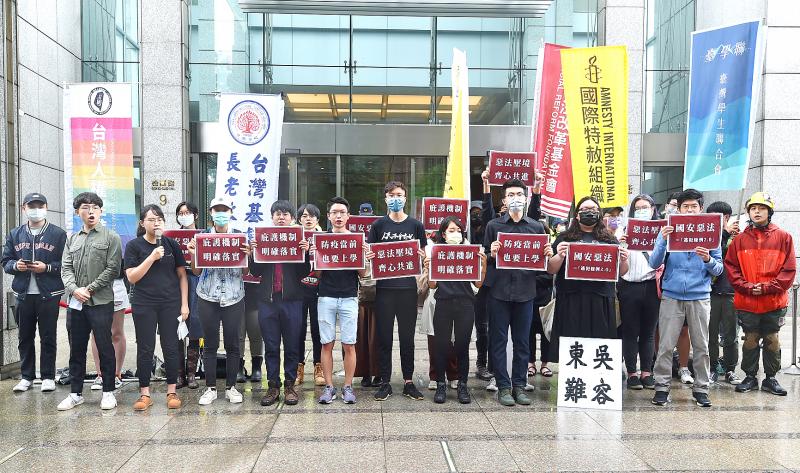
Photo: Liao Chen-huei, Taipei Times
The statement said that Taiwan should not invoke Article 60 of the Act Governing Relations with Hong Kong and Macau (香港澳門關係條例), under which Taiwan has established long-term relationship with the territory.
Article 60 states that if any change occurs in Hong Kong or Macau that endangers the security of Taiwan, the Cabinet could ask President Tsai Ing-wen (蔡英文) to order a suspension of the application of “all or part of the provisions of the act.”
Taiwan offers preferential treatment to Hong Kong and Macau in terms of trade, travel and cultural relations.
“The puppeted Hong Kong government, which is run by the Chinese Communist Party [CCP] government under the table, should be the rightful target of such international sanctions instead of resilient and brave Hong Kong,” it said.
Taiwan should also expand the scope of services it would provide in a Humanitarian Assistance Action Plan for Hong Kong, considering the “extreme consequences” that the legislation would create for the territory, it said.
The plan is to be devised by the Executive Yuan as part of the nation’s efforts to safeguard the democratic values upheld by Hong Kong.
Taiwan should “increase the numbers of beneficiaries of the Humanitarian Assistance Action Plan, especially to include protesters who used extreme measures against communist Hong Kong Police and officials,” the statement said.
Taiwan should also withdraw the preferential status it gives to Hong Kong-based organizations controlled by China, as well as deny entry to Taiwan by violators of human rights, it said.
Chinese funding could infiltrate the local market in the form of Hong Kong investments, so the government should cancel the special status of Hong Kong-based institutes and organizations that China controls, it added.
Groups and organizations that fail to prove that “Chinese funds do not have a major influence over them” should be disqualified from the preferential treatment provided for entities based in Hong Kong and Macau, the statement said.
“Hong Kong and Taiwan are on the front line of the global alliance in resisting the communist Chinese invasion,” it added.

Considering that most countries issue more than five denominations of banknotes, the central bank has decided to redesign all five denominations, the bank said as it prepares for the first major overhaul of the banknotes in more than 24 years. Central bank Governor Yang Chin-lung (楊金龍) is expected to report to the Legislative Yuan today on the bank’s operations and the redesign’s progress. The bank in a report sent to the legislature ahead of today’s meeting said it had commissioned a survey on the public’s preferences. Survey results showed that NT$100 and NT$1,000 banknotes are the most commonly used, while NT$200 and NT$2,000

The Centers for Disease Control (CDC) yesterday reported the first case of a new COVID-19 subvariant — BA.3.2 — in a 10-year-old Singaporean girl who had a fever upon arrival in Taiwan and tested positive for the disease. The girl left Taiwan on March 20 and the case did not have a direct impact on the local community, it said. The WHO added the BA.3.2 strain to its list of Variants Under Monitoring in December last year, but this was the first imported case of the COVID-19 variant in Taiwan, CDC Deputy Director-General Lin Ming-cheng (林明誠) said. The girl arrived in Taiwan on

South Korea is planning to revise its controversial electronic arrival card, a step Taiwanese officials said prompted them to hold off on planned retaliatory measures, a South Korean media report said yesterday. A Yonhap News Agency report said that the South Korean Ministry of Foreign Affairs is planning to remove the “previous departure place” and “next destination” fields from its e-arrival card system. The plan, reached after interagency consultations, is under review and aims to simplify entry procedures and align the electronic form with the paper version, a South Korean ministry official said. The fields — which appeared only on the electronic form

The Ministry of Foreign Affairs (MOFA) is suspending retaliation measures against South Korea that were set to take effect tomorrow, after Seoul said it is updating its e-arrival system, MOFA said today. The measures were to be a new round of retaliation after Taiwan on March 1 changed South Korea's designation on government-issued alien resident certificates held by South Korean nationals to "South Korea” from the "Republic of Korea," the country’s official name. The move came after months of protests to Seoul over its listing of Taiwan as "China (Taiwan)" in dropdown menus on its new online immigration entry system. MOFA last week


 RSS
RSS