


The Taiwan Equality Campaign yesterday marked the first anniversary of the implementation of a special law for same-sex marriage by outlining its four major goals for the next three years.
There is still much work to be done to achieve equal rights, as discrimination and misunderstanding involving the LGBT+ community has not been eradicated, the group said.
Although a poll it released on May 15 about attitudes toward LGBT+ and same-sex marriage showed generally positive results, it still found that 28.4 percent of respondents aged 18 and older believe the passage of the Act for Implementation of Judicial Yuan Interpretation No. 748 (司法院釋字第七四八號解釋施行法) had a negative impact on society, it said.
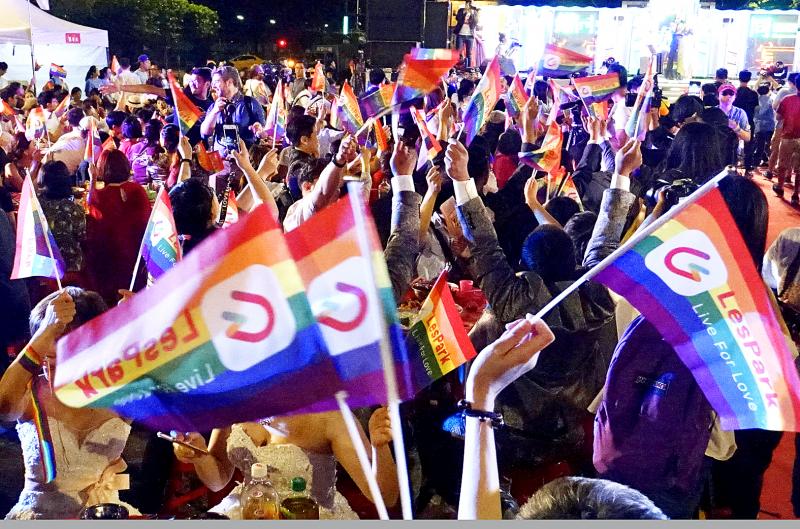
Photo: Chien Jung-fong, Taipei Times
Now an independently registered organization, the Taiwan Equality Campaign was preceded by the Marriage Equality Coalition Taiwan — a collection of five groups: the Taiwan Tongzhi (LGBTQ+) Hotline Association, the Taiwan LGBT Family Rights Advocacy, the Awakening Foundation, the Lobby Alliance for LGBT Human Rights and GagaOOLala.
The four main goals the campaign has set span the legal, political, educational and international arenas.
One objective is to push for legislation to extend the legal rights of LGBT+ people when it comes to adoption, the use of assisted reproductive technologies and transnational same-sex marriage.
The act now only gives same-sex couples the right to adopt the biological child or children of their spouse, while transnational marriages are only allowed when both parties come from a nation where same-sex marriage is legal.
The Taiwan Equality Campaign said it would also work with other gender equality advocacy groups and human rights experts to draft an “equality act” to protect against LGBT+ discrimination outside a workplace or school, something the laws currently do not do
It hopes to expand its exchanges with LGBT+-friendly lawmakers and their aides, form networks of local city councilors who are supportive of gender equality, and host a training program to foster LGBT+ participation in politics, it said.
To enhance public understanding of LGBT+ people, the group said it would continue to share information on LGBT+issues through social media platforms, conduct street surveys and other research, and host workshops and forums aimed at facilitating workplace equality.
It plans to share Taiwan’s experiences with other LGBT+ groups in Asia, it said, adding that next year it aims to forge an alliance for marriage equality in Asia and hold an international conference.
The campaign also announced the digital release of T-POP: No Fear In Love (踢趴噗:勇敢的愛), a compilation album created in collaboration with the Red Hot Organization.
The album features works by singers 9m88, Enno Cheng (鄭宜農), Zooey Wonder (黃玠瑋), Leaf Yeh (葉穎) and Crowd Lu (盧廣仲), including a remix of 9m88’s If I Could (如果可以) by Grammy-nominated producer starRo and the band Xiu Xiu’s remix of Cheng’s Jade (玉仔的心).
The group also launched a fundraising effort that went live yesterday. A limited number of signed copies of the album are being offered to donors who commit to contributing NT$1,527 per month — an amount signifying the time the same-sex marriage law passed its third reading at the Legislative Yuan on May 17 last year.
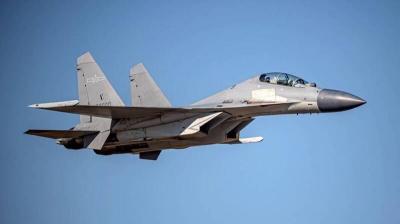
Eight Chinese naval vessels and 24 military aircraft were detected crossing the median line of the Taiwan Strait between 6am yesterday and 6am today, the Ministry of National Defense said this morning. The aircraft entered Taiwan’s northern, central, southwestern and eastern air defense identification zones, the ministry said. The armed forces responded with mission aircraft, naval vessels and shore-based missile systems to closely monitor the situation, it added. Eight naval vessels, one official ship and 36 aircraft sorties were spotted in total, the ministry said.
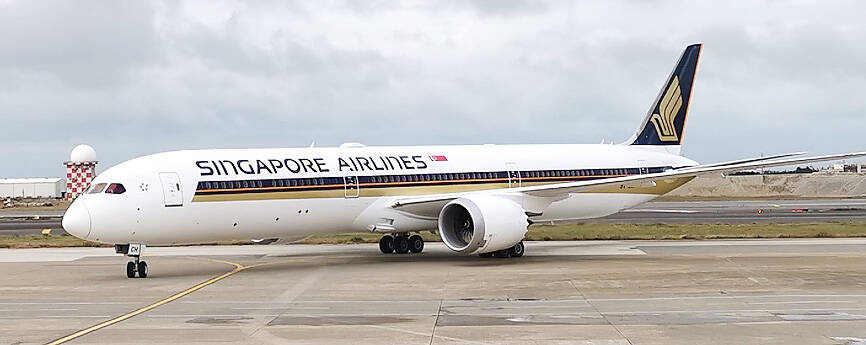
INCREASED CAPACITY: The flights on Mondays, Wednesdays, Fridays and Sundays would leave Singapore in the morning and Taipei in the afternoon Singapore Airlines is adding four supplementary flights to Taipei per week until May to meet increased tourist and business travel demand, the carrier said on Friday. The addition would raise the number of weekly flights it operates to Taipei to 18, Singapore Airlines Taiwan general manager Timothy Ouyang (歐陽漢源) said. The airline has recorded a steady rise in tourist and business travel to and from Taipei, and aims to provide more flexible travel arrangements for passengers, said Ouyang, who assumed the post in July last year. From now until Saturday next week, four additional flights would depart from Singapore on Monday, Wednesday, Friday
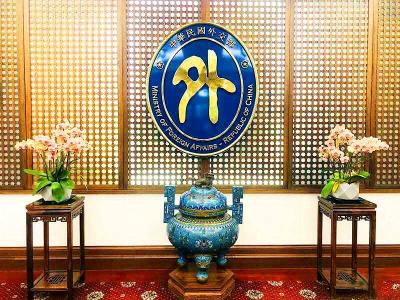
The Ministry of Foreign Affairs (MOFA) today said that if South Korea does not reply appropriately to its request to correct Taiwan’s name on its e-Arrival card system before March 31, it would take corresponding measures to alter how South Korea is labeled on the online Taiwan Arrival Card system. South Korea’s e-Arrival card system lists Taiwan as “China (Taiwan)” in the “point of departure” and “next destination” fields. The ministry said that it changed the nationality for South Koreans on Taiwan’s Alien Resident Certificates from “Korea” to “South Korea” on March 1, in a gesture of goodwill and based on the
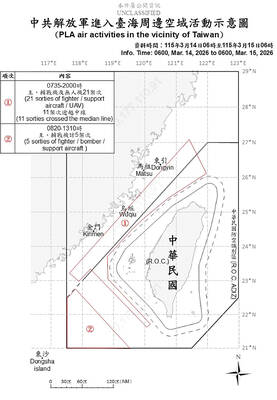
The Ministry of National Defense yesterday reported the return of large-scale Chinese air force activities after their unexplained absence for more than two weeks, which had prompted speculation regarding Beijing’s motives. China usually sends fighter jets, drones and other military aircraft around the nation on a daily basis. Interruptions to such routine are generally caused by bad weather. The Ministry of National Defense said it had detected 26 Chinese military aircraft in the Taiwan Strait over the previous 24 hours. It last reported that many aircraft on Feb. 25, when it spotted 30 aircraft, saying Beijing was carrying out another “joint combat


 RSS
RSS