


When Taiwan became the first nation in Asia to allow same-sex marriage last year, Lois, a university professor, was among thousands of gay people who cheered and waved rainbow flags on the streets of Taipei.
A year on, she and her Chinese partner still have no right to legally wed, like hundreds of such couples who face restrictions over international same-sex unions.
As Taiwan marked a year since passing its historic law in a region where gay rights progress is slow, LGBT+ rights groups have called for full recognition of same-sex marriage to protect couples and families.
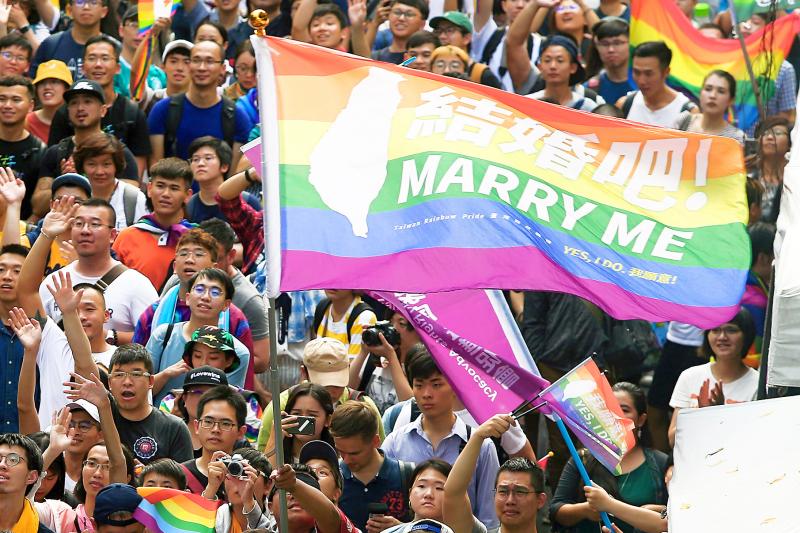
Photo: CNA
“I was so proud a year ago. Now I feel like I am treated like a third-class citizen,” said Lois, 42, who refused to give her surname, because she is not out at work.
Same-sex marriage became legal in Taiwan on May 24 last year, a week after the Legislative Yuan passed a bill offering similar protections of marriage to heterosexuals.
Yet gay people can only marry foreigners from a country where same-sex marriage is also legal, and adopt children biologically related to at least one of them.
Lois’ partner, who is from China, where gay marriage is not recognized, had to give up her job in 2017 and become a student so that she could stay in Taiwan and raise their three-year-old son.
As they are not legally married, Lois’ partner cannot get a spousal visa, and they have been apart since she and the couple’s son returned to China on holiday before Taiwan closed to visitors to control the spread of COVID-19.
“Under the law, my son and I are strangers. I want us — my wife, my son — to be recognized as a family,” Lois said.
A petition this month calling for full recognition has been signed by more than 10,000 people, said the organizer, the Taiwan Alliance to Promote Civil Partnership Rights (TAPCPR).
“Many people have had to resort to using student or travel visas to stay here. It is causing a lot of anxiety and uncertainty,” TAPCPR secretary-general Chien Chih-chieh (簡至潔) said. “It is the final missing piece of the puzzle that we need to achieve marriage equality.”
As of Friday, 4,021 gay couples had married in Taiwan, data released yesterday by the Ministry of the Interior showed, adding that the majority of the registered marriages were female couples, at 2,773, or 69 percent, while 1,248 were male couples.
New Taipei City led with the registration of 815 same-sex marriages, followed by Taipei with 633 and Kaohsiung with 534, the data showed.
While the majority of same-sex marriages were between Taiwanese, the number of couples in which one spouse was a foreign national was 189, or 5 percent of the total.
Among them, 80 people were from the US, followed by Canada at 21 and Australia at 17, ministry data showed.
A government survey conducted from May 4 to May 6 found that 52.5 percent of Taiwanese agree that same-sex couples should have the same rights as their heterosexual counterparts — a significant rise from the 37.4 percent surveyed prior to the legalization of gay marriage in 2018.
Elsewhere in Asia, progress toward gay marriage has been slow.
A court in the Philippines rejected a same-sex marriage petition last year and Hong Kong has upheld a ban on civil partnerships, although gay couples have made small gains in public housing and spousal visa rights.
Thailand drafted a bill that would recognize same-sex couples as civil partners, but progress since has stalled. Japanese gay couples meanwhile sued the government over the right to marriage last year.
“We understand changes in society take time,” said Jennifer Lu (呂欣潔), East Asian representative for the International Lesbian, Gay, Bisexual, Trans and Intersex Association.
She said that the law’s passage in Taiwan was a breakthrough as it shows gay marriage does not contradict “Asian values.”
Taiwanese publisher Lai Kai-li (賴凱俐) is optimistic that same-sex unions will be accepted more widely in Taiwan and other parts of Asia.
Her partner of six years is Malaysian and has been on a student visa since 2016, the same year they held a symbolic “wedding” following Chinese traditions to celebrate with family.
“We are hoping to settle down and have a family,” the 37-year-old said. “I am confident it is a matter of time; the law will accept us.”
Additional reporting by CNA

NATIONAL SECURITY: Authorities are working to confirm the identities of the military personnel involved and investigating possible illegal conduct and regulatory violations Authorities are probing possible national security implications after Kinmen police and immigration officers on Sunday found a Chinese woman allegedly posing as a tourist while engaging in prostitution involving more than 10 military personnel. The woman, surnamed Chen (陳), has since been deported, authorities said, adding that investigators are still working to confirm the identities of those implicated, as the records only listed code names and aliases. The case stemmed from a report received by the Kinmen District Prosecutors’ Office on Friday last week from the Jinhu Precinct of the Kinmen County Police Bureau. On Sunday, police, along with the National Immigration

GLOBALGIVING: ‘ Caving to external pressure is not acceptable for an organization that has cultivated justice reform and human rights for 30 years,’ one NGO said A slew of non-government organizations (NGOs) have withdrawn from the GlobalGiving fundraising platform after it announced it would use “Chinese Taipei” instead of “Taiwan” from next month. The Taiwan Good Rice Association wrote on Facebook on Friday that it was informed on April 28 via a teleconference call of the change, which was made because the platform wanted to operate in China. Taiwan Good Rice is to terminate all cooperative relationships with GlobalGiving in response to the platform’s “unilateral and non-negotiable” decision to remove references to Taiwan, the NGO said. “Taiwan is in the official name of Taiwan Good Rice Association and the

HEAVY WEATHER: Typhoon Jangmi is due to crash straight into the Ryukyus as airlines look to shift flights to larger aircraft or cancel flights to Okinawa entirely Taiwan’s international air carriers announced flight adjustments over the weekend as Typhoon Jangmi is forecast to hit the Ryukyu Islands today and tomorrow. The Central Weather Administration (CWA) upgraded Jangmi from a tropical storm to a typhoon at 8am yesterday, with the eye located 580km south of Naha city. It was moving north at 19kph. Today, China Airlines’ CI-120, CI-121, CI-122 and CI-123 flights between Taoyuan and Naha, Okinawa, have been canceled as well as CI-132 and CI-133 between Kaohsiung and Naha. EVA Air’s BR-112, BR-113, BR-186 and BR-185 flights between Taoyuan and Naha are also canceled. Low-cost carrier Tigerair Taiwan canceled IT-230,

Chinese Nationalist Party (KMT) Chairwoman Cheng Li-wun (鄭麗文) yesterday briefed her party’s Central Standing Committee regarding her scheduled visit to the US between Monday next week and June 16, saying that her purpose would be to persuade the US that the Republic of China (ROC) Constitution was a “one China” constitution that would foster stable and peaceful cross-strait relations. The ROC Constitution is the most important defense for all Taiwanese citizens, as it upholds our democracy and has contributed to our robust economy, which aligns with international and US interests, she said. “We would not be troublemakers and drag the US under,”


 RSS
RSS