


Prosecutors on Wednesday initiated an investigation of Kaohsiung Civil Affairs Bureau Director-General Tsao Huan-jung (曹桓榮) for allegedly telling supporters of Kaohsiung Mayor Han Kuo-yu (韓國瑜) to interfere with a recall vote against Han, while pan-green politicians denounced the mayor and his team for devising ways to obstruct voting.
After receiving complaints from residents, the Kaohsiung District Prosecutors’ Office launched its probe of Tsao for alleged breaches of the Civil Servants Election and Recall Act (公職人員選舉罷免法).
Complainants provided evidence that Tsao on Saturday last week wrote on messaging app Line that Han supporters should not vote in the June 6 recall vote, saying: “We shall not vote, but we must monitor polling stations to put pressure on people voting to recall Han,” the office said.
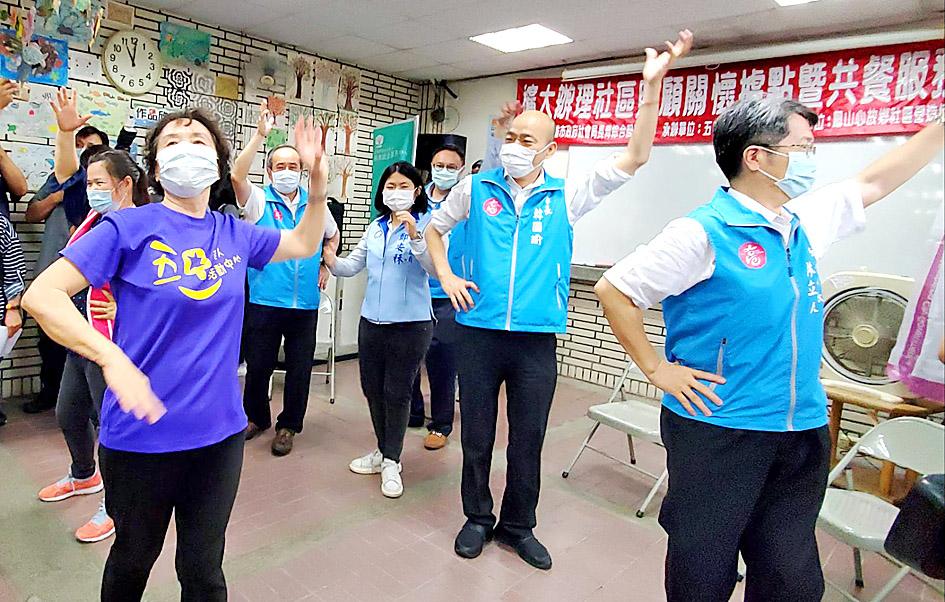
Photo: Chen Wen-chan, Taipei Times
Tsao, a former head of the youth wing of the Chinese Nationalist Party’s (KMT) Kaohsiung branch, allegedly wrote the message one day after Han in a video posted on Facebook urged people not to “engage in any political activities” on the day of the vote and “those outside of Kaohsiung should not travel to the city.”
Pundits have said that Han and his team are attempting to reduce voter turnout, as votes in favor of recalling him need to exceed 25 percent, or 575,091 ballots, of eligible voters in the city for the motion to pass.
Democratic Progressive Party (DPP) Legislator (王定宇) said that the suggestion to “monitor voting” by Han’s administration and KMT officials is aimed at identifying who attends so they can divide people into “us” and “them,” which would lead some people to fear retribution.
“It is not right to put pressure on citizens exercising their right to vote,” Wang said. “It is an intimidation tactic, and the best way to fight such ‘dirty tricks’ by the KMT and Han’s team is for Kaohsiung residents to come out en masse and cast ‘yes’ votes.”
Taipei City Councilor Wang Shih-chien (王世堅) and other DPP officials have warned that other tactics are being deployed, following reports that members of Han’s camp last week attended a banquet in Taipei for talks with China Unification Promotion Party Chairman Chang An-le (張安樂) and members of the Bamboo Union crime syndicate.
Plans were made at the banquet for gang members and Han supporters to obstruct the recall vote by lining up at polling stations, where they would try to delay and disrupt the process, sources said.
Some of the tactics include filming the proceedings outside of the polling stations to intimidate voters, as well as having older people and gang members in line move slowly and cause delays, such as by not presenting their identification when at the head of the line, to prolong the process, with the aim of making people give up on voting on what is expected to be a hot day, the sources said.
Several DPP figures denounced the purported plan, saying that Han’s political career would be finished if a judicial investigation finds that he collaborated with gangsters to disrupt voting.
They urged Kaohsiung residents to not give in to intimidation, and to wear masks and hats while voting.

FUKUOKA SITUATION: Japanese media reported that the pathogen is expected to be identified by the summer, while the CDC downplayed the idea that it was hMPV A “mysterious cold-like illness” reported in Japan’s Fukuoka Prefecture does not seem to be a new disease, but Japanese authorities have been asked about the situation, the Centers for Disease Control (CDC) said yesterday. The Fukuoka Prefectural Medical Association on Wednesday told a news conference that a “mystery cold” that has become a hot topic on social media is “highly likely to be caused by some kind of viral infection,” Japan’s KBC News reported. “Many people are experiencing symptoms starting with a sore throat, followed by a runny nose, phlegm and a severe cough,” KBC News reported, citing association officials. Health authorities are

Nvidia Corp CEO Jensen Huang (黃仁勳) arrived in Taiwan yesterday ahead of upcoming AI and technology events, saying he plans to meet with clients and Taiwan Semiconductor Manufacturing Co Chairman C.C. Wei (魏哲家) during his visit. After landing at Taipei Songshan Airport, Huang posed for photos with fans and handed out Yakult drinks to reporters and supporters waiting at the scene, saying he has “a lot to do” during the trip. Asked about reports that Nvidia’s planned headquarters site in Taipei’s Beitou Shilin Technology Park could break ground on May 27, Huang said that if the company holds an event, he would

The Ministry of Finance this afternoon announced the winning numbers for the March-April uniform invoice lottery. The winning number for the NT$10 million (US$318,060) special prize is 19531471, and the winning number for the NT$2 million grand prize is 85941329. Three numbers were drawn for the NT$200,000 first prize: 07225810, 20231230 and 83518781. Those with receipts matching the last seven digits of any of the first-prize numbers will win the NT$40,000 second prize, while those matching the last six digits will win the NT$10,000 third prize. Those whose receipts match the last five digits of the first-prize numbers can claim the NT$4,000 fourth prize,
Taiwan Travelogue (臺灣漫遊錄), which earlier this week became the first Taiwanese novel to win the International Booker Prize, is to be adapted into a television series through a Taiwan-Japan coproduction, producer Chang Chen-yu (張辰漁) said yesterday. Chang, a producer at World Softest Production Film Co, wrote on Facebook that the company had been searching for projects with international appeal that retain a strong Taiwanese identity after colleagues and Japanese partners strongly recommended the novel. After reading the book, Chang said he immediately decided to pursue the screen rights. “A great story has the power to transcend time and borders, and connect countless people,”


 RSS
RSS