


Taiwan has garnered unprecedentedly strong support for joining next week’s World Health Assembly, though its bid might not succeed under China’s influence and the WHO’s partial stance, the Ministry of Foreign Affairs said yesterday.
The 73rd session of the WHA is to be held virtually on Monday and Tuesday, but Taiwan — which participated in the annual assembly as an observer from 2009 to 2016 — has not received an invitation.
The “Taiwan model” of successfully containing COVID-19 has won global acclaim, the ministry said, adding that, as of yesterday, 29 nations had voiced support for Taiwan attending the WHA by writing letters to the WHO, responding to questions by lawmakers and journalists, or writing social media posts.
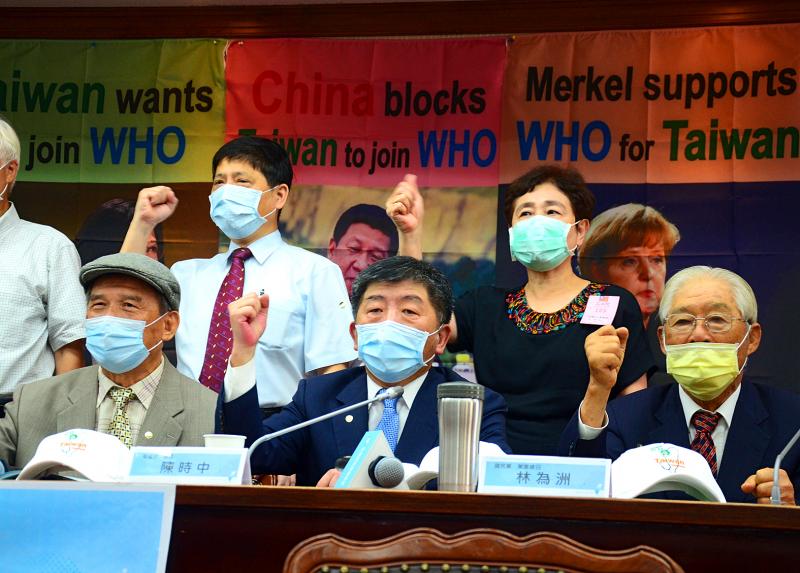
Photo: Wang Yi-sung, Taipei Times
The increased support reflects the accumulated efforts of the government and civic groups over the years, the ministry said.
Among those supporting the nation, Japanese Prime Minister Shinzo Abe and Canadian Prime Minister Justin Trudeau for the first time publicly expressed their support for Taiwan attending the WHA, the ministry said, adding that the US had also backed Taiwan with bills supporting its participation in the WHO and other global organizations, the verbal support of US Secretary of State Mike Pompeo and US Secretary of Health and Human Services Alex Azar, and social media campaigns launched by the US Department of State and the American Institute in Taiwan.
The US did not make a formal proposal for Taiwan to attend the WHA, as it chose means that it deemed appropriate, and Taiwan did not want to push the US too hard, Minister of Foreign Minister Joseph Wu (吳釗燮) said on Monday when answering questions from Chinese Nationalist Party (KMT) Chairman Johnny Chiang (江啟臣).
Despite the support of the global community, it would be very difficult for Taiwan to attend the WHA this year, as China continues to abuse its influence to block Taiwan and the WHO has failed to demonstrate impartiality and professionalism, the ministry said.
While all of the nation’s diplomatic allies except the Vatican, which is itself only an observer at the WHA, have tendered proposals calling for Taiwan’s participation, the proposals might not be discussed on Monday, a source familiar with the matter said on condition of anonymity.
Due to the tight agenda, each member state would have only two minutes to speak, the source said, adding that the proposals might be discussed at a WHO meeting scheduled for October and November.
Taiwan is hoping that WHO Director-General Tedros Adhanom Ghebreyesus would “wake up” and decide to include it, but that is almost impossible, the source said, adding that hopefully Tedros would visit Taiwan to witness the nation’s public health achievements after President Tsai Ing-wen (蔡英文) invited him on Twitter.
Separately yesterday, Minister of Health and Welfare Chen Shih-chung (陳時中), a group of lawmakers and members of the Taiwan United Nations Alliance also held a news conference about the nation’s efforts to attend the WHA.
Asked about remarks by the Chinese Ministry of Foreign Affairs that Taiwan had not received an invitation because it refused to accept the “one China” principle, Chen said: “It is impossible for us to accept something that does not exist.”
Additional reporting by CNA and Reuters
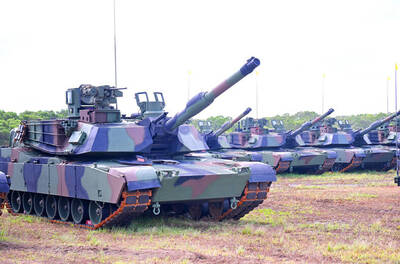
The manufacture of the remaining 28 M1A2T Abrams tanks Taiwan purchased from the US has recently been completed, and they are expected to be delivered within the next one to two months, a source said yesterday. The Ministry of National Defense is arranging cargo ships to transport the tanks to Taiwan as soon as possible, said the source, who is familiar with the matter. The estimated arrival time ranges from late this month to early next month, the source said. The 28 Abrams tanks make up the third and final batch of a total of 108 tanks, valued at about NT$40.5 billion
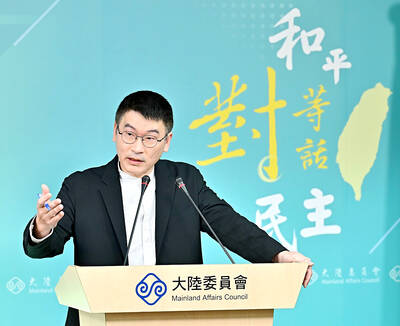
Two Taiwanese prosecutors were questioned by Chinese security personnel at their hotel during a trip to China’s Henan Province this month, the Mainland Affairs Council (MAC) said yesterday. The officers had personal information on the prosecutors, including “when they were assigned to their posts, their work locations and job titles,” MAC Deputy Minister and spokesman Liang Wen-chieh (梁文傑) said. On top of asking about their agencies and positions, the officers also questioned the prosecutors about the Cross-Strait Joint Crime-Fighting and Judicial Mutual Assistance Agreement, a pact that serves as the framework for Taiwan-China cooperation on combating crime and providing judicial assistance, Liang
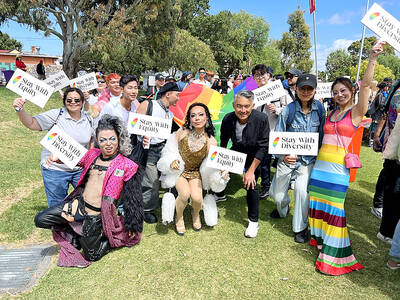
A group from the Taiwanese Designers in Australia association yesterday represented Taiwan at the Midsumma Pride March in Melbourne. The march, held in the St. Kilda suburb, is the city’s largest LGBTQIA+ parade and the flagship event of the annual Midsumma Festival. It attracted more than 45,000 spectators who supported the 400 groups and 10,000 marchers that participated this year, the association said. Taiwanese Designers said they organized a team to march for Taiwan this year, joining politicians, government agencies, professionals and community organizations in showing support for LGBTQIA+ people and diverse communities. As the first country in Asia to legalize same-sex
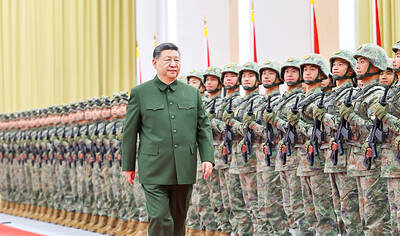
MOTIVES QUESTIONED The PLA considers Xi’s policies toward Taiwan to be driven by personal considerations rather than military assessment, the Epoch Times reports Chinese President Xi Jinping’s (習近平) latest purge of the Chinese People’s Liberation Army (PLA) leadership might have been prompted by the military’s opposition to plans of invading Taiwan, the Epoch Times said. The Chinese military opposes waging war against Taiwan by a large consensus, putting it at odds with Xi’s vision, the Falun Gong-affiliated daily said in a report on Thursday, citing anonymous sources with insight into the PLA’s inner workings. The opposition is not the opinion of a few generals, but a widely shared view among the PLA cadre, the Epoch Times cited them as saying. “Chinese forces know full well that


 RSS
RSS