


The whale shark has been added to the nation’s list of protected species, the Ocean Affairs Council said on Tuesday, adding that offenders face fines and imprisonment.
The whale shark, along with the giant oceanic manta ray and the reef manta ray, were on Tuesday last week added to the list, making the disturbance, abuse, slaughter or capture of any of the three species punishable by up to five years in prison, and a fine of NT$300,000 to NT$1.5 million (US$10,033 to US$50,164), the council said.
Whale sharks have been sighted in waters near Hualien for a few years now, and in March this year a roughly 6m whale shark swam into the Port of Hualien looking for food, it said.
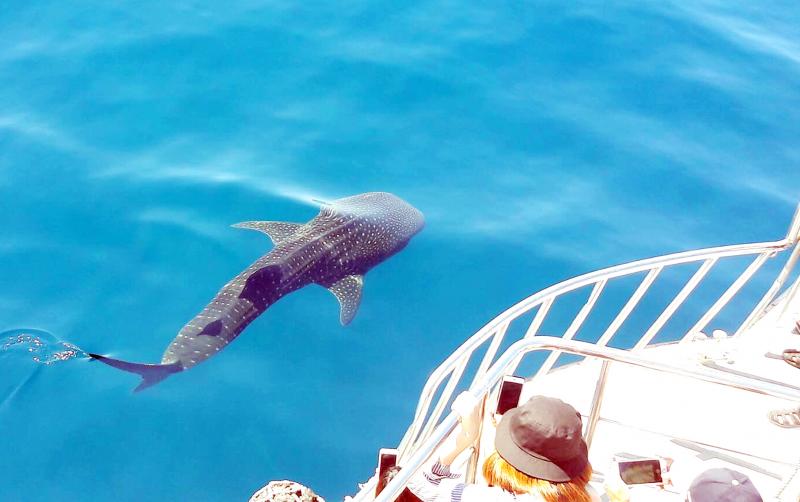
Photo courtesy of Turumoan Whale Watching and Water Entertainment Co
The capture of the three species has long been prohibited by stipulations in the Fisheries Act (漁業法), which require fishers to return the animals to the sea if accidentally caught, alive or dead, Hualien County Bureau of Agriculture Director Lo Wen-lung (羅文龍) said, but changes were made to enhance protection of the species by increasing the severity of punishments for offenders.
People who have whale sharks or manta rays in their care, or possess products made from any of the three species before Tuesday last week, must register them with the county government between June 1 and Aug. 31, according to Article 31 of the Wildlife Conservation Act (野生動物保育法) or face a fine of between NT$10,000 and NT$50,000, Lo said.
The three species are popular pets among fish enthusiasts due to their gentle temperament, Lo said. Whale sharks in particular are an oddity among sharks as they swim slowly, and feed on small fish and plankton, he said.

Fast food chain McDonald's is to raise prices by up to NT$5 on some products at its restaurants across Taiwan, starting on Wednesday next week, the company announced today. The prices of all extra value meals and sharing boxes are to increase by NT$5, while breakfast combos and creamy corn soup would go up by NT$3, the company said in a statement. The price of the main items of those meals, if ordered individually, would remain the same. Meanwhile, the price of a medium-sized lemon iced tea and hot cappuccino would rise by NT$3, extra dipping sauces for chicken nuggets would go up
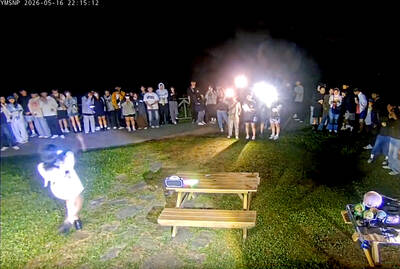
Yangmingshan National Park’s Qingtiangang (擎天崗) nature area has gone viral after a park livestream camera observed a couple in the throes of intimate congress, which was broadcast live on YouTube, drawing large late-night crowds and sparking a backlash over noise, bright lights and disruption to wildlife habitat. The area’s livestream footage appeared to show a couple engaging in sexual activity on a picnic table in the park on Friday last week, with the uncensored footage streamed publicly online. The footage quickly spread across social media, prompting a tide of visitors to travel to the site to “check in” and recreate the
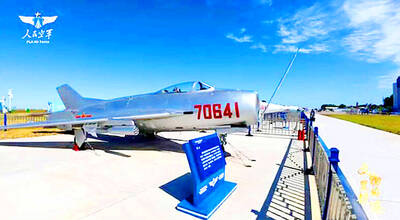
GROUNDED: A KMT lawmaker proposed eliminating drone development programs and freezing funding for counterdrone systems, despite China’s adoption of the technology China has deployed attack drones at air bases near the Taiwan Strait in a strategy aimed at overwhelming Taiwan’s air defense systems through saturation attacks, the Mainland Affairs Council (MAC) said. The council’s latest quarterly report on China said that satellite imagery and open-source intelligence indicate that the Chinese People’s Liberation Army (PLA) had converted retired J-6 fighter jets into J-6W drones, which the PLA has stationed at six air bases near Taiwan, five in China’s Fujian Province and one in Guangdong Province. The report cited J. Michael Dahm, a senior fellow at the US-based Mitchell Institute, as saying that China has
Carrefour Taiwan is to begin using a new name from the start of July, but it cannot divulge the name until then, the chairman of the supermarket chain's parent company said today. President Chain Store Co chairman Lo Chih-hsien (羅智先) was asked by reporters after a shareholders' meeting to confirm whether the company has settled on a new name for the supermarket brand. In March, the government-registered name of two Carrefour Taiwan branches was quietly changed to "Le Chia Kang" (樂家康) in Chinese, raising speculation that has been selected as the name. Lo said that because of local regulations and contractual obligations, the


 RSS
RSS