


Lawmakers yesterday passed proposed amendments to the Railway Act (鐵路法), including a provision that railway staff should be equipped with safety training and disease prevention skills.
Democratic Progressive Party (DPP) Legislator Lee Kun-tse (李昆澤), who drafted the provision, said that the change is to tackle recurring incidents involving free riders harming railway police and conductors, as well as to improve staff preparedness against COVID-19 and seasonal flu.
Apart from being tasked with disease prevention and safety response capabilities, railway staff should familiarize themselves with disease prevention or safety equipment used by rail operators, the amendment says.
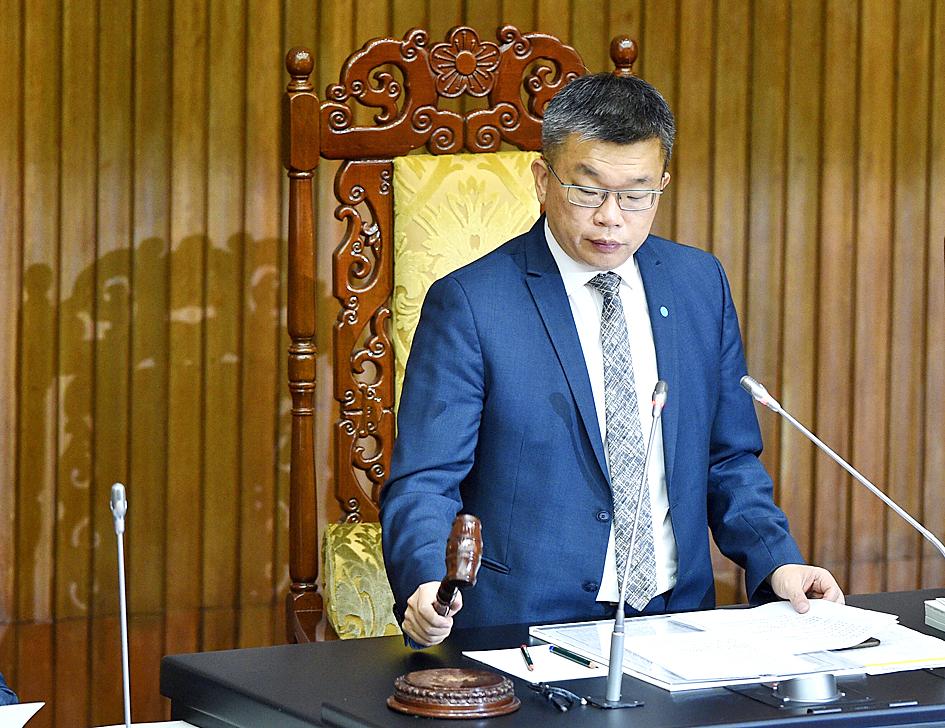
Photo: Peter Lo, Taipei Times
Rail operators must keep train operation, monitoring and maintenance logs, and retain them for a prescribed period, which is to be defined by the Ministry of Transportation and Communications, another amendment says.
Railway staff must comply with accident investigations by the Taiwan Transportation Safety Board, they say.
As the board was launched in July last year, the amendment is to require rail operators to abide by the Transportation Occurrence Investigation Act (運輸事故調查法) and cooperate with probes launched by the board, said DPP Legislator Lin Chun-hsien (林俊憲), a sponsor of the amendments.
The legislature also passed an article stipulating that products used on rail systems must be certified by institutes recognized by the ministry.
The ministry may accept reports or certification issued based on tests conducted in accordance with international conventions and protocols, or agreements signed between the government and other nations, the article says.
Independent Legislator Chao Cheng-yu (趙正宇), who drafted the proposal, said that it would help improve domestic key technologies used in rail construction, bring about a industrial upgrade and synchronize Taiwanese firms with the international community of industries.
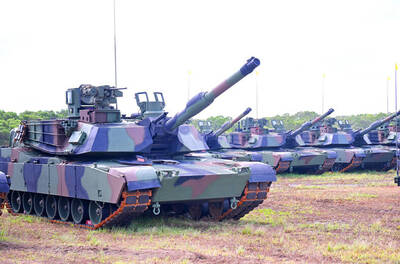
The manufacture of the remaining 28 M1A2T Abrams tanks Taiwan purchased from the US has recently been completed, and they are expected to be delivered within the next one to two months, a source said yesterday. The Ministry of National Defense is arranging cargo ships to transport the tanks to Taiwan as soon as possible, said the source, who is familiar with the matter. The estimated arrival time ranges from late this month to early next month, the source said. The 28 Abrams tanks make up the third and final batch of a total of 108 tanks, valued at about NT$40.5 billion

Two Taiwanese prosecutors were questioned by Chinese security personnel at their hotel during a trip to China’s Henan Province this month, the Mainland Affairs Council (MAC) said yesterday. The officers had personal information on the prosecutors, including “when they were assigned to their posts, their work locations and job titles,” MAC Deputy Minister and spokesman Liang Wen-chieh (梁文傑) said. On top of asking about their agencies and positions, the officers also questioned the prosecutors about the Cross-Strait Joint Crime-Fighting and Judicial Mutual Assistance Agreement, a pact that serves as the framework for Taiwan-China cooperation on combating crime and providing judicial assistance, Liang
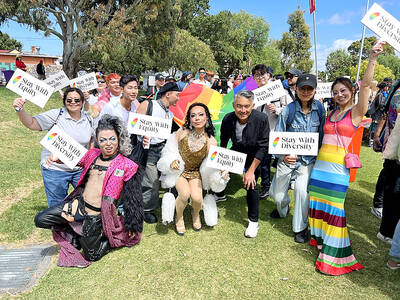
A group from the Taiwanese Designers in Australia association yesterday represented Taiwan at the Midsumma Pride March in Melbourne. The march, held in the St. Kilda suburb, is the city’s largest LGBTQIA+ parade and the flagship event of the annual Midsumma Festival. It attracted more than 45,000 spectators who supported the 400 groups and 10,000 marchers that participated this year, the association said. Taiwanese Designers said they organized a team to march for Taiwan this year, joining politicians, government agencies, professionals and community organizations in showing support for LGBTQIA+ people and diverse communities. As the first country in Asia to legalize same-sex
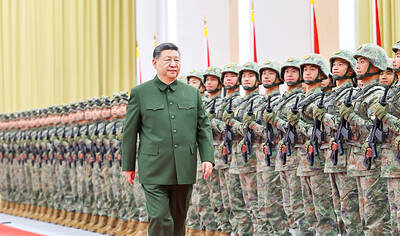
MOTIVES QUESTIONED The PLA considers Xi’s policies toward Taiwan to be driven by personal considerations rather than military assessment, the Epoch Times reports Chinese President Xi Jinping’s (習近平) latest purge of the Chinese People’s Liberation Army (PLA) leadership might have been prompted by the military’s opposition to plans of invading Taiwan, the Epoch Times said. The Chinese military opposes waging war against Taiwan by a large consensus, putting it at odds with Xi’s vision, the Falun Gong-affiliated daily said in a report on Thursday, citing anonymous sources with insight into the PLA’s inner workings. The opposition is not the opinion of a few generals, but a widely shared view among the PLA cadre, the Epoch Times cited them as saying. “Chinese forces know full well that


 RSS
RSS