


An investigation into the collapse of the Nanfangao Bridge (南方澳大橋) last year found that it had not undergone mandatory inspection since 2016 and that the asphalt pavement had added to its weight.
The bridge collapsed at 9:30am on Oct. 1 , killing six people who were working on fishing boats below it, and injuring nine fishers, three rescuers and one oil tank driver who was driving through it when the accident occurred.
The Taiwan Transportation Safety Board, which conducted the investigation, said the cable-stayed bridge was supported by 13 suspension cables.
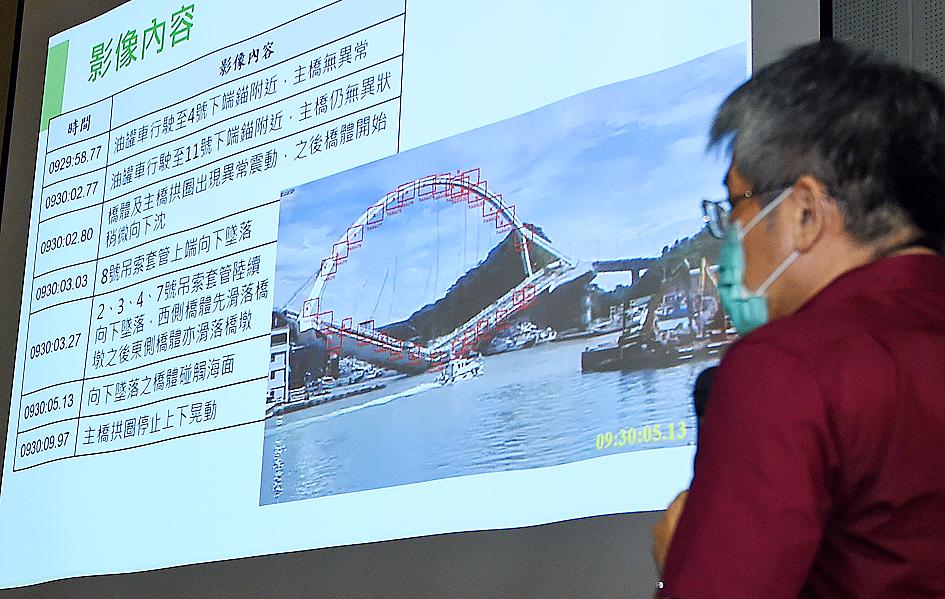
Photo: Liao Chen-huei, Taipei Times
Except for cable No. 1 and No. 13, which had 17 steel strands, each of the remaining suspension cables had 13 steel strands.
Each cable was covered by a long sheath and was fastened by anchor heads at both ends, the board added.
With the aid of footage provided by Coast Guard Administration surveillance cameras, investigators established the sequence of the bridge collapse, the board said.
After the truck drove past cable No. 11, the bridge and the arch above it were visibly shaking, with the bridge beginning to drop slightly at 9:30:02am.
About 0.13 seconds later, the sheath covering cable No. 8 fell off, followed by those covering cable Nos. 2, 3, 4 and 7. At 9:30:03am, the west end of the bridge slid down the pier, followed by the east end of the bridge.
The broken parts hit the water at about 9:30:05am, and the arch stopped shaking at 9:30:09am.
Investigators examined the bridge’s 177 steel strands, and found that some had either become untwisted or detached from their anchor heads, while others showed signs of corrosion, said board member Guo Jen-hwa (郭振華), a professor at National Taiwan University.
Guo said the No. 10 suspension cable was fastened using two 14-hole anchor heads, with each having one hole unused.
Theoretically, the unused holes should be the same on both anchor heads, but investigators found that one unused hole was near the center of the anchor head and the other was close to the rim, he added.
The bridge, which was built by the Yilan County Government, opened for traffic in November 1998. Ownership of the bridge was transferred from the county government to the Maritime and Port Bureau when Taiwan International Ports Corp was established in 2012.
The port company was in charge of maintaining the bridge, the board said.
Inspection records showed that the county government inspected the bridge seven times between 2000 and 2016, but none listed suspension cables or the anchor heads as must-check items.
The bridge has not been inspected since it was turned over to the bureau on April 28, 2016, investigators found.
Based on the Directorate-General of Highways’ maintenance manual, the bridge should have been inspected every two years.
The records showed that 60 maintenance projects for the bridge were carried out between 2005 and last year, with one being to apply new asphalt pavement on the bridge.
The bridge’s pavement should be 8cm to 9.2cm thick based on the original design, but the investigation found that the average thickness of the bridge’s pavement was 16cm, twice its designed capacity.
The bridge was accessed by vehicles carrying wave blocks four times between October 2016 and September last year, as well as by those transporting gravel and construction waste between September 2018 and January last year, the board said.
Thomas Wang (王興中), chief investigator of the bridge incident, said they would further investigate if the contractor had followed the architect’s design.
Whether corrosion, added pavement weight or allowing overweight vehicles to access the bridge led to its collapse would be the focus of the follow-up investigation, the board said.
A final investigation report is due after September, it said.
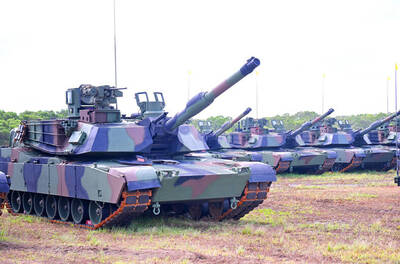
The manufacture of the remaining 28 M1A2T Abrams tanks Taiwan purchased from the US has recently been completed, and they are expected to be delivered within the next one to two months, a source said yesterday. The Ministry of National Defense is arranging cargo ships to transport the tanks to Taiwan as soon as possible, said the source, who is familiar with the matter. The estimated arrival time ranges from late this month to early next month, the source said. The 28 Abrams tanks make up the third and final batch of a total of 108 tanks, valued at about NT$40.5 billion

Two Taiwanese prosecutors were questioned by Chinese security personnel at their hotel during a trip to China’s Henan Province this month, the Mainland Affairs Council (MAC) said yesterday. The officers had personal information on the prosecutors, including “when they were assigned to their posts, their work locations and job titles,” MAC Deputy Minister and spokesman Liang Wen-chieh (梁文傑) said. On top of asking about their agencies and positions, the officers also questioned the prosecutors about the Cross-Strait Joint Crime-Fighting and Judicial Mutual Assistance Agreement, a pact that serves as the framework for Taiwan-China cooperation on combating crime and providing judicial assistance, Liang
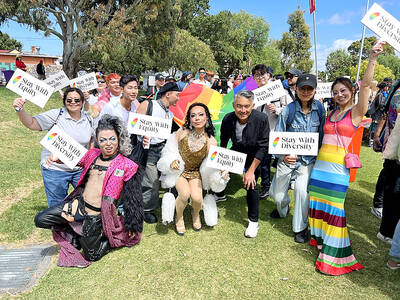
A group from the Taiwanese Designers in Australia association yesterday represented Taiwan at the Midsumma Pride March in Melbourne. The march, held in the St. Kilda suburb, is the city’s largest LGBTQIA+ parade and the flagship event of the annual Midsumma Festival. It attracted more than 45,000 spectators who supported the 400 groups and 10,000 marchers that participated this year, the association said. Taiwanese Designers said they organized a team to march for Taiwan this year, joining politicians, government agencies, professionals and community organizations in showing support for LGBTQIA+ people and diverse communities. As the first country in Asia to legalize same-sex
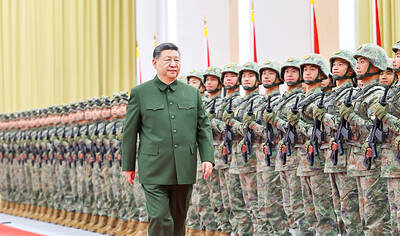
MOTIVES QUESTIONED The PLA considers Xi’s policies toward Taiwan to be driven by personal considerations rather than military assessment, the Epoch Times reports Chinese President Xi Jinping’s (習近平) latest purge of the Chinese People’s Liberation Army (PLA) leadership might have been prompted by the military’s opposition to plans of invading Taiwan, the Epoch Times said. The Chinese military opposes waging war against Taiwan by a large consensus, putting it at odds with Xi’s vision, the Falun Gong-affiliated daily said in a report on Thursday, citing anonymous sources with insight into the PLA’s inner workings. The opposition is not the opinion of a few generals, but a widely shared view among the PLA cadre, the Epoch Times cited them as saying. “Chinese forces know full well that


 RSS
RSS