


Taiwanese researchers yesterday demonstrated a new system that would allow doctors and other healthcare personnel to remotely monitor the condition of hospitalized patients with highly contagious diseases, such as COVID-19.
The technology, developed by the Industrial Technology Research Institute (ITRI) and Taipei Medical University Hospital (TMUH), was designed to reduce risk for medical personnel and improve treatment efficiency, ITRI Service Systems Technology Center director Cheng Jen-chieh (鄭仁傑) said in the demonstration at the hospital.
The system uses cameras and infrared sensors to monitor changes in color of a patient’s facial capillaries and their chest movements as they breathe, Cheng was cited as saying in a TMUH news release.
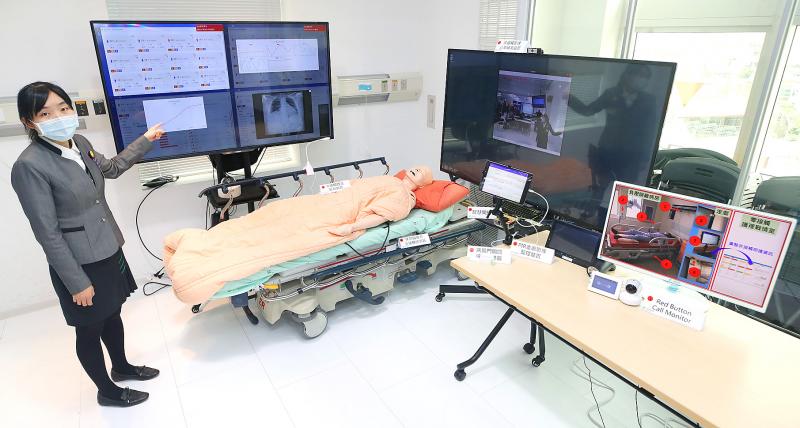
Photo: CNA
Artificial intelligence algorithms convert the data to provide a readout of the patient’s heart rate, respiratory rate and body temperature, he said.
Those vital signs are displayed on an electronic whiteboard at the nurses’ station, which can alert them to any changes in a patient’s condition, he added.
If any abnormalities are detected, doctors and other healthcare professionals can use the system’s videoconferencing feature to speak with the patient, Cheng said.
Meanwhile, patients can access their vital data in real time via a mobile app, ITRI said.
By allowing the process to be contact-free, medical professionals at hospitals would be able to work more efficiently and significantly reduce their risk of exposure to highly contagious diseases, ITRI executive vice president Chang Pei-zen (張培仁) said.
Medical staff at hospitals enter COVID-19 quarantine rooms 12 to 15 times per day, he said.
Each time, they have to don protective gear, a process that takes about 20 minutes, and on leaving the room, they have to carefully remove and dispose of the protective equipment, he added.
The remote treatment system has been installed at TMUH, but no details were provided on how widely it would be used elsewhere in the nation.

Considering that most countries issue more than five denominations of banknotes, the central bank has decided to redesign all five denominations, the bank said as it prepares for the first major overhaul of the banknotes in more than 24 years. Central bank Governor Yang Chin-lung (楊金龍) is expected to report to the Legislative Yuan today on the bank’s operations and the redesign’s progress. The bank in a report sent to the legislature ahead of today’s meeting said it had commissioned a survey on the public’s preferences. Survey results showed that NT$100 and NT$1,000 banknotes are the most commonly used, while NT$200 and NT$2,000

The Centers for Disease Control (CDC) yesterday reported the first case of a new COVID-19 subvariant — BA.3.2 — in a 10-year-old Singaporean girl who had a fever upon arrival in Taiwan and tested positive for the disease. The girl left Taiwan on March 20 and the case did not have a direct impact on the local community, it said. The WHO added the BA.3.2 strain to its list of Variants Under Monitoring in December last year, but this was the first imported case of the COVID-19 variant in Taiwan, CDC Deputy Director-General Lin Ming-cheng (林明誠) said. The girl arrived in Taiwan on

South Korea is planning to revise its controversial electronic arrival card, a step Taiwanese officials said prompted them to hold off on planned retaliatory measures, a South Korean media report said yesterday. A Yonhap News Agency report said that the South Korean Ministry of Foreign Affairs is planning to remove the “previous departure place” and “next destination” fields from its e-arrival card system. The plan, reached after interagency consultations, is under review and aims to simplify entry procedures and align the electronic form with the paper version, a South Korean ministry official said. The fields — which appeared only on the electronic form

The Ministry of Foreign Affairs (MOFA) is suspending retaliation measures against South Korea that were set to take effect tomorrow, after Seoul said it is updating its e-arrival system, MOFA said today. The measures were to be a new round of retaliation after Taiwan on March 1 changed South Korea's designation on government-issued alien resident certificates held by South Korean nationals to "South Korea” from the "Republic of Korea," the country’s official name. The move came after months of protests to Seoul over its listing of Taiwan as "China (Taiwan)" in dropdown menus on its new online immigration entry system. MOFA last week


 RSS
RSS