


An 81-year-old Amis woman has recorded an album of traditional Amis songs in an effort to preserve Amis music.
The album, titled Radiw Sanay, meaning “just sing” in Amis, features 18 traditional songs sung by Chien Yen-chun (簡燕春), also known as Osay Hongay, who said that she learned the songs when she was 17 from an elder and is now passing them down to the younger generation.
Chien said she felt “very shy” and “very excited” when she debuted the album on Saturday last week for the Tavalong community in Hualien County, where she shared the stage with young people from the tribe to perform the songs.
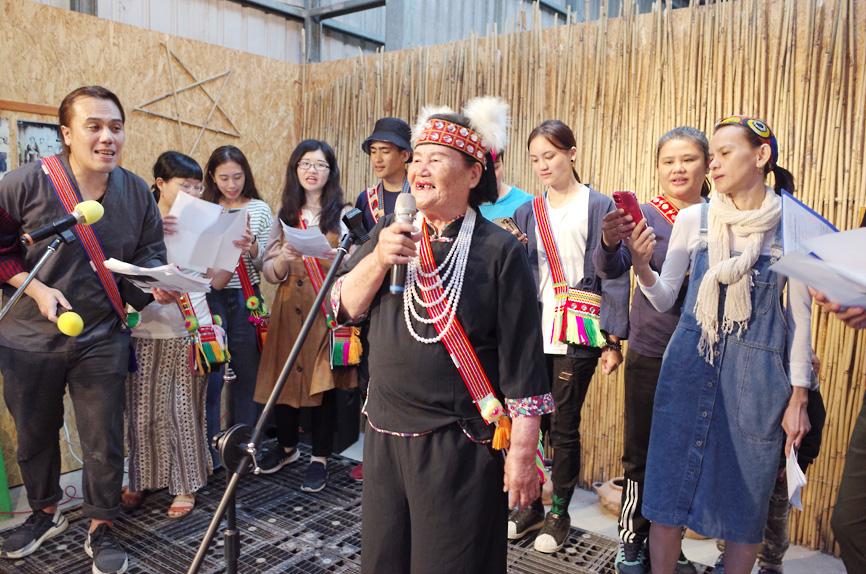
Photo: Hua Mang-Ching, Taipei Times
The album’s producer, Weng Yan-ting (翁嬿婷), a former documentary filmmaker, said that Chien is a wonderful singer; a member of the tribal organization Sisakawihay, which means “people gifted with spiritual powers;” and a leader when the community sings ritual songs for ancestral offerings.
Before soundtracks of ritual song performances were collected, Chien would let ancestors know through a divine ritual called Mifetik to show awe and respect for them, Weng said.
During the album’s production, Chien sometimes had to identify which songs were authentic and belonging to the Tavalong from recordings made up to 60 years ago, Weng said, adding that not only was she up to the task, she could even name the singers.
Chien said that she agreed to sing and help with collecting the soundtracks for the album because such cultural heritage would go extinct if no one listens to and learns from them.
Contributors include several young people from the community who conducted field surveys, recorded sounds and organized workshops on traditional Amis songs, she said.
Due to a limited budget, the 18-month production involved efforts such as fundraising and building a recording studio from scratch, with the final product consisting of 18 non-ritual songs and three remixed pieces featuring young singers from the community, she added.
Chien said that she was once approached by a record label to record albums because of her beautiful voice.
However, as the eldest daughter, she had to look after her younger siblings and perform work around the house, she said, adding that because she had not gone to school, she was illiterate, so she turned down the offer.
Now 81, Chien is realizing her childhood dream and making the most of her talent, Weng said.
Ho Chia-jung (何嘉榮), also known as Kaniw, a 23-year-old who last year moved back to Hualien after graduating from university, learned how to sing traditional songs from Chien in a workshop and contributed to the album.
“My community no longer has any elders who can sing these traditional songs,” said Ho, who is from the Fahol community, which neighbors the Tavalong, adding that he cherished the opportunity to help preserve traditional culture and encouraged more young people to learn about it.

The manufacture of the remaining 28 M1A2T Abrams tanks Taiwan purchased from the US has recently been completed, and they are expected to be delivered within the next one to two months, a source said yesterday. The Ministry of National Defense is arranging cargo ships to transport the tanks to Taiwan as soon as possible, said the source, who is familiar with the matter. The estimated arrival time ranges from late this month to early next month, the source said. The 28 Abrams tanks make up the third and final batch of a total of 108 tanks, valued at about NT$40.5 billion

Two Taiwanese prosecutors were questioned by Chinese security personnel at their hotel during a trip to China’s Henan Province this month, the Mainland Affairs Council (MAC) said yesterday. The officers had personal information on the prosecutors, including “when they were assigned to their posts, their work locations and job titles,” MAC Deputy Minister and spokesman Liang Wen-chieh (梁文傑) said. On top of asking about their agencies and positions, the officers also questioned the prosecutors about the Cross-Strait Joint Crime-Fighting and Judicial Mutual Assistance Agreement, a pact that serves as the framework for Taiwan-China cooperation on combating crime and providing judicial assistance, Liang
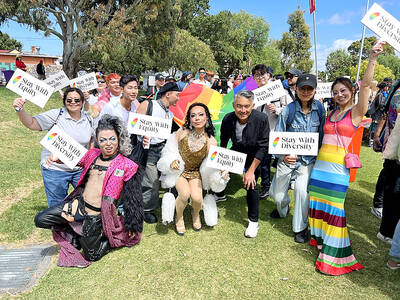
A group from the Taiwanese Designers in Australia association yesterday represented Taiwan at the Midsumma Pride March in Melbourne. The march, held in the St. Kilda suburb, is the city’s largest LGBTQIA+ parade and the flagship event of the annual Midsumma Festival. It attracted more than 45,000 spectators who supported the 400 groups and 10,000 marchers that participated this year, the association said. Taiwanese Designers said they organized a team to march for Taiwan this year, joining politicians, government agencies, professionals and community organizations in showing support for LGBTQIA+ people and diverse communities. As the first country in Asia to legalize same-sex

MOTIVES QUESTIONED The PLA considers Xi’s policies toward Taiwan to be driven by personal considerations rather than military assessment, the Epoch Times reports Chinese President Xi Jinping’s (習近平) latest purge of the Chinese People’s Liberation Army (PLA) leadership might have been prompted by the military’s opposition to plans of invading Taiwan, the Epoch Times said. The Chinese military opposes waging war against Taiwan by a large consensus, putting it at odds with Xi’s vision, the Falun Gong-affiliated daily said in a report on Thursday, citing anonymous sources with insight into the PLA’s inner workings. The opposition is not the opinion of a few generals, but a widely shared view among the PLA cadre, the Epoch Times cited them as saying. “Chinese forces know full well that


 RSS
RSS