


The nation has 10,532 Formosan landlocked salmon in several mountain creeks, a field survey by the Shei-Pa National Park administration showed.
This was the first time that the number of the endangered species had exceeded 10,000 since the park administration started its field surveys in 1999.
The salmon, which is also known as a “national treasure fish” or Taiwanese salmon, is endemic to Taiwan and at one point was close to extinction.
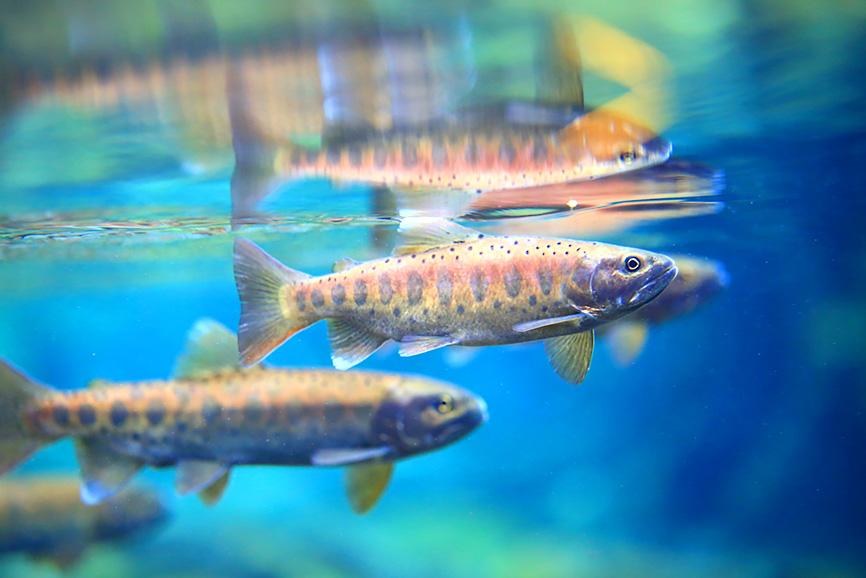
Photo courtesy of Shei-Pa National Park Headquarters via CNA
By the time the park agency was established in 1992, the number of Formosan landlocked salmon had dwindled to about 200.
The park said it spent last year surveying the number of Formosan landlocked salmon and released the results this week.
Specifically, the largest group of Formosan landlocked salmon, numbering 5,392, was found in the Cijiawan Creek (七家灣溪) in Taichung. The creek has already been identified by researchers as a natural habitat of the species.
Another 1,126 were found in the Rahao Creek (羅葉尾溪) and 121 in the Arikatsu Creek (有勝溪), in the upper reaches of Taichung’s Dajia River (大甲溪), and 136 in the Leshan Creek (樂山溪).
Nantou County also hosts large numbers of the fish, with 3,757 found in the Hehuan Creek (合歡溪).
Salmon in these creeks were growing naturally and steadily, the park said, adding that there is no need to raise the fish in hatcheries and release them into creeks.
The park attributed the success in restoring the natural growth of the species to a clear conservation policy that was established following a seminar hosted in 2000, which set a goal of restoring the Formosan landlocked salmon in Dajia River’s five creeks within 30 years.
The park spent the first four years trying to raise farmed Taiwanese salmon to ensure that the original genes of the species could be preserved.
It then worked to restore growth in the Cijiawan Creek by improving its five check dams and expropriating 8.1 hectares of private farmland to ensure sufficient waterflow and help preserve the forests, the park said.
Wuling Farm was asked to reduce its arable land to 5 hectares, it added.
In addition to the Cijiawan Creek, the park released salmon from the hatcheries into creeks that records show used to host the species.
Since 2000, the park and the Atayal community have been patrolling these creeks to protect these farmed salmon, it said.
The agency has set new conservation goals: From now to 2022, it would restore the population of salmon in the Sijielan Creek (司界蘭溪) and Nanhu Creek (南湖溪), and by 2022, traces of the salmon should be found in all five major tributary creeks of the Dajia River.
Salmon from the hatcheries are to be released every August, instead of March, it added.
To raise their survival rate, the fish should be at least 10cm long and released every 100m along the same creek, it said.
The check dam at the intersection of the Skitlan and Ikawan creeks has been damaged, which should raise the water level in both creeks, it said.
However, this should improve the natural habitats for the salmon, it said.
The park is also working with the Taroko National Park Administration by entrusting the latter with the task of monitoring the salmon released in the creeks.

Considering that most countries issue more than five denominations of banknotes, the central bank has decided to redesign all five denominations, the bank said as it prepares for the first major overhaul of the banknotes in more than 24 years. Central bank Governor Yang Chin-lung (楊金龍) is expected to report to the Legislative Yuan today on the bank’s operations and the redesign’s progress. The bank in a report sent to the legislature ahead of today’s meeting said it had commissioned a survey on the public’s preferences. Survey results showed that NT$100 and NT$1,000 banknotes are the most commonly used, while NT$200 and NT$2,000

The Centers for Disease Control (CDC) yesterday reported the first case of a new COVID-19 subvariant — BA.3.2 — in a 10-year-old Singaporean girl who had a fever upon arrival in Taiwan and tested positive for the disease. The girl left Taiwan on March 20 and the case did not have a direct impact on the local community, it said. The WHO added the BA.3.2 strain to its list of Variants Under Monitoring in December last year, but this was the first imported case of the COVID-19 variant in Taiwan, CDC Deputy Director-General Lin Ming-cheng (林明誠) said. The girl arrived in Taiwan on

South Korea is planning to revise its controversial electronic arrival card, a step Taiwanese officials said prompted them to hold off on planned retaliatory measures, a South Korean media report said yesterday. A Yonhap News Agency report said that the South Korean Ministry of Foreign Affairs is planning to remove the “previous departure place” and “next destination” fields from its e-arrival card system. The plan, reached after interagency consultations, is under review and aims to simplify entry procedures and align the electronic form with the paper version, a South Korean ministry official said. The fields — which appeared only on the electronic form

The Ministry of Foreign Affairs (MOFA) is suspending retaliation measures against South Korea that were set to take effect tomorrow, after Seoul said it is updating its e-arrival system, MOFA said today. The measures were to be a new round of retaliation after Taiwan on March 1 changed South Korea's designation on government-issued alien resident certificates held by South Korean nationals to "South Korea” from the "Republic of Korea," the country’s official name. The move came after months of protests to Seoul over its listing of Taiwan as "China (Taiwan)" in dropdown menus on its new online immigration entry system. MOFA last week


 RSS
RSS