


The government is planning a special loan for the nation’s six airlines as their businesses have been severely affected by the COVID-19 outbreak, Deputy Minister of Transportation and Communications Huang Yu-ling (黃玉霖) said yesterday.
Details of the bailout are to be decided at an Executive Yuan meeting tomorrow, he said on the sidelines of a meeting of the Legislative Yuan’s Transportation Committee.
The Central Epidemic Command Center (CECC) announcement on Saturday that he had raised the travel advisory for 27 European nations and Dubai to a level 3 “warning,” effective today, is expected to worsen the plight of airlines already hurt by massive numbers of flight cancellations and ticket refunds caused by the outbreak.
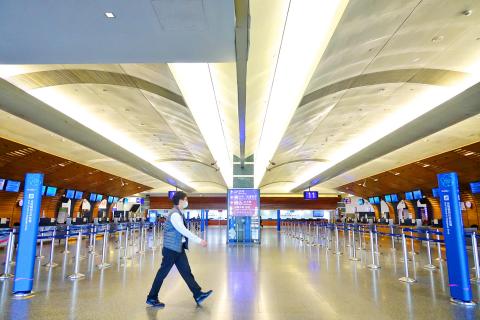
Photo: Liu Hsin-de, Taipei Times
Previously, the Ministry of Transportation and Communications (MOTC) had budgeted a total of NT$4.863 billion (US$160.92 million) to subsidize the airlines, as well as several items for the nation’ airports, including aircraft landing fees, land lease fees, airport facility usage fees and royalties, as well as the purchase of disease-prevention materials.
Asked if the bailout would be capped at NT$30 billion, as some local media have reported, Huang said that the airlines are still calculating the exact amounts they need to weather the crisis.
Premier Su Tseng-chang (蘇貞昌) supports the ministry’s proposal, Huang added.
“The airlines have experienced a massive reduction in revenue in the past few months due to the COVID-19 outbreak, which has led them to have low cash flow as well. The special loan program would fund paychecks for their employees and help them get though this difficult time,” he said.
So far, the nation has managed to keep about 20 percent of its airlines’ transport capacity to China, while more than 50 percent of their international flights have been canceled, ministry statistics showed.
The Center for Aviation, a market intelligence agency for the aviation and travel industry, yesterday forecast that most of the world’s airlines would be bankrupt by the end of May, unless coordinated government and industry action is taken now.
“As the impact of the coronavirus and multiple government travel reactions sweep through our world, many airlines have probably already been driven into technical bankruptcy, or are at least substantially in breach of debt covenants,” the center said. “Cash reserves are running low quickly as fleets are grounded, and what flights there are operate at much less than half full.”
“Forward bookings are far outweighed by cancelations and each time there is a new government recommendation it is to discourage flying. Demand is drying up in ways that are completely unprecedented,” it said. “Normality is not yet on the horizon.”

The military has spotted two Chinese warships operating in waters near Penghu County in the Taiwan Strait and sent its own naval and air forces to monitor the vessels, the Ministry of National Defense (MND) said. Beijing sends warships and warplanes into the waters and skies around Taiwan on an almost daily basis, drawing condemnation from Taipei. While the ministry offers daily updates on the locations of Chinese military aircraft, it only rarely gives details of where Chinese warships are operating, generally only when it detects aircraft carriers, as happened last week. A Chinese destroyer and a frigate entered waters to the southwest

The eastern extension of the Taipei MRT Red Line could begin operations as early as late June, the Taipei Department of Rapid Transit Systems said yesterday. Taipei Rapid Transit Corp said it is considering offering one month of free rides on the new section to mark its opening. Construction progress on the 1.4km extension, which is to run from the current terminal Xiangshan Station to a new eastern terminal, Guangci/Fengtian Temple Station, was 90.6 percent complete by the end of last month, the department said in a report to the Taipei City Council's Transportation Committee. While construction began in October 2016 with an
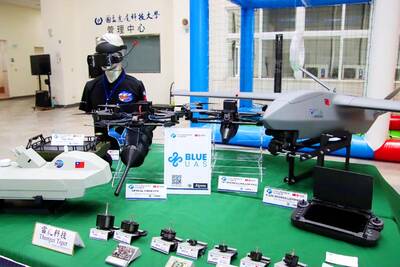
NON-RED SUPPLY: Boosting the nation’s drone industry is becoming increasingly urgent as China’s UAV dominance could become an issue in a crisis, an analyst said Taiwan’s drone exports to Europe grew 41.7-fold from 2024 to last year, with demand from Ukraine’s fight against Russian aggression the most likely driver of growth, a study showed. The Institute for Democracy, Society and Emerging Technology (DSET) in a statement on Wednesday said it found that many of Taiwan’s uncrewed aerial vehicle (UAV) sales were from Poland and the Czech Republic. These countries likely transferred the drones to Ukraine to aid it in its fight against the Russian invasion that started in 2022, it said. Despite the gains, Taiwan is not the dominant drone exporter to these markets, ranking second and fourth

Japanese Prime Minister Sanae Takaichi’s comment last year on Tokyo’s potential reaction to a Taiwan-China conflict has forced Beijing to rewrite its invasion plans, a retired Japanese general said. Takaichi told the Diet on Nov. 7 last year that a Chinese naval blockade or military attack on Taiwan could constitute a “survival-threatening situation” for Japan, potentially allowing Tokyo to exercise its right to collective self-defense. Former Japan Ground Self-Defense Force general Kiyofumi Ogawa said in a recent speech that the remark has been interpreted as meaning Japan could intervene in the early stages of a Taiwan Strait conflict, undermining China’s previous assumptions


 RSS
RSS