


Slowork Publishing (慢工文化公司), a company that specializes in documentary comics, has produced the first comic to document the life of a political victim during the White Terror era.
The comic, titled Son of Formosa (來自清水的孩子), tells the story of political prisoner Tsai Kun-lin (蔡焜霖) and was made in collaboration with historical researchers, the company said.
Tsai, 90, spent 1950 to 1960 in Green Island prison following a crackdown on members of the Taipei Workers Committee (台北市工作委員會), a group of Chinese Communist Party sympathizers planted within various government agencies.
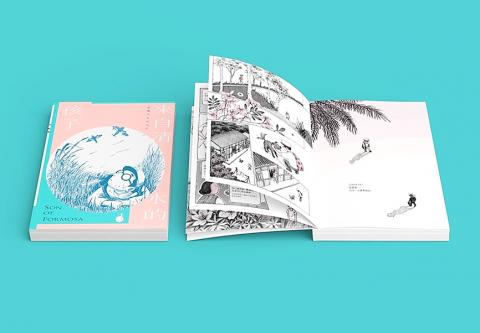
Photo courtesy of Slowork Publishing
Tsai, who worked at the now-defunct Directorate General of Telecommunications, was among the first group of political prisoners to be incarcerated at the prison.
In 1966, Tsai began publishing a children’s magazine titled Prince (王子雜誌) — which contained popular comics — for which the Ministry of Culture honored him with a Special Contributions award at the 2018 Golden Comic Awards.
Through Son of Formosa, National Taitung University professor Yu Pei-yun (游珮芸) and illustrator Chou Chien-hsin (周見信) hoped to document Tsai’s life and contributions, the publisher said.

Photo courtesy of Slowork Publishing
Slowork said it plans to publish four issues of the comic in the next two years, with the first to appear in May.
Comics are a publication for the masses and much more approachable than history textbooks, publisher president Huang Pei-shan (黃珮珊) said.
Son of Formosa shows a “respect for historical facts, close attention to narrative and use of refined imagery,” making it easy for modern readers to understand the White Terror era, Huang said, adding that she hopes the comic will one day be sold internationally.
“The pain caused by the nation’s authoritarian history needs to be examined over a long period. Only then will it be properly processed,” she said.
The publisher hopes to accomplish with Son of Formosa what the Japanese animated film In This Corner of the World did for a discussion of life in Japan during World War II, she said.
Each issue of the comic would employ a different art style, reflecting changes in society over the years of the White Terror era, she said.
Author Gustave Cheng (鄭順聰) is to act as a consultant for the four issues to ensure that the complex language environment of the period — when Taiwanese, Mandarin and Japanese intermingled — is accurately represented, she said.
National Chi Nan University assistant professor Weng Chi-an (翁稷安) is to act as the history consultant, she added.

LOUD AND PROUD Taiwan might have taken a drubbing against Australia and Japan, but you might not know it from the enthusiasm and numbers of the fans Taiwan might not be expected to win the World Baseball Classic (WBC) but their fans are making their presence felt in Tokyo, with tens of thousands decked out in the team’s blue, blowing horns and singing songs. Taiwanese fans have packed out the Tokyo Dome for all three of their games so far and even threatened to drown out home team supporters when their team played Japan on Friday. They blew trumpets, chanted for their favorite players and had their own cheerleading squad who dance on a stage during the game. The team struggled to match that exuberance on the field, with
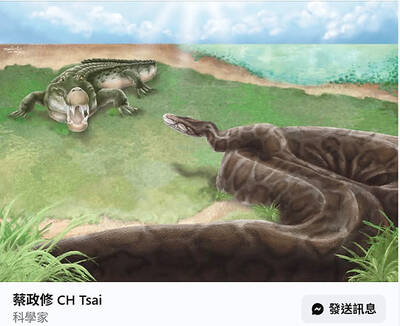
Taiwanese paleontologists have discovered fossil evidence that pythons up to 4m long inhabited Taiwan during the Pleistocene epoch, reporting their findings in the international scientific journal Historical Biology. National Taiwan University (NTU) Institute of Ecology and Evolutionary Biology associate professor Tsai Cheng-hsiu (蔡政修) led the team that discovered the largest snake fossil ever found in Taiwan. The single trunk vertebra was discovered in Tainan at the Chiting Formation, dated to between 400,000 and 800,000 years ago in the Middle Pleistocene, the paper said. The area also produced Taiwan’s first avian fossil, as well as crocodile, mammoth, saber-toothed cat and rhinoceros fossils, it said. Discoveries

Taiwanese paleontologists have discovered fossil evidence that pythons up to 4m long inhabited Taiwan during the Pleistocene epoch, reporting their findings in the international scientific journal Historical Biology. National Taiwan University (NTU) Institute of Ecology and Evolutionary Biology associate professor Tsai Cheng-hsiu (蔡政修) led the team that discovered the largest snake fossil ever found in Taiwan. A single trunk vertebra was discovered in Tainan at the Chiting Formation, dated to between 800,000 to 400,000 years ago in the Middle Pleistocene, the paper said. The area also produced Taiwan’s first avian fossil, as well as crocodile, mammoth, sabre-toothed cat and rhinoceros fossils, it said. Discoveries

Whether Japan would help defend Taiwan in case of a cross-strait conflict would depend on the US and the extent to which Japan would be allowed to act under the US-Japan Security Treaty, former Japanese minister of defense Satoshi Morimoto said. As China has not given up on the idea of invading Taiwan by force, to what extent Japan could support US military action would hinge on Washington’s intention and its negotiation with Tokyo, Morimoto said in an interview with the Liberty Times (sister paper of the Taipei Times) yesterday. There has to be sufficient mutual recognition of how Japan could provide


 RSS
RSS