


The Chinese Nationalist Party (KMT) expects 100,000 fewer voters for its chairmanship by-election on March 7 than in 2017, a party source said.
Today is the deadline for party members to pay their dues, allowing them eligibility to vote in the election, and the source said that the party expects only 310,000 members would be eligible to vote.
About 190,000 eligible voters are exempt from paying party dues, either because they became a senior member after 40 years or are from a middle or low-income household and at least 65 years old, the source said.

Photo: Tu Chien-jung, Taipei Times
That figure excludes more than 10,000 people who became lifetime members after paying a one-time NT$10,000 fee, the source added.
Party members from the KMT’s influential Huang Fu-hsing chapter account for about 80,000 — more than 20 percent — of the eligible voters, the source said.
The chapter is known for its ability to mobilize members during elections, and anticipates a 60 to 70 percent turnout among its members, the source said, adding that this, coupled with concerns that fear over COVID-19 might affect overall turnout, could make the chapter a determining factor in the by-election.
The number of party members who have paid their dues has increased markedly in Changhua and Pingtung counties, as well as in Kaohsiung and New Taipei City, sources said.
In Changhua, about 7,000 members paid their dues, which could have been a result of mobilization by local factions backing the two candidates: former KMT vice chairman Hau Lung-bin (郝龍斌) and KMT Legislator Johnny Chiang (江啟臣), they said.
Another source said that the spike in Changhua members paying dues was not surprising, as it has more KMT executives and members than other regions.
As of yesterday, party dues owed were mostly paid individually or by households of two or three members rather than in a lump sum by dozens of members, the source said.
Even if Chiang’s and Hau’s supporters had mobilized factions to secure voting rights, that would not have been surprising, the source added.
The KMT said that it would start compiling a roster of eligible voters from tomorrow to Wednesday before publishing it for public viewing, and eligible voters would receive a notice informing them of the by-election.
The by-election is to fill the vacancy left by former KMT chairman Wu Den-yih (吳敦義), who stepped down last month after the party’s losses in the Jan. 11 presidential and legislative elections.
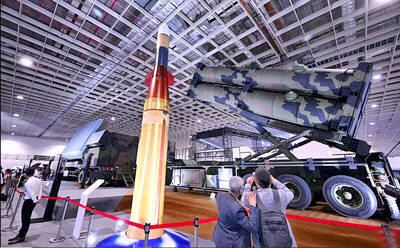
Taiwan is to commence mass production of the Tien Kung (天弓, “Sky Bow”) III, IV and V missiles by the second quarter of this year if the legislature approves the government’s NT$1.25 trillion (US$39.78 billion) special defense budget, an official said yesterday. Commenting on condition of anonymity, a defense official with knowledge of the matter said that the advanced systems are expected to provide crucial capabilities against ballistic and cruise missiles for the proposed “T-Dome,” an advanced, multi-layered air defense network. The Tien Kung III is an air defense missile with a maximum interception altitude of 35km. The Tien Kung IV and V
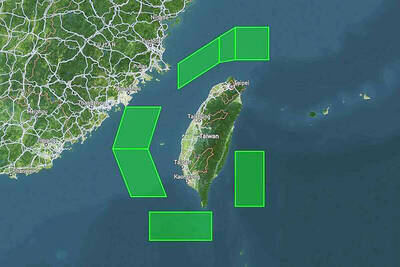
The disruption of 941 flights in and out of Taiwan due to China’s large-scale military exercises was no accident, but rather the result of a “quasi-blockade” used to simulate creating the air and sea routes needed for an amphibious landing, a military expert said. The disruptions occurred on Tuesday and lasted about 10 hours as China conducted live-fire drills in the Taiwan Strait. The Civil Aviation Administration (CAA) said the exercises affected 857 international flights and 84 domestic flights, affecting more than 100,000 travelers. Su Tzu-yun (蘇紫雲), a research fellow at the government-sponsored Institute for National Defense and Security Research, said the air
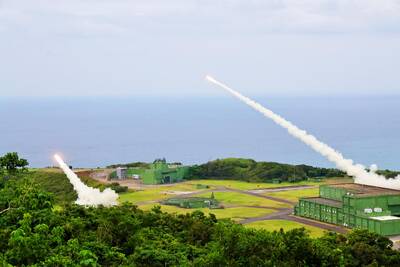
Taiwan lacks effective and cost-efficient armaments to intercept rockets, making the planned “T-Dome” interception system necessary, two experts said on Tuesday. The concerns were raised after China’s military fired two waves of rockets during live-fire drills around Taiwan on Tuesday, part of two-day exercises code-named “Justice Mission 2025.” The first wave involved 17 rockets launched at 9am from Pingtan in China’s Fujian Province, according to Lieutenant General Hsieh Jih-sheng (謝日升) of the Office of the Deputy Chief of the General Staff for Intelligence at the Ministry of National Defense. Those rockets landed 70 nautical miles (129.6km) northeast of Keelung without flying over Taiwan,
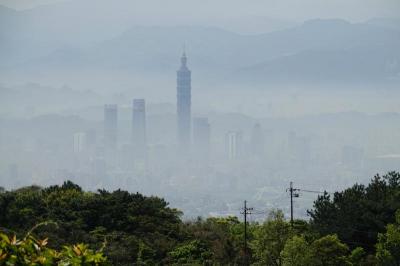
A strong continental cold air mass is to bring pollutants to Taiwan from tomorrow, the Ministry of Environment said today, as it issued an “orange” air quality alert for most of the country. All of Taiwan except for Hualien and Taitung counties is to be under an “orange” air quality alert tomorrow, indicating air quality that is unhealthy for sensitive groups. In China, areas from Shandong to Shanghai have been enveloped in haze since Saturday, the ministry said in a news release. Yesterday, hourly concentrations of PM2.5 in these areas ranged from 65 to 160 micrograms per cubic meter (mg/m³), and pollutants were


 RSS
RSS