


Liberty Times (LT): As you were new to politics when [People First Party (PFP) Chairman and presidential candidate] James Soong (宋楚瑜) asked you to be his running mate, what motivated you to enter the world of politics?
Sandra Yu (余湘): I joined the PFP in 2000, but used to think I was far removed from politics.
Chairman Soong came to speak with me many times last year, and I was unable to persuade him not to choose me as his running mate.
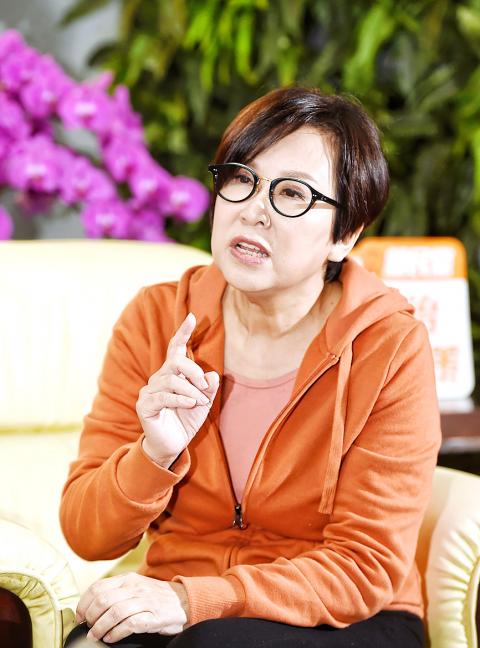
Photo: Fang Pin-chao, Taipei Times
I am a Christian, and I felt that Chairman Soong came across as a very sincere political worker when he spoke about his political views and ideas on running the nation.
I want to spread the Gospel and help people handle matters, and I regret that I was not able to give Soong a chance the last three times he ran. If he had been elected in 2000, Taiwan would be a totally different place.
It was very late when Soong decided to run. It is like he said during his platform speech — he is not the captain, but he still does not want the ship to sink, so he made the decision to run.
LT: A month into campaigning, how do you feel about things?
Yu: In the past, I was a boss, a CEO, I was very aggressive — if I said something, it had to be done. If one makes no contributions, then there were no contributions, one should not talk about hard work.
My reactions in the past were swift and decisive, but now as a running mate I walk in Soong’s footsteps. I cannot act as I did in the past, doing what I want. I must know when to speak, and when to say less. Seeing the world from the back, things look quite different.
LT: Looking back, would you still make the decision to enter politics if you could decide again?
Yu: The most charming thing about life is that you have no way to know things in advance, and the most wonderful thing about it is that there is no way to turn back the clock. At this time, whether this is intuition speaking or rationale, I would still choose this path.
I do not see it as a career in politics, I see it as the course of life. I often say to young people, if I came to a fork in the road I would choose the path less traveled, so that I might see different things from what others see.
LT: As a member of the PFP, what can you do to break Taiwanese politics free from the dichotomy between the Chinese Nationalist Party (KMT) and the Democratic Progressive Party (DPP)?
Yu: A more advanced society should be one with many political parties. Taiwan, the UK and the US are all politically bipartisan nations. After the election of US President Donald Trump, British Prime Minister Boris Johnson was ridiculed as a second “Trump.”
Conversely, Germany is a multi-party state, and is run very well — its government discusses environmental protection and ways to assist different groups of people.
Taiwanese parties only think about election victories, and use whatever ill-conceived method they can think of to achieve this, even going after their own members.
I urge the public to vote for the PFP, because the KMT and the DPP are extremely detached; under either of them the nation will not have a future. Whenever the issue of unification with China or independence is raised, no law regardless of how good it is will get passed. The situation is bad for Taiwan.
I emphasize that Taiwan needs a plethora of parties, two is not enough. The DPP should not hold too much power, the KMT should not hold too much power and neither should have a legislative majority.
Former president Ma Ying-jeou (馬英九) once said that full administrative power means full responsibility. Many policies that should have been pushed when he was in power did not get pushed.
Now President Tsai Ing-wen (蔡英文) has full administrative power, but is not fully responsible with that power — she pushes many controversial bills.
LT: What are your views on Tsai, who is seeking re-election, and Kaohsiung Mayor Han Kuo-yu (韓國瑜), the KMT’s presidential candidate?
Yu: I admire Tsai for assuming the position of DPP chairperson at the hardest time for the party.
I equally admire Han, too. Six months prior to Han’s election as Kaohsiung mayor [on Nov. 24, 2018], I was in the city and asked taxi drivers if they would vote for him and all said that would be impossible. However, the climate had changed by the time I visited the city again, about one month before that election.
The DPP had long had great influence over the city, but Han used his charisma to change that.
LT: What are your views on Taipei Mayor Ko Wen-je (柯文哲)?
Yu: Ko is a newcomer to politics and has high emotional intelligence. He has only been a politician for five or six years, and his remarks are always precise. Some people say he is cunning when answering reporters’ questions, but I think he is honest and blunt, allowing him to always get to the point.
LT: What are your views on Hon Hai Precision Industry Co founder Terry Gou (郭台銘)?
Yu: I would just say he is patriotic. As a successful business leader, he could have avoided the trouble of wading into politics. He is a man with independent thinking. He has international connections, he can attend US President Donald Trump’s private parties, and it is also not that difficult for him to meet Chinese President Xi Jinping (習近平).
However, I do not fully understand his way of thinking. He must have different concerns in a high position like that.
LT: What are your views on the cross-strait relationship during Tsai’s term?
Yu: Many women have the experience of trying to lose weight, and it is necessary to do things to maintain that weight. Maintaining the “status quo” requires effort, too. It takes more than verbal promises.
As Tsai’s administration blames China for diplomatic and economic oppression again and again, I do not think that it has succeeded in maintaining the “status quo.”
The two sides should communicate more and know each other’s bottom lines, to avoid crossing them. There is still a lot of room for negotiations within a mutually acceptable scope.
Doing businesses with China does not necessarily need to come at the expense of Taiwan’s sovereignty.
LT: If you [and Soong] lose the election, what are your plans?
Yu: God would not let me take this journey for nothing. If, unfortunately, I am not elected, every bit of this experience will still count for something.
If elected, I could gain a lot of momentum when I promote policies. I have been a volunteer my entire life, doing service work for several non-governmental organizations. So with more power, I could be an even greater benefit to society, as if “10,000,000 Sandra Yus are working” at a time.
Interviewed by Lin Liang-sheng, Chen Yun and Chiu Yen-ling
Translated by staff writers William Hetherington and Dennis Xie
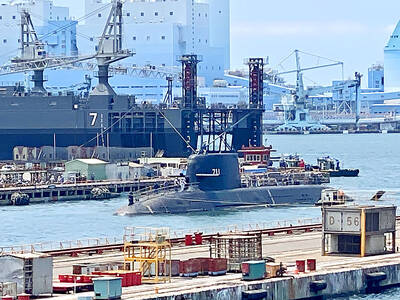
AGING: While Japan has 22 submarines, Taiwan only operates four, two of which were commissioned by the US in 1945 and 1946, and transferred to Taiwan in 1973 Taiwan would need at least 12 submarines to reach modern fleet capabilities, CSBC Corp, Taiwan chairman Chen Cheng-hung (陳政宏) said in an interview broadcast on Friday, citing a US assessment. CSBC is testing the nation’s first indigenous defense submarine, the Hai Kun (海鯤, Narwhal), which is scheduled to be delivered to the navy next month or in July. The Hai Kun has completed torpedo-firing tests and is scheduled to undergo overnight sea trials, Chen said on an SET TV military affairs program. Taiwan would require at least 12 submarines to establish a modern submarine force after assessing the nation’s operational environment and defense
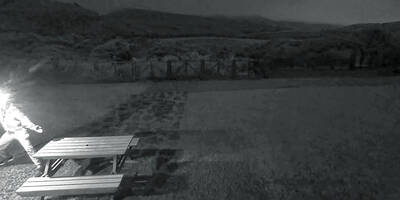
Yangmingshan National Park authorities yesterday urged visitors to respect public spaces and obey the law after a couple was caught on a camera livestream having sex at the park’s Qingtiangang (擎天崗) earlier in the day. The Shilin Police Precinct in Taipei said it has identified a suspect and his vehicle registration number, and would summon him for questioning. The case would be handled in accordance with public indecency charges, it added. The couple entered the park at about 11pm on Thursday and began fooling around by 1am yesterday, the police said, adding that the two were unaware of the park’s all-day live
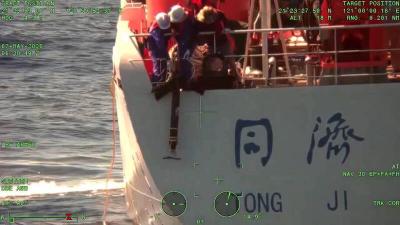
The coast guard today said that it had disrupted "illegal" operations by a Chinese research ship in waters close to the nation and driven it away, part of what Taipei sees a provocative pattern of China's stepped up maritime activities. The coast guard said that it on Thursday last week detected the Chinese ship Tongji (同濟號), which was commissioned only last year, 29 nautical miles (54km) southeast of the southern tip of Taiwan, although just outside restricted waters. The ship was observed lowering ropes into the water, suspected to be the deployment of scientific instruments for "illegal" survey operations, and the coast

A former soldier and an active-duty army officer were yesterday indicted for allegedly selling classified military training materials to a Chinese intelligence operative for a total of NT$79,440. The Taipei District Prosecutors’ Office indicted Chen Tai-yin (陳泰尹) and Lee Chun-ta (李俊達) for contravening the National Security Act (國家安全法) and the Anti-Corruption Act (貪污治罪條例). Chen left the military in September 2013 after serving alongside then-staff sergeant Lee, now an army lieutenant, at the 21st Artillery Command of the army’s Sixth Corps from 2011 to 2013, according to the indictment. Chen met a Chinese intelligence operative identified as “Wang” (王) through a friend in November


 RSS
RSS