


Miaoli County on Friday announced the implementation of an autonomous ordinance for the protection of leopard cats that would accompany other conservation measures to help protect the animal.
The new bill passed a third reading on Dec. 10, and was signed into effect by Miaoli County Commissioner Hsu Yao-chang (徐耀昌) on Friday, the county said.
The bill would be based on a reward system, rather than placing limits on residents, Hsu said.
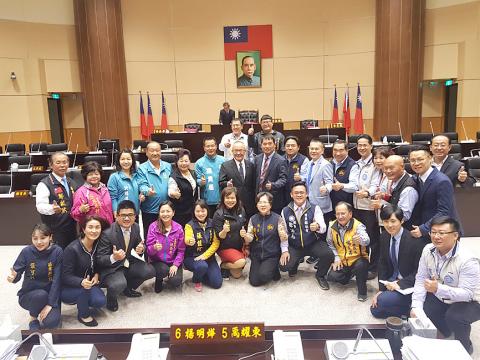
Photo: Peng Chien-lee, Taipei Times
He said he hoped county residents would cooperate to help protect endangered species, and that the county could set a benchmark for the rest of the country to follow.
The reward system would encourage tenants of leased land to engage in environmentally friendly farming practices that would help leopard cats breed and live safely, Hsu said, adding that the county was in the process of formulating regulations on rewards and subsidies, and would establish a task force responsible for promoting leopard cat conservation.
The county is an important breeding area for leopard cats.
Two previous bills on leopard cat conservation had been proposed by the county’s government, but were sent back for revision by the Miaoli County Council.
The Chinese Nationalist Party (KMT) caucus was criticized for obstructing the two bills, as the majority of the county’s councilors are members of the KMT.
Ahead of the Dec. 10 council session, the KMT proposed its own version of a conservation bill, which was combined with separate versions proposed by Democratic Progressive Party and independent councilors.
The bill include rules for areas of the county where leopard cats have been seen, such as mandatory consultation with conservation researchers prior to road expansions of 1km or more, or development projects on properties of 1 hectare or more.
These projects would must be conducted in an environmentally friendly manner, and the researchers employed would be chosen by the county government.
Separately, the county is to establish a group of conservationists to patrol communities looking for leopard cats and ensure their protection, Hsu said.
The county would also ensure that there are animal shelters to reduce the possibility of leopard cats fighting with stray domestic animals, he said, adding that officials and members of the public would be rewarded for good conservation practices.
With the introduction of the new ordinance, landowners would still have to follow existing rules on land use, the county’s Agriculture Department said.
The ordinance is merely intended to set an example, and to encourage and reward environmentally friendly practices, it said.

Taiwanese can file complaints with the Tourism Administration to report travel agencies if their activities caused termination of a person’s citizenship, Mainland Affairs Council Minister Chiu Chui-cheng (邱垂正) said yesterday, after a podcaster highlighted a case in which a person’s citizenship was canceled for receiving a single-use Chinese passport to enter Russia. The council is aware of incidents in which people who signed up through Chinese travel agencies for tours of Russia were told they could obtain Russian visas and fast-track border clearance, Chiu told reporters on the sidelines of an event in Taipei. However, the travel agencies actually applied

Japanese footwear brand Onitsuka Tiger today issued a public apology and said it has suspended an employee amid allegations that the staff member discriminated against a Vietnamese customer at its Taipei 101 store. Posting on the social media platform Threads yesterday, a user said that an employee at the store said that “those shoes are very expensive” when her friend, who is a migrant worker from Vietnam, asked for assistance. The employee then ignored her until she asked again, to which she replied: "We don't have a size 37." The post had amassed nearly 26,000 likes and 916 comments as of this

New measures aimed at making Taiwan more attractive to foreign professionals came into effect this month, the National Development Council said yesterday. Among the changes, international students at Taiwanese universities would be able to work in Taiwan without a work permit in the two years after they graduate, explainer materials provided by the council said. In addition, foreign nationals who graduated from one of the world’s top 200 universities within the past five years can also apply for a two-year open work permit. Previously, those graduates would have needed to apply for a work permit using point-based criteria or have a Taiwanese company

The Shilin District Prosecutors’ Office yesterday indicted two Taiwanese and issued a wanted notice for Pete Liu (劉作虎), founder of Shenzhen-based smartphone manufacturer OnePlus Technology Co (萬普拉斯科技), for allegedly contravening the Act Governing Relations Between the People of the Taiwan Area and the Mainland Area (臺灣地區與大陸地區人民關係條例) by poaching 70 engineers in Taiwan. Liu allegedly traveled to Taiwan at the end of 2014 and met with a Taiwanese man surnamed Lin (林) to discuss establishing a mobile software research and development (R&D) team in Taiwan, prosecutors said. Without approval from the government, Lin, following Liu’s instructions, recruited more than 70 software


 RSS
RSS