


The Sakizaya language, which is listed by the Council of Indigenous Peoples as an endangered language, was on Nov. 22 added to Wikipedia as a language option thanks to efforts to preserve and promote the Aboriginal language.
The Sakizaya people, officially recognized in 2007 as the 13th Aboriginal community in Taiwan, has a population of only 974 nationwide, making it difficult for speakers of the Sakizaya language to pass it down to younger generations, the council said.
Tuku Sayion, a Sakizaya and principal investigator for the language preservation project, on Monday last week told a conference about the development of Aboriginal languages that his team has since 2015 made efforts to make the Sakizaya language available on Wikipedia.
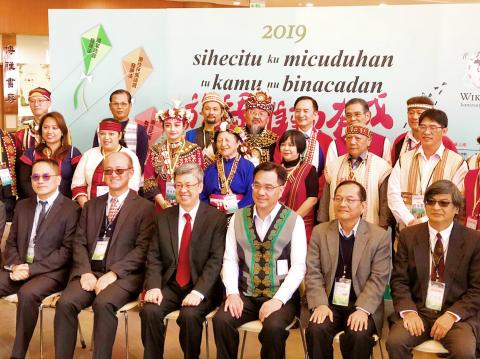
Computer terms, such as “visualization” and “program code,” took the most time to translate, as corresponding vocabulary does not exist in the Sakizaya language, he told the conference held at National Chengchi University.
There are about 3,600 Wikipedia entries in the Sakizaya language, with an edit count of more than 60,000 and a word count reaching 2 million, he added.
Atayal and Amis communities also expressed an interest in incorporating their native languages into Wikipedia, but that project has ground to a halt due to the difficulty in translating modern computer terms, said Lim Siu-theh (林修澈), the project’s co-principal investigator and professor emeritus at National Chengchi University’s ethnology department.
The Atayal and Amis are among Taiwan’s 16 officially recognized Aboriginal groups.
Vice President Chen Chien-jen (陳建仁), who attended the conference, said that Taiwan’s diverse culture and languages demonstrate the prosperity of a liberal and democratic nation, adding that the availability of the Sakizaya language on Wikipedia would help the world to learn about the language.
President Tsai Ing-wen’s (蔡英文) administration has promoted transitional justice for Aborigines since she assumed office in May 2016, especially the conservation of Aboriginal languages and cultures, such as the enactment of the National Languages Development Act (國家語言發展法) in January and amendments to the Education Act for Indigenous Peoples (原住民族教育法) in June, Chen said.
The council has launched a mentoring program to preserve indigenous languages, Council of Indigenous Peoples Minister Icyang Parod said.
In the program, one or two students are assigned to a mentor, who teaches them an Aboriginal language, including the Kanakanavu, Saaroa and Thao languages, Icyang said.
The council is also planning to establish a foundation early next year for the development of indigenous languages, which would be the nation’s first such research institute, he said.
Aboriginal students who pass indigenous language exams would receive certification, which could be used to apply for government subsidies to study abroad, he added.

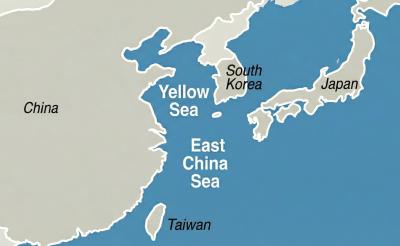
China has reserved offshore airspace in the Yellow Sea and East China Sea from March 27 to May 6, issuing alerts usually used to warn of military exercises, although no such exercises have been announced, the Wall Street Journal (WSJ) reported yesterday. Reserving such a large area for 40 days without explanation is an “unusual step,” as military exercises normally only last a few days, the paper said. These alerts, known as Notice to Air Missions (Notams), “are intended to inform pilots and aviation authorities of temporary airspace hazards or restrictions,” the article said. The airspace reserved in the alert is

South Korea is planning to revise its controversial electronic arrival card, a step Taiwanese officials said prompted them to hold off on planned retaliatory measures, a South Korean media report said yesterday. A Yonhap News Agency report said that the South Korean Ministry of Foreign Affairs is planning to remove the “previous departure place” and “next destination” fields from its e-arrival card system. The plan, reached after interagency consultations, is under review and aims to simplify entry procedures and align the electronic form with the paper version, a South Korean ministry official said. The fields — which appeared only on the electronic form

A bipartisan group of US senators has introduced a bill to enhance cooperation with Taiwan on drone development and to reduce reliance on supply chains linked to China. The proposed Blue Skies for Taiwan Act of 2026 was introduced by Republican US senators Ted Cruz and John Curtis, and Democratic US senators Jeff Merkley and Andy Kim. The legislation seeks to ease constraints on Taiwan-US cooperation in uncrewed aerial systems (UAS), including dependence on China-sourced components, limited access to capital and regulatory barriers under US export controls, a news release issued by Cruz on Wednesday said. The bill would establish a "Blue UAS

More than 6,000 Taiwanese students have participated in exchange programs in China over the past two years, despite the Mainland Affairs Council’s (MAC) “orange light” travel advisory, government records showed. The MAC’s publicly available registry showed that Taiwanese college and university students who went on exchange programs across the Strait numbered 3,592 and 2,966 people respectively. The National Immigration Agency data revealed that 2,296 and 2,551 Chinese students visited Taiwan for study in the same two years. A review of the Web sites of publicly-run universities and colleges showed that Taiwanese higher education institutions continued to recruit students for Chinese educational programs without


 RSS
RSS