


Nauruan President Lionel Aingimea, who is in Taiwan for his first foreign visit since assuming office in August, yesterday reaffirmed Nauru-Taiwan relations amid ongoing Chinese expansion in the South Pacific.
Aingimea on Friday arrived in Taiwan for a five-day state visit, his third to Taiwan and first as president.
The bilateral relations are significant, Aingimea said, adding that he sees Taiwan as family.
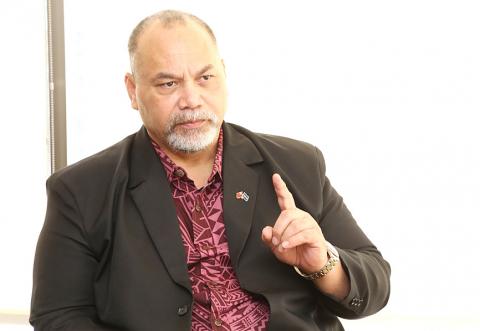
Photo: CNA
“When you start using words like family, it takes it up to a different level, a level that ensures that when things happen within family, family sticks together,” Aingimea said in an interview with the Central News Agency.
He said that Nauru-Taiwan relations are not limited to development, but also include a personal element, citing as an example Nauruans who study in Taiwan and take Taiwanese culture and customs with them when they return home.
He also enumerated Taiwan’s assistance to Nauru in education, police matters, agriculture, fisheries and renewable energy, as well as Taiwan’s contribution to the Intergenerational Trust Fund established in 2015 by several regional partners.
China has not attempted to pressure Nauru to switch diplomatic relations, probably because Beijing knows Nauru’s political stance and realizes that it would be a wasted effort to approach Nauru on that issue, Aingimea said.
“We are concerned about China’s increased presence in the Pacific. We reject the ‘one China’ principle and the ‘one country, two systems’ framework, and recognize that Taiwan is a sovereign and independent nation,” he said.
Aingimea welcomed a proposal by Tuvaluan Minister for Justice, Communication and Foreign Affairs Simon Kofe, who visited Taiwan last month, to form a coalition that supports Taiwan against China’s suppression.
Australia and New Zealand have taken steps to counter China’s expansionist strategy in the South Pacific, with initiatives such as “Pacific Step-up” and “Pacific Reset,” while the US is to hold a meeting with its allies next year for relevant discussions, Aingimea said.
To counter China’s dollar diplomacy, the three traditional partners also increased assistance to Nauru, Aingimea said, adding that there are no Beijing-funded infrastructure projects in Nauru.
However, a new port is being constructed in the country by a Chinese company, he said, adding it is an Asian Development Bank project and the Chinese company won the bid.
Nauru would need Taiwan’s expertise to operate the port when it is completed, so its economy can diversify from its heavy reliance on fishing and phosphate mining, Aingimea said.

Yangmingshan National Park authorities yesterday urged visitors to respect public spaces and obey the law after a couple was caught on a camera livestream having sex at the park’s Qingtiangang (擎天崗) earlier in the day. The Shilin Police Precinct in Taipei said it has identified a suspect and his vehicle registration number, and would summon him for questioning. The case would be handled in accordance with public indecency charges, it added. The couple entered the park at about 11pm on Thursday and began fooling around by 1am yesterday, the police said, adding that the two were unaware of the park’s all-day live

Fast food chain McDonald's is to raise prices by up to NT$5 on some products at its restaurants across Taiwan, starting on Wednesday next week, the company announced today. The prices of all extra value meals and sharing boxes are to increase by NT$5, while breakfast combos and creamy corn soup would go up by NT$3, the company said in a statement. The price of the main items of those meals, if ordered individually, would remain the same. Meanwhile, the price of a medium-sized lemon iced tea and hot cappuccino would rise by NT$3, extra dipping sauces for chicken nuggets would go up

Yangmingshan National Park’s Qingtiangang (擎天崗) nature area has gone viral after a park livestream camera observed a couple in the throes of intimate congress, which was broadcast live on YouTube, drawing large late-night crowds and sparking a backlash over noise, bright lights and disruption to wildlife habitat. The area’s livestream footage appeared to show a couple engaging in sexual activity on a picnic table in the park on Friday last week, with the uncensored footage streamed publicly online. The footage quickly spread across social media, prompting a tide of visitors to travel to the site to “check in” and recreate the

Minister of Digital Affairs Lin Yi-ching (林宜敬) yesterday cited regulatory issues and national security concerns as an expert said that Taiwan is among the few Asian regions without Starlink. Lin made the remarks on Facebook after funP Innovation Group chief executive officer Nathan Chiu (邱繼弘) on Friday said Taiwan and four other countries in Asia — China, North Korea, Afghanistan and Syria — have no access to Starlink. Starlink has become available in 166 countries worldwide, including Ukraine, Malaysia, the Philippines and Vietnam, in the six years since it became commercial, he said. While China and North Korea block Starlink, Syria is not


 RSS
RSS