


Malignant tumors are still the leading cause of death in Taiwan, affecting average life expectancy by nearly four years, Ministry of the Interior statistics showed.
Last year, the average life expectancy in Taiwan was 80.69 years. It increased by 3.94 years after excluding deaths caused by malignant tumors and 1.69 years after excluding deaths caused by heart disease, information released by the ministry on Wednesday showed.
Malignant tumors have been the leading cause of death in Taiwan for the past 37 years, while heart disease has been the second for the past 11 years, the ministry said.
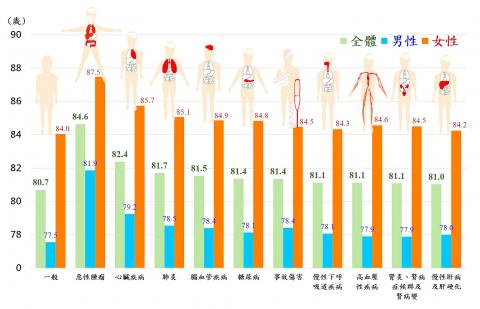
Graphic courtesy of the Ministry of the Interior
If average life expectancy increases greatly after a cause of death is eliminated, then that cause plays a major role in the number of deaths, the ministry said.
The number of lives claimed by malignant tumors has increased every year for 10 years, accounting for more than 27 percent of all deaths over the same period, the ministry said, adding that smoking, a poor diet, work stress and a person’s living environment can cause malignant tumors.
However, the effect of malignant tumors on average life expectancy dropped from 4.19 years in 2013, showing that prevention measures adopted by authorities in the past few years have been effective, the ministry said.
Pneumonia was the third leading cause of death in Taiwan last year, the ministry said, adding that the number of deaths and the percentage of total deaths attributable to pneumonia have risen every year for the past five years.
The effect of pneumonia on average life expectancy increased from 0.79 years in 2011 to 1.02 years last year, showing that the government should continue to prioritize pneumonia prevention, it said.
Some causes of death affect men more than women, including malignant tumors, cerebrovascular diseases, unintentional injuries, chronic lower respiratory diseases, chronic pulmonary diseases and cirrhosis, while women are more affected by diabetes, hypertensive diseases and kidney diseases, the ministry said.
Factors that contribute to the differences between women and men might include occupation, physiology, diet and stress, the ministry said.

LOUD AND PROUD Taiwan might have taken a drubbing against Australia and Japan, but you might not know it from the enthusiasm and numbers of the fans Taiwan might not be expected to win the World Baseball Classic (WBC) but their fans are making their presence felt in Tokyo, with tens of thousands decked out in the team’s blue, blowing horns and singing songs. Taiwanese fans have packed out the Tokyo Dome for all three of their games so far and even threatened to drown out home team supporters when their team played Japan on Friday. They blew trumpets, chanted for their favorite players and had their own cheerleading squad who dance on a stage during the game. The team struggled to match that exuberance on the field, with
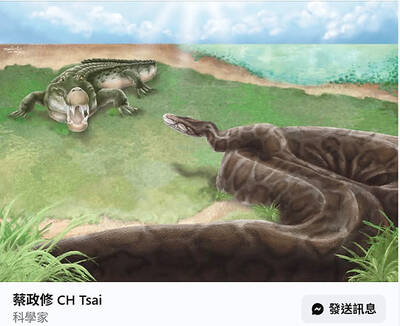
Taiwanese paleontologists have discovered fossil evidence that pythons up to 4m long inhabited Taiwan during the Pleistocene epoch, reporting their findings in the international scientific journal Historical Biology. National Taiwan University (NTU) Institute of Ecology and Evolutionary Biology associate professor Tsai Cheng-hsiu (蔡政修) led the team that discovered the largest snake fossil ever found in Taiwan. The single trunk vertebra was discovered in Tainan at the Chiting Formation, dated to between 400,000 and 800,000 years ago in the Middle Pleistocene, the paper said. The area also produced Taiwan’s first avian fossil, as well as crocodile, mammoth, saber-toothed cat and rhinoceros fossils, it said. Discoveries

Taiwanese paleontologists have discovered fossil evidence that pythons up to 4m long inhabited Taiwan during the Pleistocene epoch, reporting their findings in the international scientific journal Historical Biology. National Taiwan University (NTU) Institute of Ecology and Evolutionary Biology associate professor Tsai Cheng-hsiu (蔡政修) led the team that discovered the largest snake fossil ever found in Taiwan. A single trunk vertebra was discovered in Tainan at the Chiting Formation, dated to between 800,000 to 400,000 years ago in the Middle Pleistocene, the paper said. The area also produced Taiwan’s first avian fossil, as well as crocodile, mammoth, sabre-toothed cat and rhinoceros fossils, it said. Discoveries

Whether Japan would help defend Taiwan in case of a cross-strait conflict would depend on the US and the extent to which Japan would be allowed to act under the US-Japan Security Treaty, former Japanese minister of defense Satoshi Morimoto said. As China has not given up on the idea of invading Taiwan by force, to what extent Japan could support US military action would hinge on Washington’s intention and its negotiation with Tokyo, Morimoto said in an interview with the Liberty Times (sister paper of the Taipei Times) yesterday. There has to be sufficient mutual recognition of how Japan could provide


 RSS
RSS