


A data buoy for weather and sea observations deployed by Taiwanese researchers was vandalized by unknown individuals, with the estimated losses of Taiwanese and US instruments reaching millions of New Taiwan dollars, National Taiwan University’s Institute of Oceanography said yesterday.
A team at the institute in 2015 started deploying two buoys (named NTU1 and NTU2) in waters 375km and 175km off the coast of Oluanpi (鵝鑾鼻) for collecting in-situ data of air and sea conditions to improve typhoon forecasts, institute associate professor Yang Yiing-jang (楊穎堅) said.
The buoys have resisted 14 typhoons, thanks to their solid anchoring 5.5km below the surface, he said.
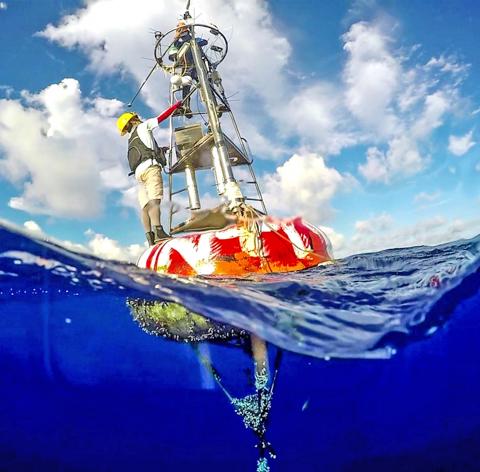
Photo courtesy of National Taiwan University’s Institute of Oceanography
However, the team last month found the NTU1 buoy had unexpectedly drifted away from its position, and they immediately convened members to board Ocean Researcher I to look for it, he said.
They first retrieved the buoy’s surface floating base and meteorological tower in waters near the contiguous zone of the Philippines, while the buoy was found cut off from the 6m part of its underwater cable, he said.
The cut was neat and likely to have been done by some mechanical cutter, instead of being pulled off by force, he added.
In a second mission, the team on Wednesday reached the buoy’s original position and used an acoustic transponder to locate its underwater instruments, but nothing more was recovered, Yang said.
They had to suspend the mission due to high seas caused by the approaching Typhoon Hagibis, he added.
Attached to the NTU1 buoy’s underwater cable are instruments belonging to the institute, the Central Weather Bureau (CWB) and their collaborators at Oregon State University, Yang said, estimating the financial losses amount to millions of NT dollars.
They are more concerned about losing valuable data, as US turbulence probes had collected unprecedented data near the centers of the eyes of several typhoons, but they were set at a self-recording mode, instead of a real-time transmitting mode, he said.
Despite the setbacks, the team would seek to recover the underwater instruments again, possibly with the help of high-resolution sonar systems, he said.
While it is the first time the team encountered such a mishap, similar incidents have been reported in different corners of the world, while buoys deployed remotely from populated land areas are less likely to be wrecked, he said, adding that their NTU2 buoy remains intact.
They still do not know the real perpetrator, but continue working with the government to communicate with local seafarers and fishers, he said.
Such vandalism can be said to harm others without benefiting oneself, as perpetrators might endanger their own safety, institute director Jan Sen (詹森) said.
However, it is part of the risks that oceanographers have to face, Jan said, adding that the institute continues supporting such altruistic monitoring missions of typhoons using the buoys.
Yang, Jan and CWB officials next week are to visit the National Data Buoy Center and the Pacific Marine Environmental Laboratory at the US National Oceanic and Atmospheric Administration, hoping to gather more advice for preventing buoy vandalism, they said.

China might accelerate its strategic actions toward Taiwan, the South China Sea and across the first island chain, after the US officially entered a military conflict with Iran, as Beijing would perceive Washington as incapable of fighting a two-front war, a military expert said yesterday. The US’ ongoing conflict with Iran is not merely an act of retaliation or a “delaying tactic,” but a strategic military campaign aimed at dismantling Tehran’s nuclear capabilities and reshaping the regional order in the Middle East, said National Defense University distinguished adjunct lecturer Holmes Liao (廖宏祥), former McDonnell Douglas Aerospace representative in Taiwan. If

TO BE APPEALED: The environment ministry said coal reduction goals had to be reached within two months, which was against the principle of legitimate expectation The Taipei High Administrative Court on Thursday ruled in favor of the Taichung Environmental Protection Bureau in its administrative litigation against the Ministry of Environment for the rescission of a NT$18 million fine (US$609,570) imposed by the bureau on the Taichung Power Plant in 2019 for alleged excess coal power generation. The bureau in November 2019 revised what it said was a “slip of the pen” in the text of the operating permit granted to the plant — which is run by Taiwan Power Co (Taipower) — in October 2017. The permit originally read: “reduce coal use by 40 percent from Jan.
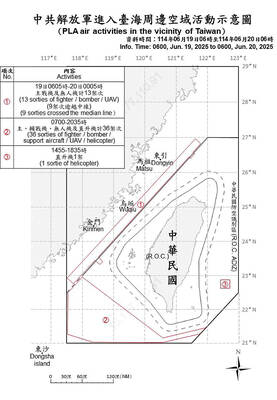
‘SPEY’ REACTION: Beijing said its Eastern Theater Command ‘organized troops to monitor and guard the entire process’ of a Taiwan Strait transit China sent 74 warplanes toward Taiwan between late Thursday and early yesterday, 61 of which crossed the median line in the Taiwan Strait. It was not clear why so many planes were scrambled, said the Ministry of National Defense, which tabulated the flights. The aircraft were sent in two separate tranches, the ministry said. The Ministry of Foreign Affairs on Thursday “confirmed and welcomed” a transit by the British Royal Navy’s HMS Spey, a River-class offshore patrol vessel, through the Taiwan Strait a day earlier. The ship’s transit “once again [reaffirmed the Strait’s] status as international waters,” the foreign ministry said. “Such transits by

Taiwan is doing everything it can to prevent a military conflict with China, including building up asymmetric defense capabilities and fortifying public resilience, Vice President Hsiao Bi-khim (蕭美琴) said in a recent interview. “Everything we are doing is to prevent a conflict from happening, whether it is 2027 or before that or beyond that,” Hsiao told American podcaster Shawn Ryan of the Shawn Ryan Show. She was referring to a timeline cited by several US military and intelligence officials, who said Chinese President Xi Jinping (習近平) had instructed the Chinese People’s Liberation Army to be ready to take military action against Taiwan


 RSS
RSS