


Octogenarians Chan Jui-tung (詹瑞東) and Han Shui-chin (韓水金) marked their 60th wedding anniversary in Taipei on Sunday, making up for the ceremony they did not have in 1958 due to cross-strait military conflict.
The ceremony was attended by their four children, two sons and two daughters, their grandchildren, friends, Taipei Mayor Ko Wen-je (柯文哲) and workers at the Hondao Senior Citizens Welfare Foundation.
Chan said he met his wife when he was a young soldier based in Kaohsiung and called their meeting love at first sight, but only for him.
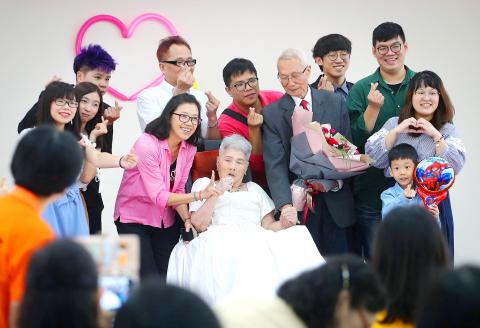
Photo: CNA
“I was quite popular with the ladies and I had an easy time getting girlfriends,” he said. “However, Han did not initially care for me, so I had to pull out all the stops for a year until she said yes.”
Their plans for a large wedding were interrupted when Chinese guns bombarded Kinmen County, which triggered the Second Taiwan Strait Crisis and prompted the army to send him to the front, he said.
For a month, Taiwanese and Chinese forces engaged in gunnery duels, aerial skirmishes and one naval action off the coast of Dongding Island (東碇島). After the main battles ended, the two sides fired symbolic barrages at each other until 1979.
During his military service, Han kept the house, raised the children, managed the family savings account and worked part-time to supplement the family income, Chan said.
“She is a very traditional woman to the point that she would not eat until the children and I finished,” he said, adding: “Thinking back on it, I feel very bad.”
After a traffic accident in 1998 left Han paralyzed in her lower body, Chan cared for her at their home for the next five years until he was no longer able due to his age, so she entered a nursing home, where he visits her every day.
“My body is not what it used to be and I wanted to do something for my wife while I still can,” he said. “We have been married for more than 60 years and I want to make her the beautiful bride that she wanted to be.”
“Mr Chan is a very gentle soul and he came every day to apply medicine to treat Mrs Chan’s nail infection,” a foundation member said. “He told us that his greatest wish is to have a big wedding for his wife.”
“Encouraging elderly people to chase their dreams creates opportunities for self-affirmation,” foundation official Chiu Tzu-ting (邱子庭) said. “They do not need to see age and loss of physicality limit their potential.”

Yangmingshan National Park authorities yesterday urged visitors to respect public spaces and obey the law after a couple was caught on a camera livestream having sex at the park’s Qingtiangang (擎天崗) earlier in the day. The Shilin Police Precinct in Taipei said it has identified a suspect and his vehicle registration number, and would summon him for questioning. The case would be handled in accordance with public indecency charges, it added. The couple entered the park at about 11pm on Thursday and began fooling around by 1am yesterday, the police said, adding that the two were unaware of the park’s all-day live

Yangmingshan National Park’s Qingtiangang (擎天崗) nature area has gone viral after a park livestream camera observed a couple in the throes of intimate congress, which was broadcast live on YouTube, drawing large late-night crowds and sparking a backlash over noise, bright lights and disruption to wildlife habitat. The area’s livestream footage appeared to show a couple engaging in sexual activity on a picnic table in the park on Friday last week, with the uncensored footage streamed publicly online. The footage quickly spread across social media, prompting a tide of visitors to travel to the site to “check in” and recreate the

A former soldier and an active-duty army officer were yesterday indicted for allegedly selling classified military training materials to a Chinese intelligence operative for a total of NT$79,440. The Taipei District Prosecutors’ Office indicted Chen Tai-yin (陳泰尹) and Lee Chun-ta (李俊達) for contravening the National Security Act (國家安全法) and the Anti-Corruption Act (貪污治罪條例). Chen left the military in September 2013 after serving alongside then-staff sergeant Lee, now an army lieutenant, at the 21st Artillery Command of the army’s Sixth Corps from 2011 to 2013, according to the indictment. Chen met a Chinese intelligence operative identified as “Wang” (王) through a friend in November

Minister of Digital Affairs Lin Yi-ching (林宜敬) yesterday cited regulatory issues and national security concerns as an expert said that Taiwan is among the few Asian regions without Starlink. Lin made the remarks on Facebook after funP Innovation Group chief executive officer Nathan Chiu (邱繼弘) on Friday said Taiwan and four other countries in Asia — China, North Korea, Afghanistan and Syria — have no access to Starlink. Starlink has become available in 166 countries worldwide, including Ukraine, Malaysia, the Philippines and Vietnam, in the six years since it became commercial, he said. While China and North Korea block Starlink, Syria is not


 RSS
RSS