


The Taipei District Court on Saturday acquitted a man who was charged after burning the Republic of China (ROC) flag on the grounds that his act was a form of constitutionally protected speech.
Lee Chia-yu (李嘉宇) was accused by the Taipei District Prosecutors’ Office of inciting others to contravene Article 118 of the Criminal Code, which prohibits destroying, damaging or pulling down the national flag or emblem in public for the purpose of insulting the nation, the court said.
The flag-burning occurred during a march on the evening of Feb. 27 last year near the Legislative Yuan in Taipei, the court said, adding that the pro-independence Alliance of Referendum for Taiwan and the 908 Taiwan Republic Campaign organized the event to commemorate the 228 Incident.
The 228 Incident refers to protesters being shot by security personnel on Feb. 28, 1949, initiating a series of government crackdowns that marked the beginning of the White Terror era.
Allegedly, Lee told the crowd to light a flag on fire at 9:47pm and another unidentified man provided the demonstrators with a flag that had been prepared for that purpose, the court said.
Lee denied the charges and told the court that the prosecutors had failed to prove that the burned object was actually the ROC flag, or that he intended to insult the nation, the court said.
The court quoted Lee as saying that his intent was to demonstrate that the ROC is not the nation of the Taiwanese, who should create their own state by declaring Taiwan’s independence.
While the court rejected Lee’s assertions that no actual flag was burned, he clearly stated to the court that the burning was a symbolic expression of a political view, which is deemed a highly protected class of speech by the constitution, the presiding judge wrote in the ruling.
The verdict is not final and the case could be retried in a higher court.
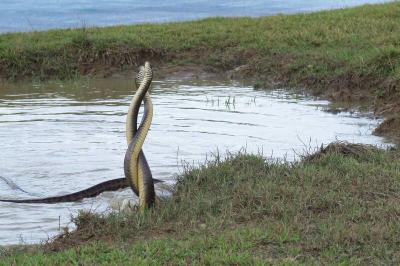
Kenting National Park service technician Yang Jien-fon (楊政峰) won a silver award in World Grand Prix Photography Awards Spring Season for his photograph of two male rat snakes intertwined in combat. Yang’s colleagues at Kenting National Park said he is a master of nature photography who has been held back by his job in civil service. The awards accept entries in all four seasons across six categories: architectural and urban photography, black-and-white and fine art photography, commercial and fashion photography, documentary and people photography, nature and experimental photography, and mobile photography. Awards are ranked according to scores and divided into platinum, gold and

More than half of the bamboo vipers captured in Tainan in the past few years were found in the city’s Sinhua District (新化), while other districts had smaller catches or none at all. Every year, Tainan captures about 6,000 snakes which have made their way into people’s homes. Of the six major venomous snakes in Taiwan, the cobra, the many-banded krait, the brown-spotted pit viper and the bamboo viper are the most frequently captured. The high concentration of bamboo vipers captured in Sinhua District is puzzling. Tainan Agriculture Bureau Forestry and Nature Conservation Division head Chu Chien-ming (朱健明) earlier this week said that the

The Chinese Nationalist Party (KMT) caucus yesterday said it opposes the introduction of migrant workers from India until a mechanism is in place to prevent workers from absconding. Minister of Labor Hung Sun-han (洪申翰) on Thursday told the Legislative Yuan that the first group of migrant workers from India could be introduced as early as this year, as part of a government program. The caucus’ opposition to the policy is based on the assessment that “the risk is too high,” KMT caucus secretary-general Lin Pei-hsiang (林沛祥) said. Taiwan has a serious and long-standing problem of migrant workers absconding from their contracts, indicating that

TRADE-OFF: Beijing seeks to trade a bowl of tempura for a Chinese delicacy, an official said, while another said its promises were attempts to interfere in the polls The government must carefully consider the national security implications of building a bridge connecting Kinmen County and Xiamen, China, the Public Construction Commission (PCC) said yesterday. PCC Commissioner Derek Chen (陳金德), who is also a minister without portfolio, made the remarks in a meeting of the legislature’s Transportation Committee, after Democratic Progressive Party Legislator Hsu Fu-kuei (徐富癸) asked about China’s proposal of new infrastructure projects to further connect Kinmen and Lienchiang (Matsu) counties with Xiamen. China unveiled the bridge plan, along with nine other policies for Taiwan, on Sunday, the last day of Chinese Nationalist Party (KMT) Chairwoman Cheng Li-wun’s (鄭麗文) visit


 RSS
RSS