


Police officers deployed at train stations and on trains have been equipped with pepper spray and bulletproof vests, and are working in teams after one of their colleagues was killed by a train passenger on Wednesday.
The measures were put in place after 24-year-old railway police officer Lee Cheng-han (李承翰) was stabbed on a northbound train at Chiayi Station at 8:42pm on Wednesday while responding to a quarrel between a passenger and a conductor.
The alleged attacker, surnamed Cheng (鄭), was found to be riding without a ticket. Following the incident, he was subdued by other passengers.
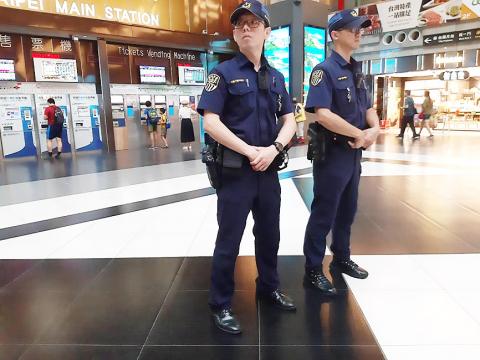
Photo: Copied by Liu Ching-hou, Taipei Times
Lee died in a hospital at 8:37am on Thursday.
Coroners said that a knife had punctured Lee’s liver, leaving a 5cm laceration on a 10cm deep wound.
Lee died of massive blood loss, as the knife had severed major arteries in his abdomen, coroners said.
The National Policy Agency deployed an additional 120 officers from its special forces to support the Taipei, Taichung and Kaohsiung police bureaus to ensure safety at train stations and on trains, the Railway Police Bureau said yesterday.
Officers are to wear bulletproof vests and patrol in pairs during peak travel times and between 8pm and 10pm, when many workers are headed home, it said.
They are to carry pepper spray and two officers will respond to any situation at all hours of the day, it said.
The agency also plans to procure stun guns to make it easier for officers to enforce the law, it said.
Separately yesterday, Chiayi head prosecutor Tsai Ying-chun (蔡英俊) said that 54-year-old Cheng faces charges of murder and obstruction of a police officer.
Investigators said that there were elements of premeditation, as surveillance footage showed Cheng entering a supermarket where he purchased two small knives before heading to Tainan Railway Station and boarding the northbound train on Wednesday evening.
“Cheng said he was upset about some issues and planned to take the train to Taipei to protest outside the Presidential Office Building, but later he changed his story, saying he wanted to hold a news conference in Taipei,” Tsai said.
Cheng first claimed that he had planned the killing, but later said the confrontation with the conductor and Lee was a spur-of-the-moment act, and Lee’s death was an accident, Tsai said.
As Cheng had given contradictory statements and his wife provided information that did not align with other aspects of his story, arrangements were made to question Cheng further, while investigators are collecting information and interviewing people with knowledge of the case, Tsai said.
Cheng’s wife told investigators that her husband has had depression for years and has been under financial strain due to being unable to collect payments from customers in his work as an electrician and air-conditioner installer.
However, media quoted the couple’s neighbors as saying that Cheng was depressed and had mood swings because he lost a lot of money on bad investments.
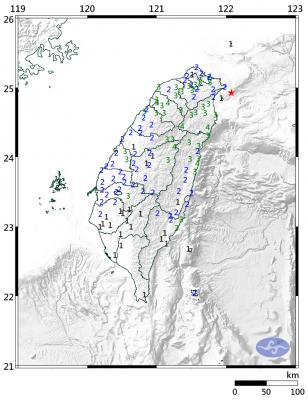
A magnitude 6.1 earthquake struck off the coast of Yilan County at 8:39pm tonight, the Central Weather Administration (CWA) said, with no immediate reports of damage or injuries. The epicenter was 38.7km east-northeast of Yilan County Hall at a focal depth of 98.3km, the CWA’s Seismological Center said. The quake’s maximum intensity, which gauges the actual physical effect of a seismic event, was a level 4 on Taiwan’s 7-tier intensity scale, the center said. That intensity level was recorded in Yilan County’s Nanao Township (南澳), Hsinchu County’s Guansi Township (關西), Nantou County’s Hehuanshan (合歡山) and Hualien County’s Yanliao (鹽寮). An intensity of 3 was
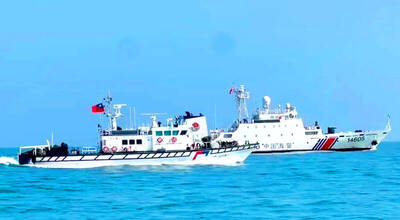
Instead of focusing solely on the threat of a full-scale military invasion, the US and its allies must prepare for a potential Chinese “quarantine” of Taiwan enforced through customs inspections, Stanford University Hoover fellow Eyck Freymann said in a Foreign Affairs article published on Wednesday. China could use various “gray zone” tactics in “reconfiguring the regional and ultimately the global economic order without a war,” said Freymann, who is also a nonresident research fellow at the US Naval War College. China might seize control of Taiwan’s links to the outside world by requiring all flights and ships entering or leaving Taiwan

The next minimum wage hike is expected to exceed NT$30,000, President William Lai (賴清德) said yesterday during an award ceremony honoring “model workers,” including migrant workers, at the Presidential Office ahead of Workers’ Day today. Lai said he wished to thank the awardees on behalf of the nation and extend his most sincere respect for their hard work, on which Taiwan’s prosperity has been built. Lai specifically thanked 10 migrant workers selected for the award, saying that although they left their home countries to further their own goals, their efforts have benefited Taiwan as well. The nation’s industrial sector and small businesses lay
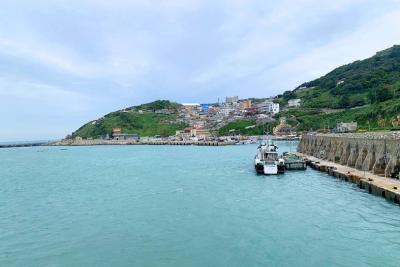
Taiwan has activated backup communications for its northernmost territory, the remote and strategically located island of Dongyin (東引), after poor weather conditions apparently shifted the wreckage of a ship onto an undersea cable causing it to break. The vulnerability of undersea communication cables linking Taiwan with its outlying islands has been a persistent cause of concern for Taipei, whose government has on several occasions blamed Chinese ships for intentionally causing damage. Dongyin, home to about 1,500 people, sits in a strategic position at the top of the Taiwan Strait and the island has a heavy military presence. It does not have an


 RSS
RSS