


Environmentalists have voiced concern about the growing numbers of banded bullfrogs (Kaloula pulchra pulchra) in Taiwan, saying that the amphibians could constrain the living spaces of indigenous frog species.
The banded bullfrog can secrete toxins from its body as a defense mechanism and not even wild snakes would find it palatable, frog expert Chuang Meng-shien (莊孟憲) said, adding that the frog’s population has been growing, as it has virtually no natural enemies.
The only solution is to manually remove them, one small area at a time, Chuang said.
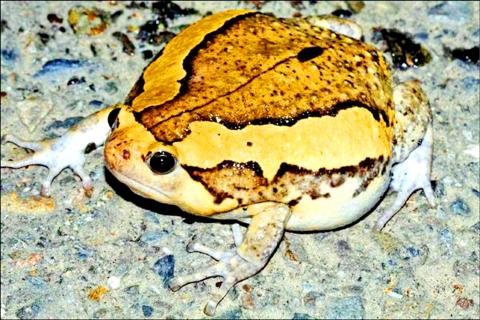
Photo courtesy of Chuang Sheng-kai
A volunteer environmentalist surnamed Lin (林) reported the presence of banded bullfrogs in the planned South Tainan Urban Central city development zone as well as Barclay Memorial Park, adding that there was a significant presence.
The planned zone of about 110 hectares would develop the southern part of Tainan, where development has been concentrated in the north.
Lin said he had never heard banded bullfrogs in the area for the proposed zone until recently, adding that he can now hear them croak whenever it rains.
Tainan Community College researcher Wu Jen-pang (吳仁邦) confirmed that the frogs have been spreading, saying that he has also found banded bullfrogs at a conservatory for the farmland green treefrog (Rhacophorus arvalis) in Yongkang District (永康).
Chuang said the first banded bullfrog was found in Kaohsiung’s Linyuan (林園) area more than 20 years ago, adding that the amphibians have slowly been spreading in the Kaohsiung and Pingtung areas.
The frog was first sighted in the Tainan area in 2005, in the Guanmiao (關廟) area, he said.
Chuang said that banded bullfrogs have been spotted near the Taijiang Cultural Center, adding that sightings have also been reported in Yunlin and Chiayi counties.
The frog feeds primarily on ants and other insects, which could affect the food sources of the ornate narrow-mouthed toad (Microhyla ornate) and other toads, Chuang said.
The tendency of the banded bullfrog to burrow underground during dry spells can lead to its rapid spread as humans move plants, he said.
Chuang said that some volunteers have been combing the conservatory in Yongkang for the banded bullfrogs and removing them.

Considering that most countries issue more than five denominations of banknotes, the central bank has decided to redesign all five denominations, the bank said as it prepares for the first major overhaul of the banknotes in more than 24 years. Central bank Governor Yang Chin-lung (楊金龍) is expected to report to the Legislative Yuan today on the bank’s operations and the redesign’s progress. The bank in a report sent to the legislature ahead of today’s meeting said it had commissioned a survey on the public’s preferences. Survey results showed that NT$100 and NT$1,000 banknotes are the most commonly used, while NT$200 and NT$2,000

The Centers for Disease Control (CDC) yesterday reported the first case of a new COVID-19 subvariant — BA.3.2 — in a 10-year-old Singaporean girl who had a fever upon arrival in Taiwan and tested positive for the disease. The girl left Taiwan on March 20 and the case did not have a direct impact on the local community, it said. The WHO added the BA.3.2 strain to its list of Variants Under Monitoring in December last year, but this was the first imported case of the COVID-19 variant in Taiwan, CDC Deputy Director-General Lin Ming-cheng (林明誠) said. The girl arrived in Taiwan on

South Korea is planning to revise its controversial electronic arrival card, a step Taiwanese officials said prompted them to hold off on planned retaliatory measures, a South Korean media report said yesterday. A Yonhap News Agency report said that the South Korean Ministry of Foreign Affairs is planning to remove the “previous departure place” and “next destination” fields from its e-arrival card system. The plan, reached after interagency consultations, is under review and aims to simplify entry procedures and align the electronic form with the paper version, a South Korean ministry official said. The fields — which appeared only on the electronic form

The Ministry of Foreign Affairs (MOFA) is suspending retaliation measures against South Korea that were set to take effect tomorrow, after Seoul said it is updating its e-arrival system, MOFA said today. The measures were to be a new round of retaliation after Taiwan on March 1 changed South Korea's designation on government-issued alien resident certificates held by South Korean nationals to "South Korea” from the "Republic of Korea," the country’s official name. The move came after months of protests to Seoul over its listing of Taiwan as "China (Taiwan)" in dropdown menus on its new online immigration entry system. MOFA last week


 RSS
RSS