


The Republic of China (ROC) Military Academy’s Kaohsiung base yesterday held a parade to celebrate its 95th anniversary.
The parade, presided over by Minister of National Defense Yen De-fa (嚴德發), opened with flybys by army helicopters, including OH-58D scout helicopters, AH-1W Super Cobras, AH-64E Apaches and UH-60M Black Hawks.
The navy’s CH-47SD Chinook transport helicopters and S-70C helicopters and the air force’s Thunder Tiger Aerobatics Team in AT-3 jet trainers also took part in the celebration.
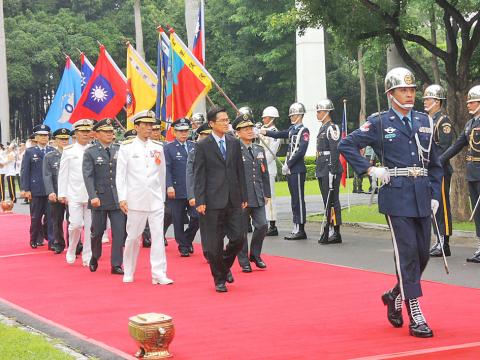
Photo: Tsai Ching-hua, Taipei Times
Soldiers from the army’s 333rd Mechanized Infantry Brigade and cadets from army, air force and navy academies paraded on the ground.
The brigade was chosen for the parade because its predecessor was one of the founding units of the Whampoa Military Academy, which preceded the ROC Military Academy, the ministry said.
The Whampoa Military Academy was established by the then-Chinese Nationalist Party (KMT) government in China’s Guangzhou Province on June 6, 1924, to build a modern military.
Following the Chinese Civil War, the academy in 1949 relocated to Kaohsiung and was renamed the ROC Military Academy.
The ceremony was attended by Kaohsiung Mayor Han Kuo-yu (韓國瑜), a graduate of the academy.
Han, who is seeking the KMT’s presidential nomination, said he was excited to attend the event as a graduate and as mayor of the host city.
Meanwhile, in Taipei, three other KMT presidential candidates — Hon Hai Precision Industry Co chairman Terry Gou (郭台銘), former Taipei county commissioner Chou Hsi-wei (周錫瑋) and National Taiwan University professor Chang Ya-chung (張亞中) — and KMT Chairman Wu Den-yih (吳敦義) attended a banquet organized by academy alumni to celebrate the anniversary.
Former New Taipei mayor Eric Chu (朱立倫), who is also vying for the party’s nomination, did not participate in any of the anniversary activities.
President Tsai Ing-wen (蔡英文) also did not participate in this year’s celebrations. She presided over the academy’s 92nd anniversary celebrations in 2016.
Beijing could eventually see a full amphibious invasion of Taiwan as the only "prudent" way to bring about unification, the US Department of Defense said in a newly released annual report to Congress. The Pentagon's "Annual Report to Congress: Military and Security Developments Involving the People's Republic of China 2025," was in many ways similar to last year’s report but reorganized the analysis of the options China has to take over Taiwan. Generally, according to the report, Chinese leaders view the People's Liberation Army's (PLA) capabilities for a Taiwan campaign as improving, but they remain uncertain about its readiness to successfully seize

Taiwan is getting a day off on Christmas for the first time in 25 years. The change comes after opposition parties passed a law earlier this year to add or restore five public holidays, including Constitution Day, which falls on today, Dec. 25. The day marks the 1947 adoption of the constitution of the Republic of China, as the government in Taipei is formally known. Back then the Chinese Nationalist Party (KMT) governed China from Nanjing. When the KMT, now an opposition party in Taiwan, passed the legislation on holidays, it said that they would help “commemorate the history of national development.” That

Taiwan has overtaken South Korea this year in per capita income for the first time in 23 years, IMF data showed. Per capita income is a nation’s GDP divided by the total population, used to compare average wealth levels across countries. Taiwan also beat Japan this year on per capita income, after surpassing it for the first time last year, US magazine Newsweek reported yesterday. Across Asia, Taiwan ranked fourth for per capita income at US$37,827 this year due to sustained economic growth, the report said. In the top three spots were Singapore, Macau and Hong Kong, it said. South

Snow fell on Yushan (Jade Mountain, 玉山) yesterday morning as a continental cold air mass sent temperatures below freezing on Taiwan’s tallest peak, the Central Weather Administration (CWA) said. Snowflakes were seen on Yushan’s north peak from 6:28am to 6:38am, but they did not fully cover the ground and no accumulation was recorded, the CWA said. As of 7:42am, the lowest temperature recorded across Taiwan was minus-5.5°C at Yushan’s Fengkou observatory and minus-4.7°C at the Yushan observatory, CWA data showed. On Hehuanshan (合歡山) in Nantou County, a low of 1.3°C was recorded at 6:39pm, when ice pellets fell at Songsyue Lodge (松雪樓), a


 RSS
RSS