


A Ministry of Transportation and Communications proposal to build a high-speed rail extension line connecting Taipei and Yilan has drawn criticism from transportation experts, with some saying it should be the last resort to ease holiday traffic jams on the Chiang Wei-shui Memorial Freeway (Freeway No. 5).
Minister of Transportation and Communications Lin Chia-lung (林佳龍) announced the proposal when he was visiting Yilan on Tuesday.
On Wednesday, he confirmed that the ministry has begun to assess the possibility of building the extension.
The ministry’s Railway Bureau had also started a study on the feasibility of building a railway line that goes straight from Taipei to Yilan, which would be different from the existing one which passes through the northeast coast.
The bureau has identified two possible corridors for a new Taipei-Yilan line, with the ministry and Yilan residents favoring the first one, which is shorter than the second one by about 17km and would cut travel time to 37 minutes.
Lin said that this option would be subject to change, as it still needs to be approved by the environmental assessment committee.
The option for first route was rejected by the environmental assessment committee in 2006, but the ministry can resubmit the proposal after making adjustments to the construction plan.
The Taipei Feitsui Reservoir Administration had also opposed construction of the first route, saying that the reservoir had already gone through the “dark ages” for 19 years when the Beiyi Highway and Huehshan Tunnel were being built.
The ministry’s proposal for the high-speed rail extension, on top of the proposed direct railway link, has met with criticism from experts.
“The ministry would have a hard time convincing members of the environmental assessment committee to approve a project that would build a straight railway line between Taipei and Yilan, as the route would pass through the Feitsui Reservoir and geologically fragile zones,” Central Police University adjunct associate professor Kurt Lee (李克聰) said. “Now it is even proposing to build a high-speed rail extension, which would bring greater environmental damage and pose bigger construction risks.”
The ministry should see if it has done everything it could to improve the traffic in Yilan through traffic management measures before it starts talking about building new transportation infrastructure, Lee said.
Even if the construction is inevitable, priority should be given to highway or railway constructions, he said, adding that a high-speed rail extension should be the last resort.
Former minister of transportation and communications Hochen Tan (賀陳旦) said that the govenrment must first gauge if there is demand for such a railway service, or the system would be left unused most of the time.
“Whether it is a high-speed rail extension or a direct railway link operated by the TRA [Taiwan Railways Administration], commuters would have to transfer to a different transport system once they arrive in Yilan,” Hochen said.
“The ministry should not only assess the difficulties of different types of construction; it should also conduct an analysis on demand, including examining peak-hour and off-peak-hour traffic volume and resolving parking problems,” he added.
It would be more meaningful to use part of the designated construction fund to improve the public transfer system and offer parking information, he said.

REASONS FOR TRAVEL: An assistant professor said that proposed amendments to penalize drivers if they used drugs overseas would not deter people from traveling People who operate a motor vehicle under the influence of marijuana would have their driver’s license revoked, even if they used the substance while overseas, the Ministry of Transportation and Communications said yesterday, citing proposed amendments to the Road Traffic Management and Penalty Act (道路交通管理處罰條例). The amendments would also authorize the government to revoke the licenses of people determined to have used Category 1 or Category 2 narcotics, even if they were not operating a vehicle while under the influence of drugs, as well as ban them from taking the license test for three years, the ministry said. People aged 18 or

GLOBALGIVING: ‘ Caving to external pressure is not acceptable for an organization that has cultivated justice reform and human rights for 30 years,’ one NGO said A slew of non-government organizations (NGOs) have withdrawn from the GlobalGiving fundraising platform after it announced it would use “Chinese Taipei” instead of “Taiwan” from next month. The Taiwan Good Rice Association wrote on Facebook on Friday that it was informed on April 28 via a teleconference call of the change, which was made because the platform wanted to operate in China. Taiwan Good Rice is to terminate all cooperative relationships with GlobalGiving in response to the platform’s “unilateral and non-negotiable” decision to remove references to Taiwan, the NGO said. “Taiwan is in the official name of Taiwan Good Rice Association and the

HEAVY WEATHER: Typhoon Jangmi is due to crash straight into the Ryukyus as airlines look to shift flights to larger aircraft or cancel flights to Okinawa entirely Taiwan’s international air carriers announced flight adjustments over the weekend as Typhoon Jangmi is forecast to hit the Ryukyu Islands today and tomorrow. The Central Weather Administration (CWA) upgraded Jangmi from a tropical storm to a typhoon at 8am yesterday, with the eye located 580km south of Naha city. It was moving north at 19kph. Today, China Airlines’ CI-120, CI-121, CI-122 and CI-123 flights between Taoyuan and Naha, Okinawa, have been canceled as well as CI-132 and CI-133 between Kaohsiung and Naha. EVA Air’s BR-112, BR-113, BR-186 and BR-185 flights between Taoyuan and Naha are also canceled. Low-cost carrier Tigerair Taiwan canceled IT-230,
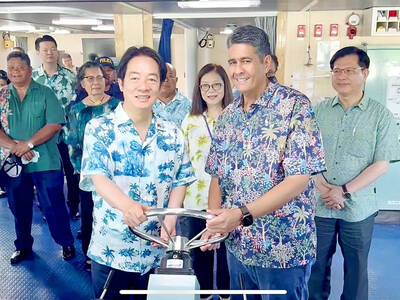
MULTIPRONGED APPROACH: China has sought to pressure Palau across a number of fronts, but the island nation has staunchly resisted overtures to ditch Taiwan Palau has been firm in backing Taiwan despite Chinese pressure that uses tourism economics, cyberattacks and criminal infiltration as tools to threaten the Pacific ally into renouncing its recognition of Taiwan as a sovereign state. The Presidential Office yesterday announced that Vice President Hsiao Bi-khim (蕭美琴) would visit Palau from Saturday to Wednesday next week at the invitation of Palauan President Surangel Whipps Jr. Whipps in April said in an interview that China had outspokenly asked Palau to “denounce Taiwan.” “And we have said: ‘We have no enemies, but nobody tells us who our friends are,’” he said. Whipps has told reporters multiple times


 RSS
RSS