


Premier Su Tseng-chang (蘇貞昌) yesterday urged people not to trivialize the qualifications of new Central Election Commission (CEC) Chairman Lee Chin-yung (李進勇) simply because he used to be a member of the Democratic Progressive Party (DPP).
Su made the remarks on the sidelines of the opening ceremony in Taipei of InnoVEX, an exhibition of start-ups, one day after the DPP used its majority in the Legislative Yuan to push through approval of Lee’s appointment, despite opposition lawmakers trying to block the vote.
“The situation we saw on election day on Nov. 24 last year, where people had to wait in line for two to three hours and voting continued [at some stations] despite the closure of polls, drew fierce public criticism. The government is determined to prevent similar occurrences in the future,” Su said.
Lee was nominated to head the commission because he was well-regarded when he was a judge and has extensive practical experience as deputy minister of the interior, deputy minister of justice, a Yunlin County commissioner and as a lawmaker, he said.
It is exactly because the government is determined to address the root of the problems marring the elections in November last year, and prevent them from happening again, that the Executive Yuan decided to nominate Lee, Su said, without saying if other qualified candidates without partisan pasts were considered.
“Lee immediately canceled his DPP membership following the nomination, and we should not be too quick to dismiss a person’s experience and way of doing things simply because of their past party membership,” he said.
Lee was nominated in February to fill the vacancy left by Chen In-chin (陳英鈐), who resigned the day after the Nov. 24 elections and the 10 referendums that were held alongside them. His handling of the polls and subsequent vote counting was heavily criticized.
Due to Lee’s longtime affiliation with the DPP, his nomination to take over the supposedly non-partisan Central Election Commission has faced fierce opposition, and CEC member Chang Sue-chung (張淑中) resigned in protest on Tuesday.
Su said that as Lee’s nomination had received a majority of votes in the legislature, people should focus on his future performance.
“I hope his performance will satisfy the public,” he said.
Asked to comment on Hon Hai Precision Industry Co Chairman Terry Gou’s (郭台銘) accusation that Lee’s nomination was designed to ensure President Tsai Ing-wen’s (蔡英文) re-election, Su said the tycoon should avoid engaging in mudslinging based only on partial information that his aides have given him, without elaborating.
Gou is seeking the nomination of the Chinese Nationalist Party (KMT) for next year’s presidential race.
The premier has not yet decided on the date on which Lee would officially take office, Executive Yuan spokeswoman Kolas Yotaka said.

SECURITY: Starlink owner Elon Musk has taken pro-Beijing positions, and allowing pro-China companies to control Taiwan’s critical infrastructure is risky, a legislator said Starlink was reluctant to offer services in Taiwan because of the nation’s extremely high penetration rates in 4G and 5G services, the Ministry of Digital Affairs said yesterday. The ministry made the comments at a meeting of the legislature’s Transportation Committee, which reviewed amendments to Article 36 of the Telecommunications Management Act (電信管理法). Article 36 bans foreigners from holding more than 49 percent of shares in public telecommunications networks, while shares foreigners directly and indirectly hold are also capped at 60 percent of the total, unless specified otherwise by law. The amendments, sponsored by Chinese Nationalist Party (KMT) Legislator Ko

The military has spotted two Chinese warships operating in waters near Penghu County in the Taiwan Strait and sent its own naval and air forces to monitor the vessels, the Ministry of National Defense (MND) said. Beijing sends warships and warplanes into the waters and skies around Taiwan on an almost daily basis, drawing condemnation from Taipei. While the ministry offers daily updates on the locations of Chinese military aircraft, it only rarely gives details of where Chinese warships are operating, generally only when it detects aircraft carriers, as happened last week. A Chinese destroyer and a frigate entered waters to the southwest
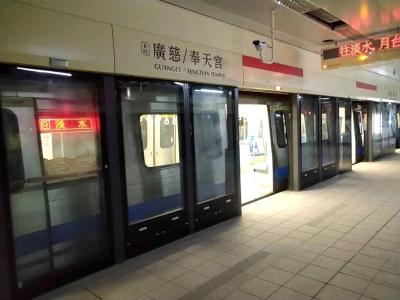
The eastern extension of the Taipei MRT Red Line could begin operations as early as late June, the Taipei Department of Rapid Transit Systems said yesterday. Taipei Rapid Transit Corp said it is considering offering one month of free rides on the new section to mark its opening. Construction progress on the 1.4km extension, which is to run from the current terminal Xiangshan Station to a new eastern terminal, Guangci/Fengtian Temple Station, was 90.6 percent complete by the end of last month, the department said in a report to the Taipei City Council's Transportation Committee. While construction began in October 2016 with an
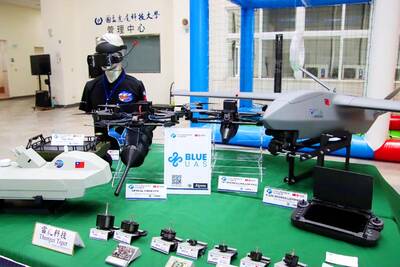
NON-RED SUPPLY: Boosting the nation’s drone industry is becoming increasingly urgent as China’s UAV dominance could become an issue in a crisis, an analyst said Taiwan’s drone exports to Europe grew 41.7-fold from 2024 to last year, with demand from Ukraine’s fight against Russian aggression the most likely driver of growth, a study showed. The Institute for Democracy, Society and Emerging Technology (DSET) in a statement on Wednesday said it found that many of Taiwan’s uncrewed aerial vehicle (UAV) sales were from Poland and the Czech Republic. These countries likely transferred the drones to Ukraine to aid it in its fight against the Russian invasion that started in 2022, it said. Despite the gains, Taiwan is not the dominant drone exporter to these markets, ranking second and fourth


 RSS
RSS