


Freedom of speech must not be used to shield media outlets from rumor-mongering and circulating false reports that undermine democracy, the Democratic Progressive Party (DPP) caucus said yesterday.
The caucus made the remarks in response to Chinese Nationalist Party (KMT) legislators who called on the National Communications Commission (NCC) to reconsider a fine issued to CtiTV News.
DPP Legislator Kuan Bi-ling (管碧玲) said she supported the fine.
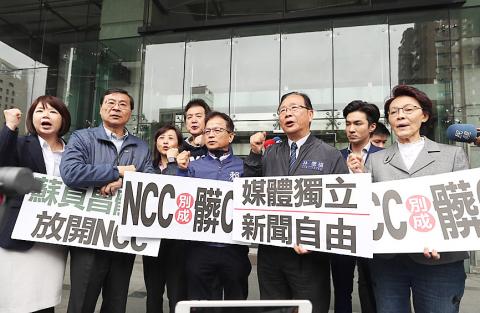
Photo: CNA
“The move is to safeguard our democracy. It is vital to establish the code of conduct and guidance for media outlets,” Kuan said.
“Media outlets cannot become factories for producing rumors and false reports,” she said. “The KMT must not use freedom of expression to shield outlets from the consequences of fabrication and dissemination of fake news.”
The NCC on Wednesday fined CtiTV News NT$1 million (US$32,383) for failing to verify a pomelo grower’s account on a political talk show.
The grower said during a live broadcast that pomelo prices last year were so low that 2 million tonnes of the fruit were dumped into the Zengwen Reservoir (曾文水庫) in Chiayi County.
However, after questions from agricultural officials and other media outlets, he said that not so many were dumped.
Fact-checking and verification showed that the information he provided on TV was fabricated, the NCC said.
KMT legislators led by Tseng Ming-chung (曾銘宗), Lai Shyh-bao (賴士葆) and Alex Fei (費鴻泰) yesterday visited the NCC offices in Taipei, where they spoke with NCC Deputy Chairman Wong Po-tsung (翁柏宗) and other officials.
The lawmakers demanded that the body uphold freedom of expression and treat all media outlets on equal terms.
The NCC has become a political tool of the DPP government to silence media outlets, Lai said.
“The NCC should be an independent agency and it should not selectively work to punish CtiTV, which has a lot of news content focused on [Kaohsiung Mayor] Han Kuo-yu (韓國瑜)” of the KMT, Lai said.
The legislators said that the NCC’s budget should be cut, as it is restricting the nation’s free media and imposing constraints on freedom of expression.
Kuan said that the “KMT was attempting to obfuscate the real issue and mislead the public.”
Nations including the US, Germany and France have amended laws to deal with false news reports and the deliberate circulation of misinformation, while Brazil, Singapore, Canada and Australia have either pushed for amendments or have implemented measures to combat “fake news,” she said.
“Compared with those countries, Taiwan is lagging behind having not progressed with amendments and policies to deal with fake news,” Kuan said, adding that she is concerned the KMT was putting undue pressure on NCC officials, or even threatening them.
DPP Legislator Kuo Kuo-wen (郭國文) said that the false pomelo report severely affected growers in his constituency in Tainan, as they worried that prices would collapse and they would lose money.

UNREASONABLE SURVEILLANCE: A camera targeted on an road by a neighbor captured a man’s habitual unsignaled turn into home, netting him dozens of tickets The Taichung High Administrative Court has canceled all 45 tickets given to a man for failing to use a turn signal while driving, as it considered long-term surveillance of his privacy more problematic than the traffic violations. The man, surnamed Tseng (曾), lives in Changhua County and was reported 45 times within a month for failing to signal while driving when he turned into the alley where his residence is. The reports were filed by his neighbor, who set up security cameras that constantly monitored not only the alley but also the door and yard of Tseng’s house. The surveillance occurred from July

SECURITY: Starlink owner Elon Musk has taken pro-Beijing positions, and allowing pro-China companies to control Taiwan’s critical infrastructure is risky, a legislator said Starlink was reluctant to offer services in Taiwan because of the nation’s extremely high penetration rates in 4G and 5G services, the Ministry of Digital Affairs said yesterday. The ministry made the comments at a meeting of the legislature’s Transportation Committee, which reviewed amendments to Article 36 of the Telecommunications Management Act (電信管理法). Article 36 bans foreigners from holding more than 49 percent of shares in public telecommunications networks, while shares foreigners directly and indirectly hold are also capped at 60 percent of the total, unless specified otherwise by law. The amendments, sponsored by Chinese Nationalist Party (KMT) Legislator Ko

A Japan Self-Defense Forces vessel entered the Taiwan Strait yesterday, Japanese media reported. After passing through the Taiwan Strait, the Ikazuchi was to proceed to the South China Sea to take part in a joint military exercise with the US and the Philippines, the reports said. Japan Self-Defense Force vessels were first reported to have passed through the strait in September, 2024, with two further transits taking place in February and June last year, the Asahi Shimbun reported. Yesterday’s transit also marked the first time since Japanese Prime Minister Sanae Takaichi took office that a Japanese warship has been sent through the Taiwan
‘SAME OLD TRICK’: Even if Beijing resumes individual travel to Taiwan, it would only benefit Chinese tourism companies, the Economic Democracy Union convener said China’s 10 new “incentives” are “sugar-coated poison,” an official said yesterday, adding that Taiwanese businesses see them clearly for what they are, but that Beijing would inevitably find some local collaborators to try to drums up support. The official, speaking on condition of anonymity, made the remark ahead of a news conference the General Chamber of Commerce is to hold today. The event, titled “Industry Perspectives on China’s Recent Pro-Taiwan Policies,” is expected to include representatives from industry associations — such as those in travel, hotels, food and agriculture — to request the government cooperate with China’s new measures, people familiar with


 RSS
RSS