


The Humanistic Education Foundation yesterday called for stricter regulations on teacher misconduct after instructors who were found to have mistreated children were allowed to keep their jobs.
The foundation, which provides assistance to parents whose children have been physically or emotionally abused by educators, has repeatedly seen unfit teachers continue to teach at the same school, despite government intervention, foundation executive director Joanna Feng (馮喬蘭) told a news conference in Taipei.
In a case the foundation took up in January, a first-grade student with autism in a special class at a Hsinchu elementary school was beaten with a stick by his teacher for biting his nails in November last year, the foundation said.
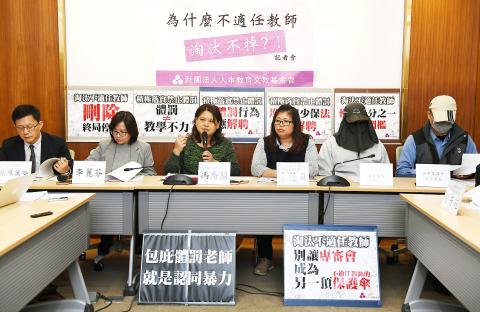
Photo: CNA
The teacher did so in front of the boy’s mother and told her that hitting children is “more effective,” it said.
The father hid a recording device in his son’s bag after he noticed that the boy had become more irritable and anxious, and was having problems with incontinence, it said.
In one recording, a teacher and an assistant can be heard deliberately provoking the boy until he begins to cry and act out, in an attempt to film a video showing that the child was the problem, the father said.
“I could only bear to listen to the recording on the first day. After that I had to ask other people to listen to for me,” he said.
In another recording, the assistant can be heard beating and yelling at the child after he was found eating a cookie in class.
“Do not dare to eat someone else’s food. I will beat you to death,” she yelled at the crying boy, before forbidding him to eating lunch as punishment.
“If you dare eat your food, you are finished” another teacher can be heard saying.
The assistant then told the teacher to remove the child’s lunch box, to pretend that he had eaten it, adding: “Do not let his mother know he did not have lunch.”
During its investigation, the foundation found that the assistant and two teachers had mistreated other students before, it said.
One of the teachers was fined NT$60,000 by the Hsinchu City Government in November last year after she caused extensive bruising on a child’s back, bottom, thigh, knee and arm in September, it said.
Another teacher was in 2016 accused of force-feeding a special needs student and making him hold chili pepper water in his mouth, it said, adding that the teacher later said they had used chili pepper water to “train the student to gargle.”
In the same year, the assistant was accused of hitting a student with a ruler and slapping him in the face, it said.
The school’s internal investigation committee examined all evidence gathered by parents and the foundation, and concluded that the teachers and assistant used “inappropriate language” and “inappropriate teaching methods,” Feng said.
However, the school only required that the teachers undergo a two-month “special consultation” and gave one of them a major demerit, she said.
Although it fired the assistant, the stated reason was “a C performance rating,” rather than mistreating students, she said.
Because she was not fired for using violence against children, she would still be allowed to work at other schools, Feng added.
“Teachers on internal committees turn a blind eye to each other’s faults, which makes firing a teacher very difficult, even when they admit to mistreating children and when there is clear evidence,” she said.
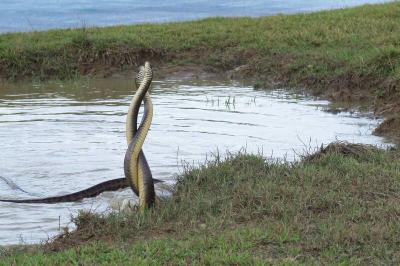
Kenting National Park service technician Yang Jien-fon (楊政峰) won a silver award in World Grand Prix Photography Awards Spring Season for his photograph of two male rat snakes intertwined in combat. Yang’s colleagues at Kenting National Park said he is a master of nature photography who has been held back by his job in civil service. The awards accept entries in all four seasons across six categories: architectural and urban photography, black-and-white and fine art photography, commercial and fashion photography, documentary and people photography, nature and experimental photography, and mobile photography. Awards are ranked according to scores and divided into platinum, gold and
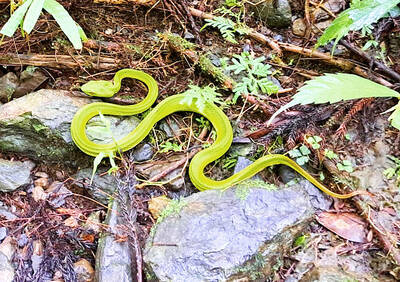
More than half of the bamboo vipers captured in Tainan in the past few years were found in the city’s Sinhua District (新化), while other districts had smaller catches or none at all. Every year, Tainan captures about 6,000 snakes which have made their way into people’s homes. Of the six major venomous snakes in Taiwan, the cobra, the many-banded krait, the brown-spotted pit viper and the bamboo viper are the most frequently captured. The high concentration of bamboo vipers captured in Sinhua District is puzzling. Tainan Agriculture Bureau Forestry and Nature Conservation Division head Chu Chien-ming (朱健明) earlier this week said that the

The Chinese Nationalist Party (KMT) caucus yesterday said it opposes the introduction of migrant workers from India until a mechanism is in place to prevent workers from absconding. Minister of Labor Hung Sun-han (洪申翰) on Thursday told the Legislative Yuan that the first group of migrant workers from India could be introduced as early as this year, as part of a government program. The caucus’ opposition to the policy is based on the assessment that “the risk is too high,” KMT caucus secretary-general Lin Pei-hsiang (林沛祥) said. Taiwan has a serious and long-standing problem of migrant workers absconding from their contracts, indicating that

TRADE-OFF: Beijing seeks to trade a bowl of tempura for a Chinese delicacy, an official said, while another said its promises were attempts to interfere in the polls The government must carefully consider the national security implications of building a bridge connecting Kinmen County and Xiamen, China, the Public Construction Commission (PCC) said yesterday. PCC Commissioner Derek Chen (陳金德), who is also a minister without portfolio, made the remarks in a meeting of the legislature’s Transportation Committee, after Democratic Progressive Party Legislator Hsu Fu-kuei (徐富癸) asked about China’s proposal of new infrastructure projects to further connect Kinmen and Lienchiang (Matsu) counties with Xiamen. China unveiled the bridge plan, along with nine other policies for Taiwan, on Sunday, the last day of Chinese Nationalist Party (KMT) Chairwoman Cheng Li-wun’s (鄭麗文) visit


 RSS
RSS