


As scorers grade the essay portions of the General Scholastic Ability Test (GSAT) — Taiwan’s university entrance exam, which is held in late January or early February each year — some are reporting the responses they have seen, such as one student who drew an image of a goose and a butterfly.
The College Entrance Examination Center released the grading rubric for the non-multiple choice sections of the GSAT yesterday. The rubric was based on a sample of 3,000 exam papers.
This year, high-school students received two questions in each of the Chinese and English writing sections.
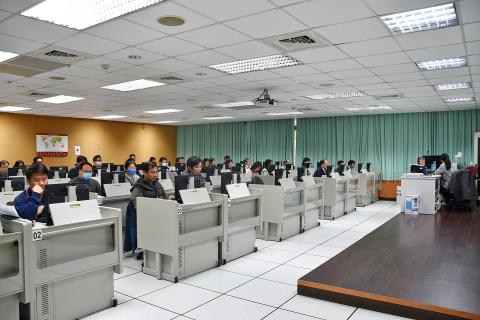
Photo: Wu Po-hsuan, Taipei Times
The first part of the Chinese writing section prompted students to discuss hypothetical policies reducing or banning the consumption of sweetened drinks at schools based on two diagrams they were given.
The second tested students’ reading comprehension of two passages and asked them to write an essay sharing their personal experience of kindness.
To receive high marks for their responses to the first part, students needed to make a clear, justified argument and use good diction, said National Chengchi University (NCCU) Chinese literature professor Lin Chi-ping (林啟屏), who is the convener of a team of 222 people scoring the Chinese written responses.
For the second part, scorers are looking for a deep understanding of the texts, elegant style and vivid descriptions, he said.
For the essay about their experiences of kindness, many students wrote about their relationships with their parents, grandparents, teachers or classmates, test scorers said.
Some wrote about good deeds they had done or witnessed, such as helping an older person cross the street or donating money, they said.
However, one student chose to draw an image of a goose and a butterfly, they said, adding that they would likely receive zero for that question.
For the first part of the English writing section, students were asked to translate two sentences outlining the speed and convenience of the high-speed rail system.
Students lost 0.5 points for each mistake they made, said NCCU English professor Lai Huei-ling (賴惠玲), the convener of a team of 160 people scoring the English responses.
Many students made careless mistakes in this section, such as misspelling the word “choice” as “choise,” she said.
In the second part, students were required to write a minimum of 120 words on the two aspects of Taiwan they were most proud of and how they would introduce or market these to the world.
Taipei 101, Hualien County’s Taroko National Park, Tainan’s temples and ancient sites, and night market culture were among the subjects students chose to write about, test scorers said.
Others chose to highlight the friendliness and kindness of Taiwanese, democracy or the convenience of living in Taiwan, they said.
Responses that were clear and organized are likely to receive good scores, they added.

Taiwanese can file complaints with the Tourism Administration to report travel agencies if their activities caused termination of a person’s citizenship, Mainland Affairs Council Minister Chiu Chui-cheng (邱垂正) said yesterday, after a podcaster highlighted a case in which a person’s citizenship was canceled for receiving a single-use Chinese passport to enter Russia. The council is aware of incidents in which people who signed up through Chinese travel agencies for tours of Russia were told they could obtain Russian visas and fast-track border clearance, Chiu told reporters on the sidelines of an event in Taipei. However, the travel agencies actually applied

New measures aimed at making Taiwan more attractive to foreign professionals came into effect this month, the National Development Council said yesterday. Among the changes, international students at Taiwanese universities would be able to work in Taiwan without a work permit in the two years after they graduate, explainer materials provided by the council said. In addition, foreign nationals who graduated from one of the world’s top 200 universities within the past five years can also apply for a two-year open work permit. Previously, those graduates would have needed to apply for a work permit using point-based criteria or have a Taiwanese company
The Shilin District Prosecutors’ Office yesterday indicted two Taiwanese and issued a wanted notice for Pete Liu (劉作虎), founder of Shenzhen-based smartphone manufacturer OnePlus Technology Co (萬普拉斯科技), for allegedly contravening the Act Governing Relations Between the People of the Taiwan Area and the Mainland Area (臺灣地區與大陸地區人民關係條例) by poaching 70 engineers in Taiwan. Liu allegedly traveled to Taiwan at the end of 2014 and met with a Taiwanese man surnamed Lin (林) to discuss establishing a mobile software research and development (R&D) team in Taiwan, prosecutors said. Without approval from the government, Lin, following Liu’s instructions, recruited more than 70 software

Taiwanese singer Jay Chou (周杰倫) plans to take to the courts of the Australian Open for the first time as a competitor in the high-stakes 1 Point Slam. The Australian Open yesterday afternoon announced the news on its official Instagram account, welcoming Chou — who celebrates his 47th birthday on Sunday — to the star-studded lineup of the tournament’s signature warm-up event. “From being the King of Mandarin Pop filling stadiums with his music to being Kato from The Green Hornet and now shifting focus to being a dedicated tennis player — welcome @jaychou to the 1 Point Slam and #AusOpen,” the


 RSS
RSS