


A sense of humor and creativity have made the Centers for Disease Control (CDC) infectious diseases awareness campaign on Facebook popular with social media users.
The first posting, on Nov. 15 last year, was a cover shot of the fictitious “Disease” magazine, featuring a tall gentleman clad in black, wearing a monocle and a bird’s beak mask, under the headline “Exclusive interview with Novel Influenza A Virus Infections.”
The cover line teasers included “A winter fashion — large chickens crow later” and “Bye to the chickens? — avian influenza has evolved to become novel influenza A virus infections, a handsome and charming rebel character with a masked face.”

Photo courtesy of the Centers for Disease Control
A profile of the character said that he was “male, 185cm, 75kg, born on July 1,” and “he likes birds, poultry, eggs and himself, but hates soap, mask and vaccines.”
The post drew more than 7,000 likes and was shared more than 3,000 times in two days, a record for the center’s Facebook page, which it has had for about 10 years.
Most of the comments praised the creativity, humor and artwork.
“I could not believe this was created by the Taiwan CDC. What a good job,” said a graphic designer surnamed Yeh (葉) in her early 30s. “This type of creative promotion is more usually seen in business advertisements, so I can see the government is also improving.”
“Seeing the government being not so serious makes me surprised and happy at the same time,” another comment read.
The center then debuted four more cover characters: Influenza, a young teenage boy who likes hip-hop; Dengue Fever, a sophisticated, mature woman wearing a backless black dress that showed off tattoos on her back and arms; Enterovirus, an androgynous child holding a doll, with a cover line that read: “Angel face, devil heart? The purest evil — enterovirus.”
The fourth character, which debuted on Christmas Eve last year was named Pai Ching (白淨, “white and clean”), a fair-skinned teenage girl with silver-white hair wearing a white uniform and holding a gun labeled “disinfection.”
Pai Ching’s profile said she has an incredible passion for maintaining public health.
Traffic on the Facebook page rapidly increased, with more than 100,000 visits by early December.
The CDC held a lottery to distribute posters of the characters, and even put up large prints of the “Disease” magazine cover on the outside of its Taipei headquarters so the public could pose with them for photographs.
The CDC on Tuesday last week announced its collaborator on the project was Turing Digital Co and released 16 articles with the characters in them, which attracted more than 2.43 million views in all — an average of more than 150,000 views per post.
Government policy materials have tended to be conservative, making it harder to reach young people, so he was very proud of the creative team for coming up with a concept that has made such an impression, CDC Director-General Chou Jih-haw (周志浩) said.
Lo Pei-shan (羅培珊), the illustrator who created the characters, said that it was difficult at first “to make these seemingly abstract things [viruses and diseases] more concrete, because they are not like those tangible things that we often see in real life.”
“That was also the key point of the project, because many diseases have similar symptoms and people are easily confused by them,” she said. “Now with the distinctive characters, people might more easily tell the diseases apart, as well as be more aware of them.”
Initially, she though the characters should be like people who can be seen on the street every day, because these diseases can be caught easily, but when she sent in her first design for Novel Influenza A Virus Infections, the CDC told her that “it didn’t obviously convey the message that it is transmitted mainly through exposure to infected birds,” she said.
“I later used the plague doctors [who treated victims of bubonic plague in Europe’s Middle Ages and wore a bird beak mask] for inspiration,” she said.
She also learned to add more distinctive details for each character, such as Pai Ching’s disinfecting gun and Dengue Fever’s mosquito-wing tattoo.
Her favorite is Influenza, the pale teenager who frequently coughs and has the letters A, B and C tattooed on his knuckles to represent the three types of influenza virus, she said.
She created Enterovirus as a gender-free child because there are various types of enteroviruses and boys and girls are both at high risk of infection, she said.
The looks and profile of every character were the product of many discussions with the CDC, she said.
CDC Deputy Director-General Philip Lo (羅一鈞) said the fake magazine covers were the first time the center has tried using characters in a public health campaign, and Pai Ching was designed with bleach as the starting point for inspiration.
“We plan to bring out more characters this year,” he said, along with related materials and content.

The first of 10 new high-capacity trains purchased from South Korea’s Hyundai Rotem arrived at the Port of Taipei yesterday to meet the demands of an expanding metro network, Taipei Rapid Transit Corp (TRTC) said yesterday. The train completed a three-day, 1,200km voyage from the Port of Masan in South Korea, the company said. Costing NT$590 million (US$18.79 million) each, the new six-carriage trains feature a redesigned interior based on "human-centric" transportation concepts, TRTC said. The design utilizes continuous longitudinal seating to widen the aisles and optimize passenger flow, while also upgrading passenger information displays and driving control systems for a more comfortable

Instead of focusing solely on the threat of a full-scale military invasion, the US and its allies must prepare for a potential Chinese “quarantine” of Taiwan enforced through customs inspections, Stanford University Hoover fellow Eyck Freymann said in a Foreign Affairs article published on Wednesday. China could use various “gray zone” tactics in “reconfiguring the regional and ultimately the global economic order without a war,” said Freymann, who is also a nonresident research fellow at the US Naval War College. China might seize control of Taiwan’s links to the outside world by requiring all flights and ships entering or leaving Taiwan
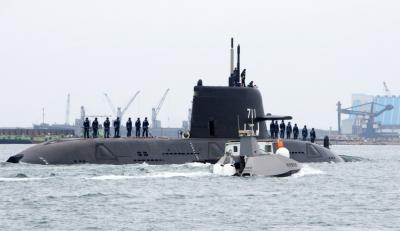
Taiwan's first indigenous defense submarine, the SS-711 Hai Kun (海鯤, or Narwhal), departed for its 13th sea trial at 7am today, marking its seventh submerged test, with delivery to the navy scheduled for July. The outing also marked its first sea deployment since President William Lai (賴清德) boarded the submarine for an inspection on March 19, drawing a crowd of military enthusiasts who gathered to show support. The submarine this morning departed port accompanied by CSBC Corp’s Endeavor Manta (奮進魔鬼魚號) uncrewed surface vessel and a navy M109 assault boat. Amid public interest in key milestones such as torpedo-launching operations and overnight submerged trials,
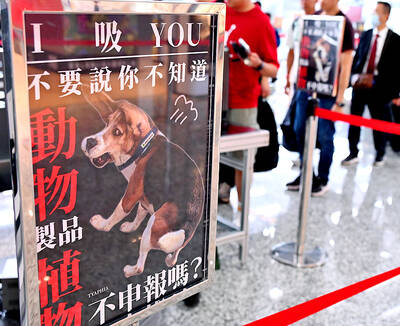
Quarantine awareness posters at Taiwan Taoyuan International Airport have gone viral for their use of wordplay. Issued by the airport branch of the Animal and Plant Health Inspection Agency, the posters feature sniffer dogs making a range of facial expressions, paired with advisory messages built around homophones. “We update the messages for holidays and campaign needs, periodically refreshing materials to attract people’s attention,” quarantine officials said. “The aim is to use the dogs’ appeal to draw focus to quarantine regulations.” A Japanese traveler visiting Taiwan has posted a photo on X of a poster showing a quarantine dog with a


 RSS
RSS