


Chinese Nationalist Party (KMT) Legislator Chiang Wan-an (蔣萬安) yesterday reaffirmed his opposition to China’s “one country, two systems” formula after his previous support for President Tsai Ing-wen’s (蔡英文) “four musts” drew ire from pan-blue supporters.
Chiang, grandson of former president Chiang Ching-kuo (蔣經國), first expressed opposition to the “one country, two systems” formula during a political talk show on Thursday last week, in which he also expressed support for Tsai’s “four musts” as a basis for cross-strait relations.
Tsai in her New Year’s Day speech on Tuesday last week said that China must recognize the existence of the Republic of China (ROC); respect the values of democracy and freedom that Taiwan’s 23 million residents hold dear; resolve cross-strait differences in a peaceful and equitable manner; and engage in negotiations with the government or an institution with a mandate from the government.
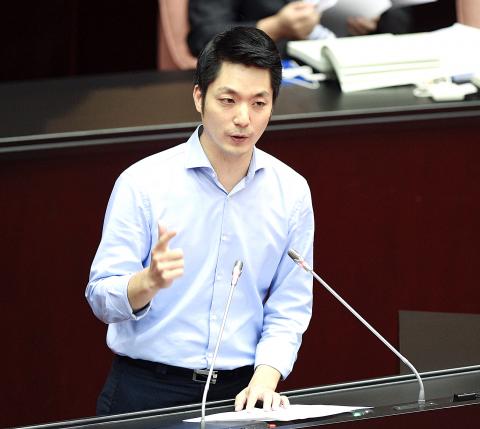
Photo: George Tsorng, Taipei Times
Chiang Wan-an’s support for Tsai’s position on cross-strait ties drew criticism from KMT supporters, with many attacking him on Facebook and some calling him a “separatist.”
A KMT member praising Tsai’s speech “is classic inexperience and naivety,” former KMT Central Policy Committee director Alex Tsai (蔡正元) said.
“When did Tsai Ing-wen and the Democratic Progressive Party (DPP) ever acknowledge the existence of the ROC? Does [Beijing] require the abolition of freedom and democratic systems [as part of unification]?” he asked.
The so-called “1992 consensus” is a peaceful way for Taiwan to achieve parity with China, Alex Tsai said.
The “1992 consensus,” a term former Mainland Affairs Council chairman Su Chi (蘇起) in 2006 admitted making up in 2000, refers to a tacit understanding between the KMT and the Chinese Communist Party that both sides of the Taiwan Strait acknowledge there is “one China,” with each side having its own interpretation of what “China” means.
Chiang Wan-an yesterday said that he supports the KMT’s definition of the “1992 consensus” that both sides of the Strait must be free to define “China” in their own way.
That freedom forms the basis of the “1992 consensus,” which is built on the foundation of the ROC Constitution and is executed through the Act Governing Relations Between the People of the Taiwan Area and the Mainland Area (台灣地區與大陸地區人民關係條例), he said.
While he does not agree with Tsai Ing-wen’s refusal to acknowledge the “1992 consensus,” he could not accept the “one country, two systems” formula, Chiang said.
“Taiwan is not Hong Kong,” he said, adding that most Taiwanese would not accept unification under the formula.
Whoever is president needs to follow the nation’s Constitution and protect its sovereignty, he said.
He added that regardless of who is president, they must acknowledge the existence of the ROC, protect democracy and the freedom of its citizens, and must resolve differences with China in a way that recognizes the equal legitimacy of the ROC and its institutions.
“If President Tsai refuses to accept the ‘1992 consensus’ and refuses to acknowledge its existence, I implore her to provide a specific solution for discourse with China, and not just throw around hipster slogans,” Chiang Wan-an said.

A preclearance service to facilitate entry for people traveling to select airports in Japan would be available from Thursday next week to Feb. 25 at Taiwan Taoyuan International Airport, Taoyuan International Airport Corp (TIAC) said on Tuesday. The service was first made available to Taiwanese travelers throughout the winter vacation of 2024 and during the Lunar New Year holiday. In addition to flights to the Japanese cities of Hakodate, Asahikawa, Akita, Sendai, Niigata, Okayama, Takamatsu, Kumamoto and Kagoshima, the service would be available to travelers to Kobe and Oita. The service can be accessed by passengers of 15 flight routes operated by
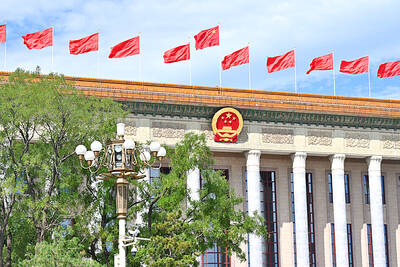
MORE FALL: An investigation into one of Xi’s key cronies, part of a broader ‘anti-corruption’ drive, indicates that he might have a deep distrust in the military, an expert said China’s latest military purge underscores systemic risks in its shift from collective leadership to sole rule under Chinese President Xi Jinping (習近平), and could disrupt its chain of command and military capabilities, a national security official said yesterday. If decisionmaking within the Chinese Communist Party has become “irrational” under one-man rule, the Taiwan Strait and the regional situation must be approached with extreme caution, given unforeseen risks, they added. The anonymous official made the remarks as China’s Central Military Commission Vice Chairman Zhang Youxia (張又俠) and Joint Staff Department Chief of Staff Liu Zhenli (劉振立) were reportedly being investigated for suspected “serious

ENHANCING EFFICIENCY: The apron can accommodate 16 airplanes overnight at Taoyuan airport while work on the third runway continues, the transport minister said A new temporary overnight parking apron at Taiwan Taoyuan International Airport is to start operating on Friday next week to boost operational efficiency while the third runway is being constructed, the Ministry of Transportation and Communications said yesterday. The apron — one of the crucial projects in the construction of the third runway — can accommodate 16 aircraft overnight at the nation’s largest international airport, Minister of Transportation and Communications Chen Shih-kai (陳世凱) told reporters while inspecting the new facility yesterday morning. Aside from providing the airport operator with greater flexibility in aircraft parking during the third runway construction,

American climber Alex Honnold is to attempt a free climb of Taipei 101 today at 9am, with traffic closures around the skyscraper. To accommodate the climb attempt and filming, the Taipei Department of Transportation said traffic controls would be enforced around the Taipei 101 area. If weather conditions delay the climb, the restrictions would be pushed back to tomorrow. Traffic controls would be in place today from 7am to 11am around the Taipei 101 area, the department said. Songzhi Road would be fully closed in both directions between Songlian Road and Xinyi Road Sec 5, it said, adding that bidirectional traffic controls would


 RSS
RSS