


National Chiao Tung University professor Wu I-chen (吳毅成) presented an intelligent “Life-Learning System for Go” training and grading system for go players at the Future Tech Expo in Taipei yesterday.
The system is the result of a years-long endeavor he hopes could help players make faster progress.
The three-day expo, which ends today at Taipei World Trade Center Hall 3, showcases techniques related to artificial intelligence (AI) applications, biotechnology, medical devices, chemical engineering and materials science.
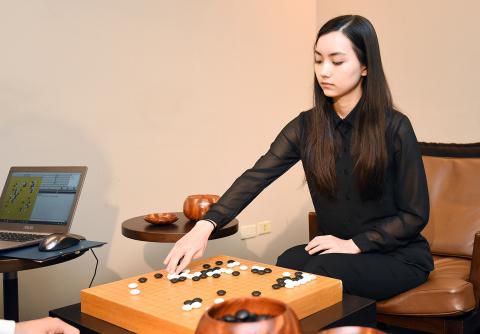
Photo: Liao Chen-huei, Taipei Times
In the AI section, Wu introduced a smart learning system for go players that offers nearly 40 difficulty levels, from beginner to professional and above.
Many go players said they felt they were making no progress when playing against computer systems, which motivated him to develop his intelligent system, Wu said, adding that it could become a tool to assess players’ levels.
The system would not have to slow its computing when adjusting levels, as most other go systems do, and its steps are less predictable, said Wu, who runs a computer games and intelligence (CGI) laboratory at the university and started developing the system in 2015.
The lab last year received a NT$6.6 million (US$213,821) donation from Siliconware Precision Industries Co chairman and Haifong Weiqi Academy founder Bough Lin (林文伯), who signed a three-year contract with the university for a project to boost go players’ performance.
Weiqi (圍棋) is the Chinese word for go.
Cloud computing technology supplier Ubitus Inc provided Wu’s lab with graphic processing units.
A previous CGI go program designed by Wu’s team was ranked the world’s second-strongest in an international match in China last year, after it beat China’s Fine Art Go software and Japan’s DeepZenGo, but was later defeated by DeepZenGo, academy head coach Chou Chun-hsun (周俊勳) said.
Before the match, the Chinese and Japanese systems had been the second-strongest systems since Google’s AlphaGo retired, Chou added.
Considering that AlphaGo is able to train itself without studying human game records, Wu hopes that his system can also reduce reliance on human players, Wu said.
His lab would announce a new technique showing the system’s evolution next year, he added.
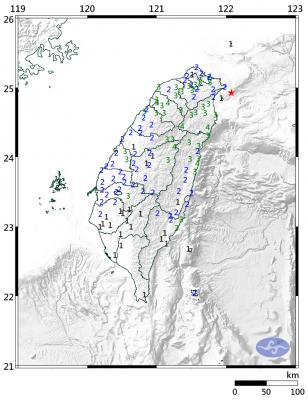
A magnitude 6.1 earthquake struck off the coast of Yilan County at 8:39pm tonight, the Central Weather Administration (CWA) said, with no immediate reports of damage or injuries. The epicenter was 38.7km east-northeast of Yilan County Hall at a focal depth of 98.3km, the CWA’s Seismological Center said. The quake’s maximum intensity, which gauges the actual physical effect of a seismic event, was a level 4 on Taiwan’s 7-tier intensity scale, the center said. That intensity level was recorded in Yilan County’s Nanao Township (南澳), Hsinchu County’s Guansi Township (關西), Nantou County’s Hehuanshan (合歡山) and Hualien County’s Yanliao (鹽寮). An intensity of 3 was
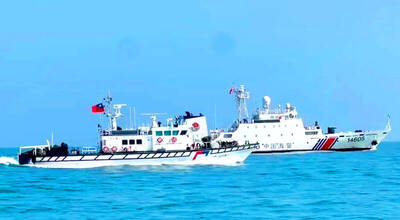
Instead of focusing solely on the threat of a full-scale military invasion, the US and its allies must prepare for a potential Chinese “quarantine” of Taiwan enforced through customs inspections, Stanford University Hoover fellow Eyck Freymann said in a Foreign Affairs article published on Wednesday. China could use various “gray zone” tactics in “reconfiguring the regional and ultimately the global economic order without a war,” said Freymann, who is also a nonresident research fellow at the US Naval War College. China might seize control of Taiwan’s links to the outside world by requiring all flights and ships entering or leaving Taiwan
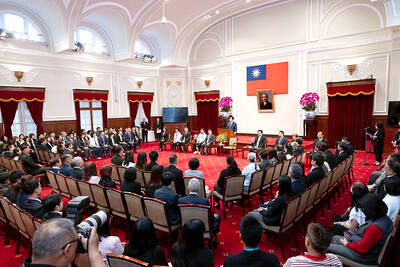
The next minimum wage hike is expected to exceed NT$30,000, President William Lai (賴清德) said yesterday during an award ceremony honoring “model workers,” including migrant workers, at the Presidential Office ahead of Workers’ Day today. Lai said he wished to thank the awardees on behalf of the nation and extend his most sincere respect for their hard work, on which Taiwan’s prosperity has been built. Lai specifically thanked 10 migrant workers selected for the award, saying that although they left their home countries to further their own goals, their efforts have benefited Taiwan as well. The nation’s industrial sector and small businesses lay
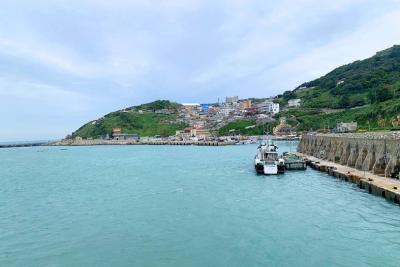
Taiwan has activated backup communications for its northernmost territory, the remote and strategically located island of Dongyin (東引), after poor weather conditions apparently shifted the wreckage of a ship onto an undersea cable causing it to break. The vulnerability of undersea communication cables linking Taiwan with its outlying islands has been a persistent cause of concern for Taipei, whose government has on several occasions blamed Chinese ships for intentionally causing damage. Dongyin, home to about 1,500 people, sits in a strategic position at the top of the Taiwan Strait and the island has a heavy military presence. It does not have an


 RSS
RSS