


Sun An-tso (孫安佐), who was deported from the US after being convicted of charges linked to a threat to shoot up his Pennsylvania high school, landed at Taiwan Taoyuan International Airport on Tuesday night and was directly taken to the Shilin District Prosecutors’ Office for questioning.
Prosecutors had previously said they wanted to question him over possible contraventions of Taiwanese laws.
He was taken to the office in the Shilin District Court, where he was questioned for nearly two hours before being released without bail at 11:25pm.
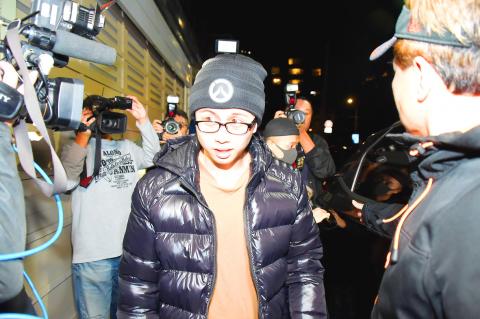
Photo: Hu Shun-hsiang, Taipei Times
However, prosecutors placed travel restrictions on him, barring him from leaving the nation.
Sun was able to return to his family home in Taipei’s Shilin District (士林) in the early hours of yesterday.
The son of actors Sun Peng (孫鵬) and Di Ying (狄鶯), Sun An-tso was arrested on March 26 and charged with making terror threats after he threatened to carry out a mass shooting on May 1 at Bonner and Prendergast Catholic High School in Upper Darby, Pennsylvania.
US authorities found ammunition and various types of firearms in his bedroom, including a 9mm handgun made with parts that he bought online.
On June 4, Sun pleaded guilty to the state charges against him and was sentenced to four to 23 months in prison, with immediate parole and credit for time served.
He was released into US Immigration and Customs Enforcement custody on June 5 and charged federally with being a foreign resident in possession of ammunition.
On Aug. 28, Sun entered a guilty plea to the federal charge.
At a sentencing hearing at the US District Court for the Eastern District of Pennsylvania on Nov. 19, the 18-year-old pleaded guilty to one count of being a foreign resident in possession of ammunition.
He was sentenced to about five-and-a-half months in prison, about the amount of time he had already served.
The judge ordered that Sun be removed from the US and permanently barred from entering the country.

The Centers for Disease Control (CDC) yesterday reported the first case of a new COVID-19 subvariant — BA.3.2 — in a 10-year-old Singaporean girl who had a fever upon arrival in Taiwan and tested positive for the disease. The girl left Taiwan on March 20 and the case did not have a direct impact on the local community, it said. The WHO added the BA.3.2 strain to its list of Variants Under Monitoring in December last year, but this was the first imported case of the COVID-19 variant in Taiwan, CDC Deputy Director-General Lin Ming-cheng (林明誠) said. The girl arrived in Taiwan on

South Korea is planning to revise its controversial electronic arrival card, a step Taiwanese officials said prompted them to hold off on planned retaliatory measures, a South Korean media report said yesterday. A Yonhap News Agency report said that the South Korean Ministry of Foreign Affairs is planning to remove the “previous departure place” and “next destination” fields from its e-arrival card system. The plan, reached after interagency consultations, is under review and aims to simplify entry procedures and align the electronic form with the paper version, a South Korean ministry official said. The fields — which appeared only on the electronic form

The Ministry of Foreign Affairs (MOFA) is suspending retaliation measures against South Korea that were set to take effect tomorrow, after Seoul said it is updating its e-arrival system, MOFA said today. The measures were to be a new round of retaliation after Taiwan on March 1 changed South Korea's designation on government-issued alien resident certificates held by South Korean nationals to "South Korea” from the "Republic of Korea," the country’s official name. The move came after months of protests to Seoul over its listing of Taiwan as "China (Taiwan)" in dropdown menus on its new online immigration entry system. MOFA last week
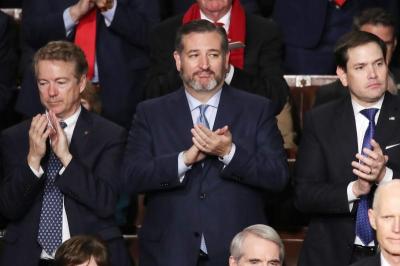
A bipartisan group of US senators has introduced a bill to enhance cooperation with Taiwan on drone development and to reduce reliance on supply chains linked to China. The proposed Blue Skies for Taiwan Act of 2026 was introduced by Republican US senators Ted Cruz and John Curtis, and Democratic US senators Jeff Merkley and Andy Kim. The legislation seeks to ease constraints on Taiwan-US cooperation in uncrewed aerial systems (UAS), including dependence on China-sourced components, limited access to capital and regulatory barriers under US export controls, a news release issued by Cruz on Wednesday said. The bill would establish a "Blue UAS


 RSS
RSS