


People face fines of between NT$600 and NT$1,800 for calling for an ambulance after sustaining minor injuries or over minor ailments, Ministry of the Interior statistics showed.
The 10 administrative regions that have fines for people who call an ambulance when they are not in need of emergency medical care are Taipei, Taoyuan, Taichung, Kaohsiung, Hsinchu County, Hsinchu City, Miaoli County, Chiayi City, Pingtung County and Hualien County, with fines in Taipei the highest at NT$1,800 and lowest in Hsinchu City at NT$600.
Ambulances nationwide were dispatched more than 1.1 million times last year, a daily average of 3,015, ministry statistics showed. While that was a slight decrease from more than 1.11 million in 2016, it was more than three times the 336,409 in 1998.
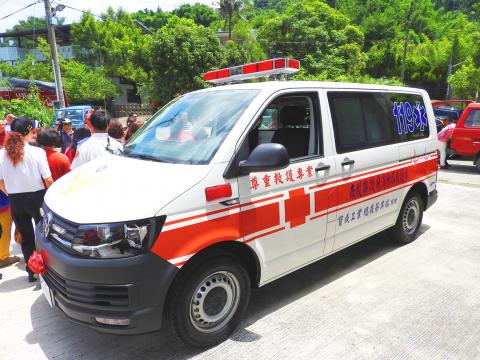
Photo: Tung Chen-kuo, Taipei Times
The most common reason for ambulance calls last year was traffic accidents, with 330,725, or 37.1 percent, such instances, followed by the onset of acute syndromes at 320,221, or 35.9 percent, the statistics showed.
External injuries and injuries sustained from falls accounted for 91,630, or 10.28 percent, of ambulance calls last year, they showed.
Examples of acute syndromes include acute headaches or vertigo, facial numbness or paralysis, chest pains, back pains, asphyxiation, unconsciousness, intense hemorrhaging and large burns, the ministry said, adding that people in such situations need an ambulance.
People who fall asleep on a roadsides after drinking; sustain light injuries from traffic accidents; require hospitalization; or have a toothache, a cold, a sprain or cuts should be taken to seek medical care without calling an ambulance, it said.
National Fire Agency Chief Secretary Feng Chun-yi (馮俊益) said that the agency would step up communication with the 12 local governments that do not have fines in place for improper ambulance calls as part of its effort to curb misuse of the healthcare system.
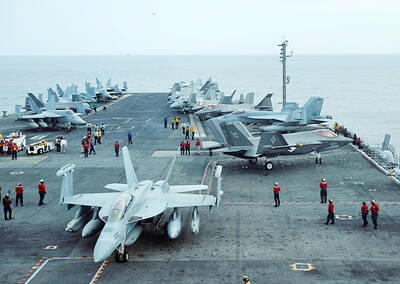
China might accelerate its strategic actions toward Taiwan, the South China Sea and across the first island chain, after the US officially entered a military conflict with Iran, as Beijing would perceive Washington as incapable of fighting a two-front war, a military expert said yesterday. The US’ ongoing conflict with Iran is not merely an act of retaliation or a “delaying tactic,” but a strategic military campaign aimed at dismantling Tehran’s nuclear capabilities and reshaping the regional order in the Middle East, said National Defense University distinguished adjunct lecturer Holmes Liao (廖宏祥), former McDonnell Douglas Aerospace representative in Taiwan. If
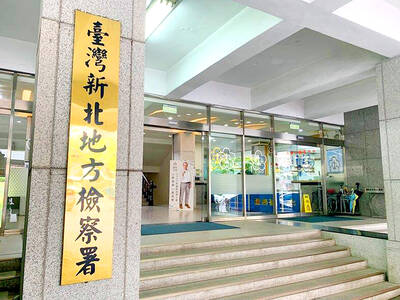
Prosecutors in New Taipei City yesterday indicted 31 individuals affiliated with the Chinese Nationalist Party (KMT) for allegedly forging thousands of signatures in recall campaigns targeting three Democratic Progressive Party (DPP) lawmakers. The indictments stem from investigations launched earlier this year after DPP lawmakers Su Chiao-hui (蘇巧慧) and Lee Kuen-cheng (李坤城) filed criminal complaints accusing campaign organizers of submitting false signatures in recall petitions against them. According to the New Taipei District Prosecutors Office, a total of 2,566 forged recall proposal forms in the initial proposer petition were found during the probe. Among those
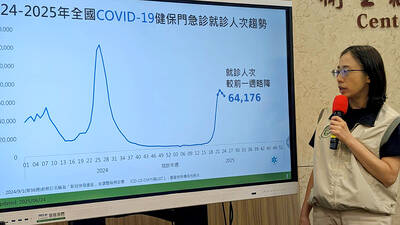
ECHOVIRUS 11: The rate of enterovirus infections in northern Taiwan increased last week, with a four-year-old girl developing acute flaccid paralysis, the CDC said Two imported cases of chikungunya fever were reported last week, raising the total this year to 13 cases — the most for the same period in 18 years, the Centers for Disease Control (CDC) said yesterday. The two cases were a Taiwanese and a foreign national who both arrived from Indonesia, CDC Epidemic Intelligence Center Deputy Director Lee Chia-lin (李佳琳) said. The 13 cases reported this year are the most for the same period since chikungunya was added to the list of notifiable communicable diseases in October 2007, she said, adding that all the cases this year were imported, including 11 from
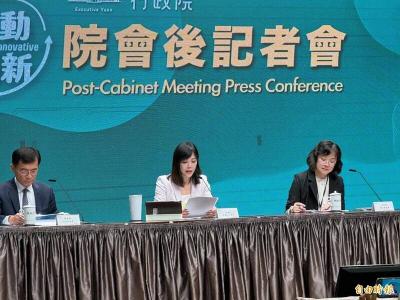
The Ma-anshan Nuclear Power Plant’s license has expired and it cannot simply be restarted, the Executive Yuan said today, ahead of national debates on the nuclear power referendum. The No. 2 reactor at the Ma-anshan Nuclear Power Plant in Pingtung County was disconnected from the nation’s power grid and completely shut down on May 17, the day its license expired. The government would prioritize people’s safety and conduct necessary evaluations and checks if there is a need to extend the service life of the reactor, Executive Yuan spokeswoman Michelle Lee (李慧芝) told a news conference. Lee said that the referendum would read: “Do


 RSS
RSS