


Liberty Times (LT): You told the story of this chapter in history from the Dutch perspective. Why did this part of history grab your attention?
Li Lung-chieh (李隆杰): Because looking back at Taiwan’s 400-year history, Koxinga [Cheng Cheng-kung, 鄭成功] is the most interesting figure.
The Koxinga that Dutch authors write about is completely different from the Koxinga we read about in textbooks. In their eyes, Koxinga is the antagonist. While this might not be a novel concept for historians, for younger readers who are learning about history through comics, it is an interesting approach.
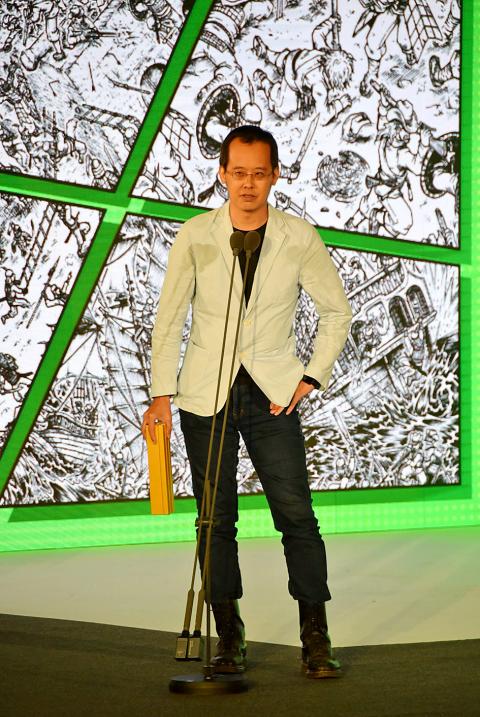
Photo: Wu Po-hsuan, Taipei Times
Besides being beneficial for marketing purposes, the main reason for adopting a Dutch perspective was that, from the historical materials I encountered, the written records of Han Chinese were limited. Some were even questionable. In contrast, the documents left behind by the Dutch East India Company seemed like day-to-day reporting. These accounts had no political intention and no considerations as to who was portrayed as the hero. Apart from occasionally thanking God, these records were simply everyday accounts of what was happening.
I have participated in Academia Sinica’s Creative Comic Collection project. From that experience, I learned how to turn historical materials into comics. One year, I attended the Angouleme International Comics Festival in France. As the theme of the Taiwan Pavilion that year [2015] was “The Strangers in Formosa,” or, in other words, “foreigners in Taiwan,” I decided to turn the story of Koxinga’s killing of Dutch pastor Antonius Hambroek into an eight-page comic. Later, I discovered that in 1796, the Dutch had put on a play titled Antonius Hambroek, of De Belegering van Formoza (Antonius Hambroek, or The Siege of Formosa) portraying the story. These materials were used in the early forms of Koxinga Z (1661國姓來襲).
Previous comics by Taiwanese related to Koxinga have probably all been created in line with the requirements of the party-state era. Due to historical and educational needs, they have been accustomed to presenting Koxinga as a national hero and rarely consider the battle of Luermen Bay (鹿耳門, between the Chinese and Dutch navies), which is relevant to modern Taiwanese history. They do not include scenes of the battle or a deeper and more diverse historical commentary, much less a negative perspective.
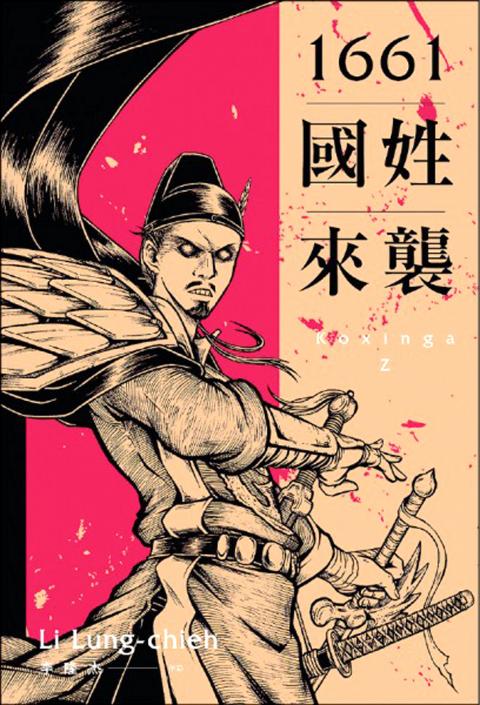
Photo courtesy of Li Lung-chieh
Although I wanted to depict Koxinga as an antagonist, I did not want to go overboard. My intention was to serve an audience that enjoys learning about history through comics, so I used a great amount of narration to explain the development of this part of history.
LT: Why did you depict Koxinga as an antagonist and give him a mask?
Li: In depicting Koxinga as an antagonist, my intention was not to smear or vilify him. Sometimes portraying a character as the “bad guy” gives them the most charm.
I drew Koxinga out of a fondness for him, but even though I like Koxinga, that does not mean I have to draw him as a good person. The most important consideration when it comes to creative work is to make the characters look interesting.
For example, the most interesting character in Star Wars is not Luke Skywalker, but Darth Vader. Vader’s merchandise also sells the best. Since his first scene in the series, he was portrayed as an antagonist whom everyone feared. Only later were prequels created to explain his life. He is an antagonist, but also the most charming character in the series. Vader became a character who surpassed the protagonist. With this in mind, I gave Koxinga a mask.
While I was going through the historical materials, I could never figure out what kind of person Koxinga was. He feels likes a masked character with a touch of mystery. As most of his interactions with [then-colonial governor of Formosa] Frederick Coyett were via letters — one wrote letters asking the other to surrender, and one replied saying he would not — some say they never met in real life and did not know what the other looked like, but who would read a comic book written this way? Would it have been sensible to depict them as pen pals?
LT: Your use of masks with Koxinga and the chairman who appears at the end seem to be a jab at the former Chinese Nationalist Party (KMT) regime’s idolization of its leaders and a form of allegory tying Koxinga to Chiang Kai-shek (蔣介石) and his desire to retake China. Is that accurate?
Li: Before the creation of Koxinga Z, I researched paintings, wax impressions and statues, and realized how the KMT regime then even expressly stipulated how Koxinga should be portrayed.
In the short piece The Record of Burning Sunset Clouds (日落烽雲錄) that I submitted to the 2007 Dragon Youth contest, I depicted Chiang with a metal face, which turned out well and won an award. It would be a real waste if I did not use that effect again, so I used the mask to link Chiang and Koxinga. I believe this can facilitate many more topics for comics.
As expected, after the comic was published, several comments critical of me appeared on Gaea Books’ Facebook fan page, written in simplified Chinese and accusing me of “desinicization” and for vilifying a “national hero.” There was one comment that said that my depiction of Koxinga with crooked teeth was a deliberate attempt to make him look ugly. Actually, a person’s teeth have nothing to do with the quality of their character. It was quite funny.
In fact, the question I hope to bring to readers’ minds is: Which is the real Koxinga — the masked one, or the one under the mask?
LT: Naturally, it is difficult to avoid conflict when making comics that touch upon historical events. What is your motivation and objective for creating comics?
Li: When it comes to talking about the Wushe Incident [a 1930 uprising against colonial Japanese forces in Taiwan] or former Sediq leader Mona Rudao, most people will refer to Chiu Ruo-long’s (邱若龍) comic named after the incident. Chiu is like a wall and those next to him cannot transcend him.
Selfishly, I hope one day when people bring up Koxinga, my comic will serve as an important point of reference.
Japanese do not have this same high wall of apprehension to deal with. In Japan there is no shortage of comics that discuss historical events, which have been discussed previously. Take Romance of the Three Kingdoms for example. Whether it be Mitsuteru Yokoyama’s version of the story, or the adaptation by Hong Kong artist Chan Mou (陳某) titled The Ravages of Time (火鳳燎原), comic fans all rush to snap them up.
The protagonist is also changed in different adaptations, from the traditional Liu Bei (劉備) to Cao Cao (曹操) and Zhao Yun (趙雲), and even a junior-high school girl in Yoshito Yamahara’s Legend of the Dragon’s Son (龍狼傳) in which the girl is sucked back in time to the Three Kingdoms period.
These adaptations use the names of the original characters, but someone familiar with the story will see just how much creativity was employed by the artists.
Taiwanese artists rarely create new historical commentaries, but they really ought to do so.
LT: Do you have any plans to draw other comics on Taiwanese history?
Li: I have always been interested in creating comics on Taiwanese history. There is quite a lot of Japanese-era research material and comics, but few exploring the Qing Dynasty. On one hand, the hairstyle during the Qing Dynasty — shaved heads and braids — is unlikeable. On the other hand, most historical events during the Qing Dynasty were uprisings. It is difficult to find an epic-like scenario such as the battle of Luermen.
I want to focus on the interactions between the Cheng family of the 17th century and Taiwanese history. Future works will first be labeled by time period and then the historical figure or event. Doing so would prevent them from being restricted or limited by the traditional sequel model.
In my mind, comics will be written for three points in time: The stories of [pirates] Yan Siqi (顏思齊) and Li Dan (李旦), around 1624; the 1633 Battle of Liaoluo Bay (料羅灣) in Kinmen County between Cheng Chih-lung (鄭芝龍) and the fourth governor of Formosa; and the 1683 invasion of Taiwan by Shi Liang (施琅).
Translated by staff writers Sherry Hsiao and William Hetherington
REASONS FOR TRAVEL: An assistant professor said that proposed amendments to penalize drivers if they used drugs overseas would not deter people from traveling People who operate a motor vehicle under the influence of marijuana would have their driver’s license revoked, even if they used the substance while overseas, the Ministry of Transportation and Communications said yesterday, citing proposed amendments to the Road Traffic Management and Penalty Act (道路交通管理處罰條例). The amendments would also authorize the government to revoke the licenses of people determined to have used Category 1 or Category 2 narcotics, even if they were not operating a vehicle while under the influence of drugs, as well as ban them from taking the license test for three years, the ministry said. People aged 18 or

GLOBALGIVING: ‘ Caving to external pressure is not acceptable for an organization that has cultivated justice reform and human rights for 30 years,’ one NGO said A slew of non-government organizations (NGOs) have withdrawn from the GlobalGiving fundraising platform after it announced it would use “Chinese Taipei” instead of “Taiwan” from next month. The Taiwan Good Rice Association wrote on Facebook on Friday that it was informed on April 28 via a teleconference call of the change, which was made because the platform wanted to operate in China. Taiwan Good Rice is to terminate all cooperative relationships with GlobalGiving in response to the platform’s “unilateral and non-negotiable” decision to remove references to Taiwan, the NGO said. “Taiwan is in the official name of Taiwan Good Rice Association and the

HEAVY WEATHER: Typhoon Jangmi is due to crash straight into the Ryukyus as airlines look to shift flights to larger aircraft or cancel flights to Okinawa entirely Taiwan’s international air carriers announced flight adjustments over the weekend as Typhoon Jangmi is forecast to hit the Ryukyu Islands today and tomorrow. The Central Weather Administration (CWA) upgraded Jangmi from a tropical storm to a typhoon at 8am yesterday, with the eye located 580km south of Naha city. It was moving north at 19kph. Today, China Airlines’ CI-120, CI-121, CI-122 and CI-123 flights between Taoyuan and Naha, Okinawa, have been canceled as well as CI-132 and CI-133 between Kaohsiung and Naha. EVA Air’s BR-112, BR-113, BR-186 and BR-185 flights between Taoyuan and Naha are also canceled. Low-cost carrier Tigerair Taiwan canceled IT-230,
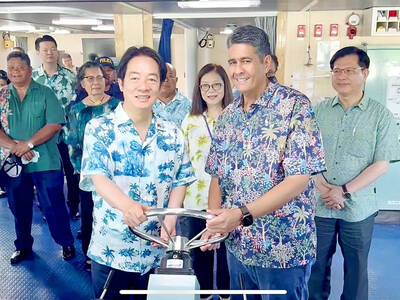
MULTIPRONGED APPROACH: China has sought to pressure Palau across a number of fronts, but the island nation has staunchly resisted overtures to ditch Taiwan Palau has been firm in backing Taiwan despite Chinese pressure that uses tourism economics, cyberattacks and criminal infiltration as tools to threaten the Pacific ally into renouncing its recognition of Taiwan as a sovereign state. The Presidential Office yesterday announced that Vice President Hsiao Bi-khim (蕭美琴) would visit Palau from Saturday to Wednesday next week at the invitation of Palauan President Surangel Whipps Jr. Whipps in April said in an interview that China had outspokenly asked Palau to “denounce Taiwan.” “And we have said: ‘We have no enemies, but nobody tells us who our friends are,’” he said. Whipps has told reporters multiple times


 RSS
RSS