


Presidential Office Deputy Secretary-General Yao Jen-to (姚人多) was yesterday elected as vice chairman and secretary-general of the Straits Exchange Foundation (SEF).
Yao’s election was confirmed by the board of the foundation, spokeswoman Kuan An-lu (管安露) said.
Following his confirmation, Yao said he would work with the foundation’s staff to handle cross-strait affairs based on the principle of serving the interests of people on the both sides of the Taiwan Strait, Kuan said.
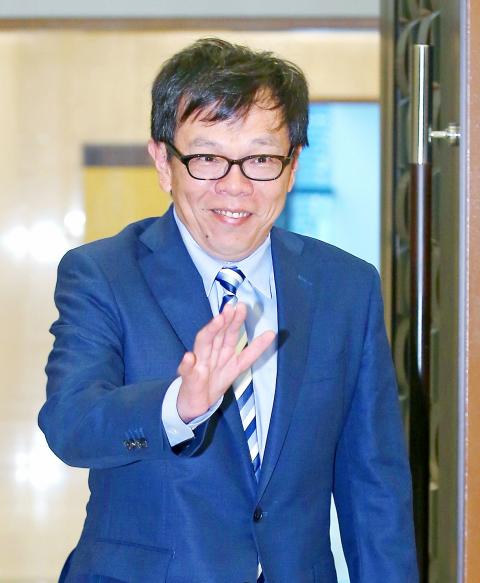
Photo: Fang Pin-chao, Taipei Times
Asked how Yao’s stance on Taiwanese independence might affect his job, Kuan said that politics should not influence people-to-people exchanges between Taiwan and China, adding that the two sides of the strait have engaged in exchanges for more than 30 years.
Taiwan has always kept an open mind about cross-strait exchanges and would not turn down opportunities for communication with pro-unification factions in China, Kuan said.
During a public forum in 2013, Yao, at the time an associate professor of sociology at National Tsing Hua University, said that Taiwanese independence had lost its place in the mainstream and urged the Democratic Progressive Party to facilitate democratization in China by promoting Taiwan’s experiences in furthering democracy, freedom and human rights.
Yao on Wednesday resigned from his Presidential Office position to take up the new role, Kuan said.
Yao is a capable person who would contribute to the positive development of cross-strait relations, foundation chairwoman Katharine Chang (張小月) said.
The foundation would in August or September set up a telephone hotline to provide information to young people who wish to study in China, she said.
It would also continue to improve its services for China-based Taiwanese businesses, Chinese spouses of Taiwanese and Chinese students in Taiwan, Chang added.
Additional reporting by staff writer
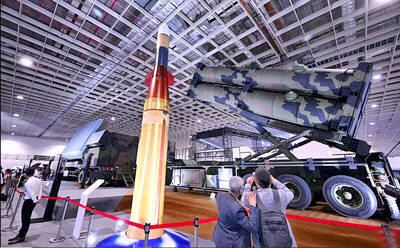
Taiwan is to commence mass production of the Tien Kung (天弓, “Sky Bow”) III, IV and V missiles by the second quarter of this year if the legislature approves the government’s NT$1.25 trillion (US$39.78 billion) special defense budget, an official said yesterday. Commenting on condition of anonymity, a defense official with knowledge of the matter said that the advanced systems are expected to provide crucial capabilities against ballistic and cruise missiles for the proposed “T-Dome,” an advanced, multi-layered air defense network. The Tien Kung III is an air defense missile with a maximum interception altitude of 35km. The Tien Kung IV and V
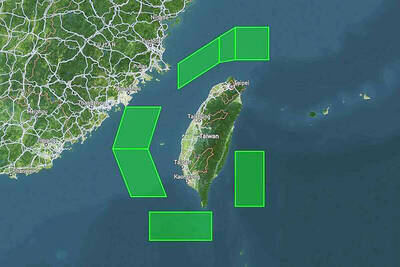
The disruption of 941 flights in and out of Taiwan due to China’s large-scale military exercises was no accident, but rather the result of a “quasi-blockade” used to simulate creating the air and sea routes needed for an amphibious landing, a military expert said. The disruptions occurred on Tuesday and lasted about 10 hours as China conducted live-fire drills in the Taiwan Strait. The Civil Aviation Administration (CAA) said the exercises affected 857 international flights and 84 domestic flights, affecting more than 100,000 travelers. Su Tzu-yun (蘇紫雲), a research fellow at the government-sponsored Institute for National Defense and Security Research, said the air
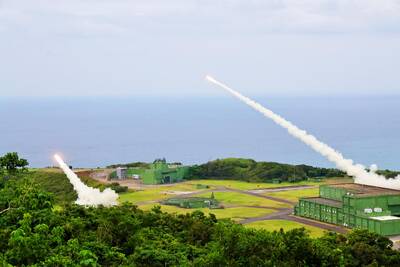
Taiwan lacks effective and cost-efficient armaments to intercept rockets, making the planned “T-Dome” interception system necessary, two experts said on Tuesday. The concerns were raised after China’s military fired two waves of rockets during live-fire drills around Taiwan on Tuesday, part of two-day exercises code-named “Justice Mission 2025.” The first wave involved 17 rockets launched at 9am from Pingtan in China’s Fujian Province, according to Lieutenant General Hsieh Jih-sheng (謝日升) of the Office of the Deputy Chief of the General Staff for Intelligence at the Ministry of National Defense. Those rockets landed 70 nautical miles (129.6km) northeast of Keelung without flying over Taiwan,
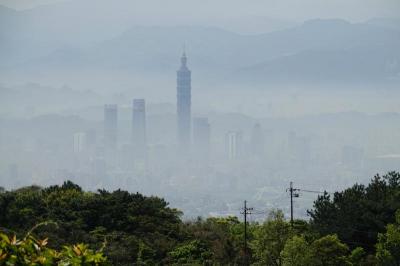
A strong continental cold air mass is to bring pollutants to Taiwan from tomorrow, the Ministry of Environment said today, as it issued an “orange” air quality alert for most of the country. All of Taiwan except for Hualien and Taitung counties is to be under an “orange” air quality alert tomorrow, indicating air quality that is unhealthy for sensitive groups. In China, areas from Shandong to Shanghai have been enveloped in haze since Saturday, the ministry said in a news release. Yesterday, hourly concentrations of PM2.5 in these areas ranged from 65 to 160 micrograms per cubic meter (mg/m³), and pollutants were


 RSS
RSS