


About 100 Vietnamese migrant workers and spouses yesterday rallied at the Vietnam Economic and Cultural Office in Taipei to protest a Vietnamese government plan to establish new special economic zones (SEZ) to attract investment from China.
The protest was organized by the Vietnamese Migrant Workers and Brides Office and the Taiwan International Workers’ Association, which said in a joint statement that the Vietnamese government plans to pass a bill this month that would legalize the establishment of SEZs.
Vietnam plans to establish one zone each in Van Don district in the country’s Quang Ninh Province; Bac Van Phong district in Khanh Hoa Province; and Phu Quoc Island in Kien Giang Province, the groups said.
The Vietnamese government is to offer many incentives for foreigners to invest in Vietnam, including allowing them to lease properties for 99 years, the organizers said, adding that they suspect this is done to cater to the Chinese government’s demands.
“The bill does not specifically favor investment from China, but it says that it targets the countries bordering Vietnam,” the organizers said in the statement.
“We are concerned that the move would allow more Chinese investors to cross the border and wield power all over Vietnam,” they said.
The rally was briefly disrupted by the police from the Taipei Police Department’s Zhongshan Precinct, which warned that the rally was illegal.
Foreign investors would be granted special privileges by the government and would be empowered to take matters into their own hands, said Father Peter Van Hung Nguyen (阮文雄), who founded the workers and brides office in Taoyuan.
The outside world would have no idea what is happening inside the SEZs, Nguyen added.
“The SEZs will not create advantages for Vietnam’s economy and its people. They will only make it easier for more Chinese people to migrate to Vietnam,” one protester said.
“Through massive settlement, China will invade Vietnam economically and seek to assimilate Vietnamese people with its culture and values, making Vietnam a province of China, like one Chinese advertisement suggested recently,” the protester said, adding that the Vietnamese government should hold a referendum on such issues.
Vietnam would increase its reliance on the Chinese capital through the establishment of the zones, making Vietnam a Chinese colony, a Vietnamese woman nicknamed A-hsueh said.
Vietnam has already experienced the consequences of an increase of trade with China, she said.
“China has exported contaminated food to the Vietnamese market and reduced the barriers for Chinese tourists traveling to Vietnam,” she said. “China has set up many industrial zones, which has led to a huge amount of pollution.”
In Vietnam, the government has arrested protesters against the bill on charges of sedition and rebellion, and plans to adopt an Internet Safety Act to further suppress the freedom of speech.
The Vietnamese government is obligated to protect the rights of its people after joining the International Covenant on Civil of Political Rights and International Covenant on Economic Social and Cultural Rights, Covenants Watch representative Hsu Wei-chun (徐偉群) said.
Not allowing the public to participate in reviews of the legislation and forcing people to relocate for the establishment of SEZs has caused the Vietnamese government to contravene these international agreements, he said.
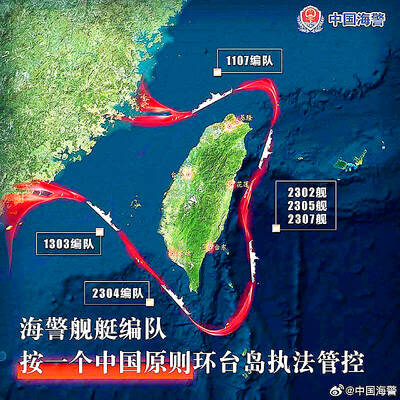
Taiwan would benefit from more integrated military strategies and deployments if the US and its allies treat the East China Sea, the Taiwan Strait and the South China Sea as a “single theater of operations,” a Taiwanese military expert said yesterday. Shen Ming-shih (沈明室), a researcher at the Institute for National Defense and Security Research, said he made the assessment after two Japanese military experts warned of emerging threats from China based on a drill conducted this month by the Chinese People’s Liberation Army’s (PLA) Eastern Theater Command. Japan Institute for National Fundamentals researcher Maki Nakagawa said the drill differed from the
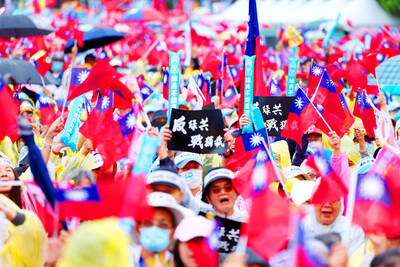
‘WORSE THAN COMMUNISTS’: President William Lai has cracked down on his political enemies and has attempted to exterminate all opposition forces, the chairman said The legislature would motion for a presidential recall after May 20, Chinese Nationalist Party (KMT) Chairman Eric Chu (朱立倫) said yesterday at a protest themed “against green communists and dictatorship” in Taipei. Taiwan is supposed to be a peaceful homeland where people are united, but President William Lai (賴清德) has been polarizing and tearing apart society since his inauguration, Chu said. Lai must show his commitment to his job, otherwise a referendum could be initiated to recall him, he said. Democracy means the rule of the people, not the rule of the Democratic Progressive Party (DPP), but Lai has failed to fulfill his

A rally held by opposition parties yesterday demonstrates that Taiwan is a democratic country, President William Lai (賴清德) said yesterday, adding that if opposition parties really want to fight dictatorship, they should fight it on Tiananmen Square in Beijing. The Chinese Nationalist Party (KMT) held a protest with the theme “against green communists and dictatorship,” and was joined by the Taiwan People’s Party. Lai said the opposition parties are against what they called the “green communists,” but do not fight against the “Chinese communists,” adding that if they really want to fight dictatorship, they should go to the right place and face
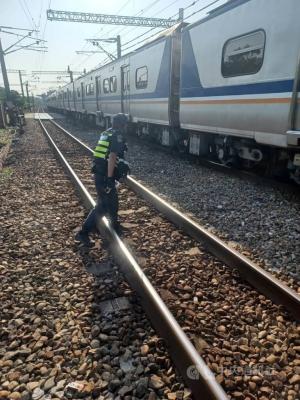
A 79-year-old woman died today after being struck by a train at a level crossing in Taoyuan, police said. The woman, identified by her surname Wang (王), crossed the tracks even though the barriers were down in Jhongli District’s (中壢) Neili (內壢) area, the Taoyuan Branch of the Railway Police Bureau said. Surveillance footage showed that the railway barriers were lowered when Wang entered the crossing, but why she ventured onto the track remains under investigation, the police said. Police said they received a report of an incident at 6:41am involving local train No. 2133 that was heading from Keelung to Chiayi City. Investigators


 RSS
RSS