


Judicial authorities in Taoyuan have arrested China-based businessman Lin Wei-lin (林偉琳) on allegations of spying for Beijing, after searching his residence on Thursday, they said.
Lin, 39, is accused of helping China to develop a spy network and trying to recruit Taiwanese intelligence officials to access sensitive national security materials, Taoyuan Deputy Chief Prosecutor Wang Yi-wen (王以文) said.
A judge approved a request by prosecutors at the bail hearing late on Thursday that Lin be placed in judicial detention and that his communications be restricted due to the risks that he might flee or corrupt evidence.
Lin is to be charged with breaching the National Security Act (國家安全法), the National Intelligence Services Act (國家情報工作法) and the Anti-Corruption Act (貪污治罪條例), Wang said.
Taoyuan prosecutors said they put Lin under surveillance in December last year after receiving reports that he was engaged in illegal activities.
They decided to arrest him now, as he works in China and does nto often travel to his residence in Taoyuan, prosecutors said.
Investigators found that Lin completed his military service in the Marine Corps, an elite unit, and was discharged in 2000, after which he went to work for a Taiwanese electrical engineering company based in Suzhou in China’s Jiangsu Province.
Lin once headed the association for young Taiwanese entrepreneurs in Suzhou and also served as a board member for the Suzhou chapter of the All-China Youth Federation, a Chinese Communist Party organization for young people and students, prosecutors said, adding that he still serves as deputy chairman of a Taiwanese business association promoting investment in Suzhou.
Noticing his rising prominence, Chinese government officials allegedly approached Lin and successfully recruited him to work for them, paying him in return, Wang said.
Lin returned to Taiwan to attend a high school reunion, and allegedly tried to recruit a former classmate who held a job in the section responsible for national security and counterintelligence work at the Ministry of Justice’s Investigation Bureau.
Investigators said that Lin invited his former classmate for dinner and other functions, at which he allegedly inquired about the details of the classmate’s work at the bureau, repeatedly proposed to introducing his Chinese friends to him and requested information.
Lin offered the bureau officer NT$60,000 and NT$200,000 in cash, as well as luxury goods, investigators said.
The officer was not swayed and reported Lin to the authorities, who began an investigation and surveillance late last year, Wang said.


UPGRADE: The Kang Ding-class frigate is replacing its Chaparall missiles with Tien Chien II and Hua Yang VLS, which would provide it with long-range, 360° air defense Taiwan plans to produce 1,200 to 1,376 Hai Chien II missiles (海劍二, Sea Sword II) — also known as TC-2N — to serve as the standard air defense system of the navy’s surface combatant fleet, a source said yesterday. Last week, the Hai Chien II, the naval version of the Tien Kung II missile (天劍二, Sky Sword II), completed a live-fire test in waters off the National Chungshan Institute of Science and Technology’s Jiupeng facility (九鵬) in Pingtung County’s Manjhou Township (滿州). The MIM72 Chaparral and other dated air defense missiles that currently arm Taiwanese ships have inadequate range to combat Chinese

REASONS FOR TRAVEL: An assistant professor said that proposed amendments to penalize drivers if they used drugs overseas would not deter people from traveling People who operate a motor vehicle under the influence of marijuana would have their driver’s license revoked, even if they used the substance while overseas, the Ministry of Transportation and Communications said yesterday, citing proposed amendments to the Road Traffic Management and Penalty Act (道路交通管理處罰條例). The amendments would also authorize the government to revoke the licenses of people determined to have used Category 1 or Category 2 narcotics, even if they were not operating a vehicle while under the influence of drugs, as well as ban them from taking the license test for three years, the ministry said. People aged 18 or
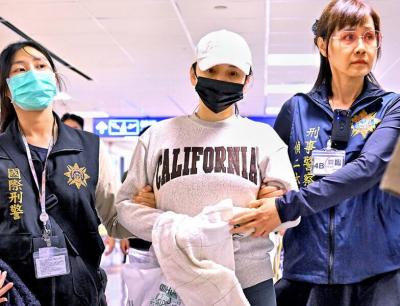
Johanne Liou (劉喬安), a Taiwanese woman who shot to unwanted fame during the Sunflower movement protests in 2014, returned to Taiwan last night after being deported from the US. She is to stand trial in Taiwan for charges involving embezzlement, fraud and drug crimes. The Criminal Investigation Bureau (CIB) said it took her into custody at Taiwan Taoyuan International Airport and would first question her before transferring her to the New Taipei District Prosecutors’ Office. She was arrested upon disembarking a flight from San Francisco that landed shortly before 7pm. Liou absconded to the US in 2019 after jumping bail
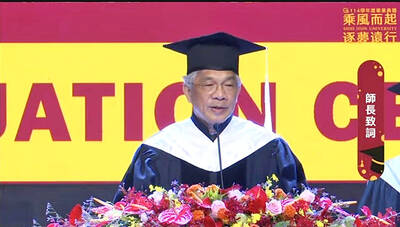
Shih Hsin University President Chen Ching-he (陳清河) yesterday issued a public apology for comments made in his commencement speech last week, stating that he has asked the school to suspend his duties and halt his wages for two months as a show of contrition. At the commencement ceremony on May 30, Chen said, “If you don’t manage your time well, or your own emotions, or your health, then I am telling every one of you — put a quick end to ‘you,’ because the world has no need for ‘you.’” The comments have sparked significant controversy online, and Chen through an open


 RSS
RSS