


A company claim to sell “goat’s milk” has been making its product with cow’s milk, commercial milk powder, non-dairy creamer and artificial flavoring, Tainan authorities said.
Public prosecutors and Tainan Public Health Bureau officials on Tuesday searched what they called “an underground dairy producer” operated by a couple in the city’s Annan District (安南).
The product, called Little Ding Dong Fresh Goat Milk (小叮噹鮮羊乳), was established by the couple in 1995.
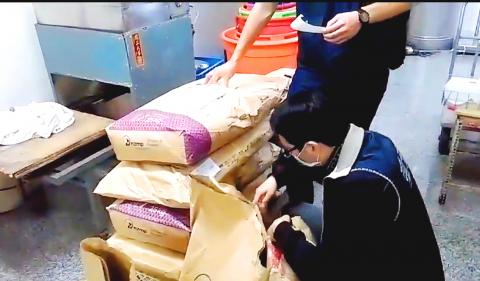
Photo: Wang Chun-chung, Taipei Times
Prosecutors estimate the company made more than NT$20 million (US$685,753) in the past decade.
Public health officials said that about 500 customers have paid the company for long-term daily home delivery of its Little Ding Dong Fresh Goat Milk.
Authorities are investigating if the company has customers outside Tainan and is checking sales and delivery records.
“The company touted the health benefits of their products, promoting them as ‘100 percent guaranteed goat’s milk,’ from their own goat farm. Their advertising claims that goat’s milk has far superior nutritional value than cow’s milk,” an official said.
Testing indicated that Little Ding Dong Fresh Goat Milk contained cow’s milk powder, full-fat liquid cow’s milk, nondairy creamer, artificial flavoring and other ingredients, but no trace of goat’s milk, officials said.
Prosecutors summoned the owners and two employees for questioning.
The couple were allowed bail of NT$100,000 each, but said they did not have sufficient funds.
After bail was reduced to NT$50,000 each, they were released yesterday.
Investigators uncovered 1,700 bottles of Little Ding Dong Fresh Goat Milk ready for delivery and 20 sacks of skim milk powder and full-fat cow’s milk powder, as well as 400kg of nondairy creamer and artificial flavorings.

Costa Rica sent a group of intelligence officials to Taiwan for a short-term training program, the first time the Central American country has done so since the countries ended official diplomatic relations in 2007, a Costa Rican media outlet reported last week. Five officials from the Costa Rican Directorate of Intelligence and Security last month spent 23 days in Taipei undergoing a series of training sessions focused on national security, La Nacion reported on Friday, quoting unnamed sources. The Costa Rican government has not confirmed the report. The Chinese embassy in Costa Rica protested the news, saying in a statement issued the same

Taiwan is to extend its visa-waiver program for Philippine passport holders for another year, starting on Aug. 1, Minister of Foreign Affairs Lin Chia-lung (林佳龍) said on Friday. Lin made the announcement during a reception in Taipei marking the 127th anniversary of Philippine independence and the 50th anniversary of the establishment of the Manila Economic and Cultural Office (MECO) in Taiwan, the Ministry of Foreign Affairs said. The decision reflected Taiwan’s commitment to deepening exchanges with the Philippines, the statement cited Lin as saying, adding that it was a key partner under the New Southbound Policy launched in 2016. Lin also expressed hope
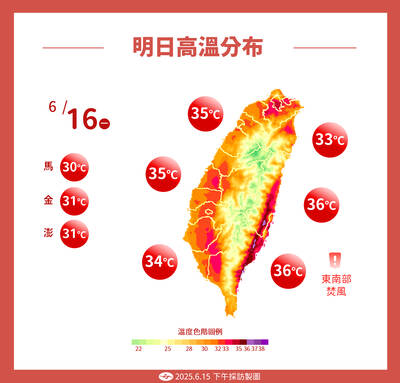
Temperatures in New Taipei City’s Sindian District (新店) climbed past 37°C yesterday, as the Central Weather Administration (CWA) issued heat alerts for 16 municipalities, warning the public of intense heat expected across Taiwan. The hottest location in Taiwan was in Sindian, where the mercury reached 37.5°C at about 2pm, according to CWA data. Taipei’s Shilin District (士林) recorded a temperature of 37.4°C at noon, Taitung County’s Jinfeng Township (金峰) at 12:50 pm logged a temperature of 37.4°C and Miaoli County’s Toufen Township (頭份) reached 36.7°C at 11:40am, the CWA said. The weather agency yesterday issued a yellow level information notice for Taipei, New
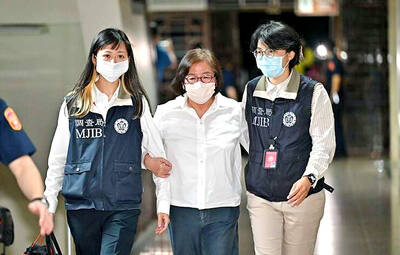
CASE: Prosecutors have requested heavy sentences, citing a lack of remorse and the defendants’ role in ‘undermining the country’s democratic foundations’ Five people affiliated with the Chinese Nationalist Party (KMT), including senior staff from the party’s Taipei branch, were indicted yesterday for allegedly forging thousands of signatures to recall two Democratic Progressive Party (DPP) lawmakers. Those indicted include KMT Taipei chapter director Huang Lu Chin-ru (黃呂錦茹), secretary-general Chu Wen-ching (初文卿) and secretary Yao Fu-wen (姚富文), the Taipei District Prosecutors’ Office said in a news release. Prosecutors said the three were responsible for fabricating 5,211 signature forms — 2,537 related to the recall of DPP Legislator Wu Pei-yi (吳沛憶) and 2,674 for DPP Legislator Rosalia Wu (吳思瑤) — with forged entries accounting for


 RSS
RSS