


As air pollution has spiraled into a political issue, upgrading a coal-fired power plant seems to many a retrogressive move for the Democratic Progressive Party (DPP) and an academic researcher yesterday said that the project might result in a backlash from local businesses.
The controversial Shenao (深澳) Power Plant in New Taipei City’s Rueifang District (瑞芳) is expected to start operating in 2025. Once completed, it would be the third operational power plant in the north of Taiwan, along with the municipality's Linkou (林口) Power Plant and Keelung’s Hsieh-ho (協和) Power Plant.
State-run Taiwan Power Co’s (Taipower) plan to rebuild the plant, which was decommissioned in 2007 and then demolished, had passed an environmental impact assessment (EIA) in 2006.
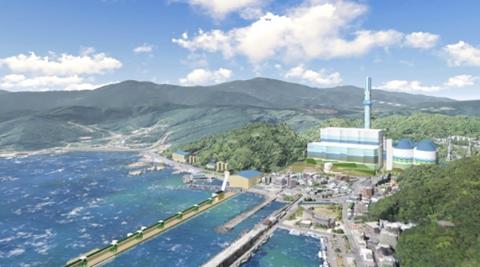
Photo courtesy of Taiwan Power Co
Due to changes to the project, Taipower filed an environmental impact analysis report with the Environmental Protection Administration (EPA) in May last year.
It proposes to replace two supercritical generators with ultra-supercritical generators and reduce their capacity from 800,000 to 600,000 kilowatts each, and has said that their polluting emissions of sulfur oxides, nitrogen oxides and particulate matter would be more than halved.
On Wednesday, the project was approved by the EPA’s environmental impact assessment grand assembly, sparking criticism.
The decisive vote was cast by assembly chairperson and EPA Deputy Minister Thomas Chan (詹順貴), who was previously a prominent lawyer known for his environmental work.
In an interview with the Taipei Times yesterday, Chan said the EPA was not entitled to reject the project, given that its potential impact on the environment has been lessened.
He added that the EPA could only choose between the 2006 project and Taipower’s modified proposal, citing Article 38 of the Environmental Impact Assessment Enforcement Rules (環境影響評估法施行細則).
“If it was a new project, the assembly could have required the developer to conduct more surveys,” he said, adding that he made the decision based on his legal expertise without any political pressure from higher-ranking officials.
Nonetheless, the assembly has required that Taipower reveal its plans for achieving energy transformation by 2025, with 50 percent of power being generated from natural gas, 30 percent from coal and 20 percent from renewable sources, he said.
In its final report on the project, the utility would clarify the information required by the assembly, Ministry of Economic Affairs Bureau of Energy Deputy Director-General Lee Chun-li (李君禮) said yesterday, but did not promise to conduct additional surveys regarding public health.
Lee added that the percentage of the nation’s power generated using coal would decrease from 47 percent to 30 percent by 2025.
Since November last year, Taipower has cooperated with the EPA and reduced electricity output when air quality is bad, Lee said.
Asked if the Shenao Power Plant upgrade would be the last coal-fired power plant construction project, he said it was difficult to say, because plants could replace older generators with better units that pollute less.
For some people, it is the utility and the ministry, instead of the EPA, that should be held responsible for the Shenao project.
As a state-run utility, Taipower should have taken the lead in convincing the public of the project’s necessity by providing thorough documentation, National Taiwan University Risk Society and Policy Research Center researcher Chao Chia-wei (趙家緯) said.
Even without the Shenao plant, the nation’s power reserve could reach about 15 percent by 2025, when taking into account the new gas-fired generators at the utility’s Datan (大潭) and Tongsiao (通霄) power plants, a new coal-fired unit at its Linkou Power Plant and about 27 gigawatts of renewable power installations, he said, adding that Formosa Plastics Group (FPG) has also announced its plan to convert its coal-fired power plant in Yunlin County’s Mailiao Township (麥寮) into a gas-fired plant.
While the EPA’s decision is upsetting, the ministry should have pushed the utility to propose a more convincing plan, he said.
The case might cause a “domino effect,” as some businesses, such as FPG, could use it as a pretext to not cooperate with the EPA’s air pollution reduction policies, Chao warned.
Nonetheless, there is still a chance to block the coal-fired plant upgrade, he added.
The Legislative Yuan could cut or freeze the utility’s budget by investigating whether the plant can really help stabilize the north’s power supply and reduce the pollution emitted from older generators, he said.
Environmental groups could also demand that the Control Yuan investigate the ministry to see if it properly fulfilled its duty of supervising the utility, Chao said.
Meanwhile, Chan said local residents opposed to the project could file an administrative appeal against the EPA and the Executive Yuan’s Petitions and Appeals Committee would have the opportunity to make the EPA to revoke its administrative action.
After the ministry reveals its plan for energy transformation by 2025, the Executive Yuan could also reassess the Shenao project’s necessity, he added.
Asked how the EPA will push other air pollution control policies after it has given the go-ahead for a coal-fired plant upgrade, Chan said it would continue implementing the policies even if the public questions its executive power.
“Improving air pollution is already a social consensus,” and people can supervise how the EPA implements its plans, Chan said, adding that he would attend a legislative session on Monday which is scheduled to discuss several amendments to the Air Pollution Control Act (空氣污染防制法).
This story has been corrected since it was first published to indicate that that original Shenao Power Plant was torn down after it was decommissioned.

REASONS FOR TRAVEL: An assistant professor said that proposed amendments to penalize drivers if they used drugs overseas would not deter people from traveling People who operate a motor vehicle under the influence of marijuana would have their driver’s license revoked, even if they used the substance while overseas, the Ministry of Transportation and Communications said yesterday, citing proposed amendments to the Road Traffic Management and Penalty Act (道路交通管理處罰條例). The amendments would also authorize the government to revoke the licenses of people determined to have used Category 1 or Category 2 narcotics, even if they were not operating a vehicle while under the influence of drugs, as well as ban them from taking the license test for three years, the ministry said. People aged 18 or

UPGRADE: The Kang Ding-class frigate is replacing its Chaparall missiles with Tien Chien II and Hua Yang VLS, which would provide it with long-range, 360° air defense Taiwan plans to produce 1,200 to 1,376 Hai Chien II missiles (海劍二, Sea Sword II) — also known as TC-2N — to serve as the standard air defense system of the navy’s surface combatant fleet, a source said yesterday. Last week, the Hai Chien II, the naval version of the Tien Kung II missile (天劍二, Sky Sword II), completed a live-fire test in waters off the National Chungshan Institute of Science and Technology’s Jiupeng facility (九鵬) in Pingtung County’s Manjhou Township (滿州). The MIM72 Chaparral and other dated air defense missiles that currently arm Taiwanese ships have inadequate range to combat Chinese

GLOBALGIVING: ‘ Caving to external pressure is not acceptable for an organization that has cultivated justice reform and human rights for 30 years,’ one NGO said A slew of non-government organizations (NGOs) have withdrawn from the GlobalGiving fundraising platform after it announced it would use “Chinese Taipei” instead of “Taiwan” from next month. The Taiwan Good Rice Association wrote on Facebook on Friday that it was informed on April 28 via a teleconference call of the change, which was made because the platform wanted to operate in China. Taiwan Good Rice is to terminate all cooperative relationships with GlobalGiving in response to the platform’s “unilateral and non-negotiable” decision to remove references to Taiwan, the NGO said. “Taiwan is in the official name of Taiwan Good Rice Association and the

HEAVY WEATHER: Typhoon Jangmi is due to crash straight into the Ryukyus as airlines look to shift flights to larger aircraft or cancel flights to Okinawa entirely Taiwan’s international air carriers announced flight adjustments over the weekend as Typhoon Jangmi is forecast to hit the Ryukyu Islands today and tomorrow. The Central Weather Administration (CWA) upgraded Jangmi from a tropical storm to a typhoon at 8am yesterday, with the eye located 580km south of Naha city. It was moving north at 19kph. Today, China Airlines’ CI-120, CI-121, CI-122 and CI-123 flights between Taoyuan and Naha, Okinawa, have been canceled as well as CI-132 and CI-133 between Kaohsiung and Naha. EVA Air’s BR-112, BR-113, BR-186 and BR-185 flights between Taoyuan and Naha are also canceled. Low-cost carrier Tigerair Taiwan canceled IT-230,


 RSS
RSS