


The National Communications Commission (NCC) yesterday approved Mao Te International Investment Co’s acquisition of Eastern Broadcasting Co (EBC), one of the nation’s leading cable TV stations.
The commission said that the company must submit a revised business plan based on the promises Mao Te chairman Chang Kao-hsiang (張高祥) made when he visited the commission’s office last week.
These include maintaining the independence of EBC’s news channels, retaining media professionals to manage the network, raising the annual program production cost from NT$300 million to NT$450 million (US$10.3 million to US$15.4 million) over six years and increasing the starting salary for employees to at least NT$30,000, commission spokesman Weng Po-tsung (翁柏宗) said.
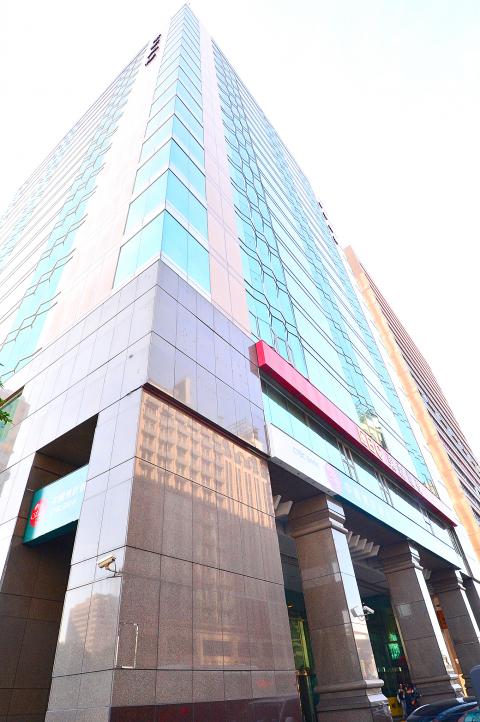
Photo: Wang Yi-sung, Taipei Times
These promises must be part of the network’s revised plan, which it has to submit to the commission for approval, Weng said.
Chang acquired EBC last year from its two largest shareholders — Eastern Media International and Carlyle Group, which held 27 percent and close to 65 percent of its stock respectively.
As the deal involved a foreign investor disinvesting in a local firm, it required the approval of the Investment Commission, which gave its okay yesterday afternoon.
In related news, cable system operators yesterday opposed the NCC’s proposal to adopt a tiered pricing system for charging subscribers, saying it would interfere with their right to handle their own property.
That would mean cable operators cannot deny channel operators the right to form their own channel packages for cable subscribers to choose from and to set the subscription fee for each channel, Cable Broadband Institute in Taiwan chairwoman Gloria Peng (彭淑芬) told a public hearing.
That would be an invasion of the right of cable system operators to handle their own property, as well as infringe on their freedom of speech, Peng said.
Taiwan Broadband Communications legal counsel Lin Chih-feng (林志峰) said that his company has invested NT$13 billion building cable systems and bandwidths.
“Should these facilities not be counted as our property? If the NCC cannot refuse any a la carte plan or ban channel operators from offering channel packages for subscribers, will that not be an invasion of our right to conduct business?” Lin said.
The NCC has recognized that channel operators should have the right to set channel subscription fees, instead of making it an exclusive right of cable system operators, EBC legal counsel Wang Chiu-ping (王秋萍) said, questioning how this constitutes invasion of cable operators’ right to handle their property and do business.
The NCC can revise the law and make this a legal right of channel operators, Wang added.
Channel operators have never received their fair share of the profits in their partnerships with cable systems, and this has not changed, despite the switch from analog to digital service, Satellite Television Broadcasting Association secretary-general May Chen (陳依玫) said.
“Cable operators have invested a lot to revamp their facilities, but now they have a chance to develop value-added services with their digital operation,” she said.
“They should start paying channel operators reasonable content fees,” she added.

UPGRADE: The Kang Ding-class frigate is replacing its Chaparall missiles with Tien Chien II and Hua Yang VLS, which would provide it with long-range, 360° air defense Taiwan plans to produce 1,200 to 1,376 Hai Chien II missiles (海劍二, Sea Sword II) — also known as TC-2N — to serve as the standard air defense system of the navy’s surface combatant fleet, a source said yesterday. Last week, the Hai Chien II, the naval version of the Tien Kung II missile (天劍二, Sky Sword II), completed a live-fire test in waters off the National Chungshan Institute of Science and Technology’s Jiupeng facility (九鵬) in Pingtung County’s Manjhou Township (滿州). The MIM72 Chaparral and other dated air defense missiles that currently arm Taiwanese ships have inadequate range to combat Chinese

REASONS FOR TRAVEL: An assistant professor said that proposed amendments to penalize drivers if they used drugs overseas would not deter people from traveling People who operate a motor vehicle under the influence of marijuana would have their driver’s license revoked, even if they used the substance while overseas, the Ministry of Transportation and Communications said yesterday, citing proposed amendments to the Road Traffic Management and Penalty Act (道路交通管理處罰條例). The amendments would also authorize the government to revoke the licenses of people determined to have used Category 1 or Category 2 narcotics, even if they were not operating a vehicle while under the influence of drugs, as well as ban them from taking the license test for three years, the ministry said. People aged 18 or
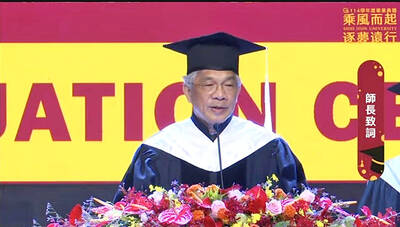
Shih Hsin University President Chen Ching-he (陳清河) yesterday issued a public apology for comments made in his commencement speech last week, stating that he has asked the school to suspend his duties and halt his wages for two months as a show of contrition. At the commencement ceremony on May 30, Chen said, “If you don’t manage your time well, or your own emotions, or your health, then I am telling every one of you — put a quick end to ‘you,’ because the world has no need for ‘you.’” The comments have sparked significant controversy online, and Chen through an open
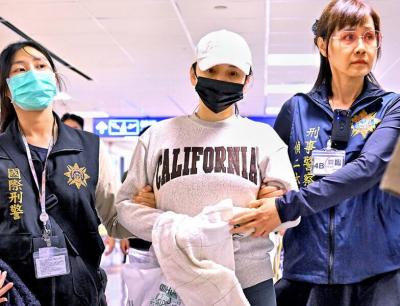
Johanne Liou (劉喬安), a Taiwanese woman who shot to unwanted fame during the Sunflower movement protests in 2014, returned to Taiwan last night after being deported from the US. She is to stand trial in Taiwan for charges involving embezzlement, fraud and drug crimes. The Criminal Investigation Bureau (CIB) said it took her into custody at Taiwan Taoyuan International Airport and would first question her before transferring her to the New Taipei District Prosecutors’ Office. She was arrested upon disembarking a flight from San Francisco that landed shortly before 7pm. Liou absconded to the US in 2019 after jumping bail


 RSS
RSS