


Inspired by the spirits of their ancestors, Puyuma musicians from Nanwang Village (南王) — also known as Katratripul, or Jhihben (知本) — and who are part of Taitung’s Beinan community — have won 14 Golden Melody Awards.
During the Japanese colonial era Puyuma singer Lu Sen-bao (陸森寶), who was also known as BaLiwakes, transcribed ancient Beinan songs so they could be passed down.
In the past, Beinan people only sang at traditional festivals.
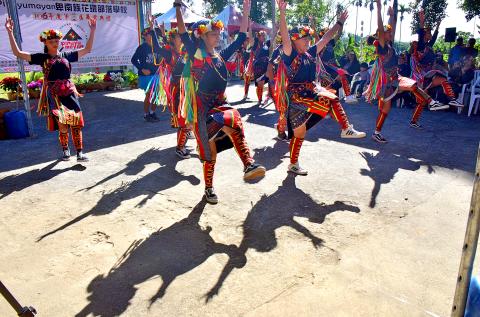
Photo: CNA
Lu’s song Beautiful Rice Grain (美麗的穗稻) was made popular by Puyuma singer Ara Kimbo, who originally gained fame under his Chinese name, Hu De-fu (胡德夫).
During Taiwan’s folk-music movement, Kimbo was hailed as the “father of Taiwanese folk music.”
Wan Sha-lang’s (萬沙浪) Where Does the Wind Come From (風從哪裡來) continued the trend, and folk music became very popular in the 1960s and 1970s.
Singer Kao Tien (高田) entered then-popular television singing competition Five Lights Awards and was awarded the highest recognition five times in a row.
Singer Lai Hsiu-hsing (賴秀星), known by her stage name Tien Chen (甸真), was honored with first place in the Golden Melody Awards.
Puyuma police officer-turned singer Chen Chien-nien (陳建年) — also known as Pur-dur — won the Best Male Singer award at the 11th Golden Melody Awards with his album The Ocean (海洋), defeating other nominees such as Jacky Cheung (張學友) and Wang Lee-hom (王力宏).
Chen’s victory shocked the Puyuma community.
However, he would only rank 26th if he returned to the Puyuma community to sing, said Agilasay Pakawyan — also known as Lin Chih-hsing (林志興) — who was the master of ceremony that evening.
Everyone in the community is a good singer, Pakawyan said.
Along with Chen, Puyuma singers Samingad, Hao-en (昊恩), Jia Jia (家家) and the Nanwang Sisters (南王姐妹花) have won a total nine Golden Melody Awards.
At the 20th Golden Melody Awards ceremony in 2009, the Nanwang Sisters thanked their ancestors for their success.
Their comments moved Beinan elder Chen Kuan-nien (陳冠年), who was watching the ceremony on television, to tears, he said.
The ancestors should be thanked for the Beinan community’s good voice, Chen Kuan-nien said.
During the Japanese occupation, many Aborigines were afraid to practice their traditions, Chen Kuan-nien said, adding that many ritual festivals were stopped.
Only the Puyuma community continued with their festivals, Chen Kuan-nien said.
He said that ancient songs must be sung at festivals — such as the “monkey festival” which marks a Puyuma man’s rite of passage, the women’s “crop-reaping festival,” the “hunting festival,” the annual festival and the “mourning-ceasing festival.”
Puyuma begin singing and developing an ear for music and tones at a young age, Chen Kuan-nien said.
“Two-thirds of us are singers,” Democratic Progressive Party Legislator Chen Ying (陳瑩) said.
The Katratripulr community has also won five Golden Melody Awards, with its first Golden Melody Award in 2001 bestowed on singer Chen Ming-jen (陳明仁), who won the Best Singing Group Award with his band Peiyuan Shanmao (北原山貓).
At the 28th Golden Melody Awards in June last year, Sangpuy won the Best Aboriginal Singer and Best Album of the Year awards, as well as a technical award for his album Yaangad.
Sangpuy has won four Golden Melody Awards, including Best Aboriginal Singer in 2013.
Sangpuy incorporates ancient tunes with modern melodies, and also performs original music in the Puyuma language.
Like the Nanwang Sisters, Sangpuy thanked his ancestors when he received his award and said he would continue to share Aboriginal music.
He hopes that people in Taiwan will respect and appreciate each other regardless of where they come from, Sangpuy said.
The Beinan community has also given rise to Isao, who was paralyzed from the neck down and used a wooden stick held in his mouth to produce electronic music on a computer.

FUKUOKA SITUATION: Japanese media reported that the pathogen is expected to be identified by the summer, while the CDC downplayed the idea that it was hMPV A “mysterious cold-like illness” reported in Japan’s Fukuoka Prefecture does not seem to be a new disease, but Japanese authorities have been asked about the situation, the Centers for Disease Control (CDC) said yesterday. The Fukuoka Prefectural Medical Association on Wednesday told a news conference that a “mystery cold” that has become a hot topic on social media is “highly likely to be caused by some kind of viral infection,” Japan’s KBC News reported. “Many people are experiencing symptoms starting with a sore throat, followed by a runny nose, phlegm and a severe cough,” KBC News reported, citing association officials. Health authorities are

Nvidia Corp CEO Jensen Huang (黃仁勳) arrived in Taiwan yesterday ahead of upcoming AI and technology events, saying he plans to meet with clients and Taiwan Semiconductor Manufacturing Co Chairman C.C. Wei (魏哲家) during his visit. After landing at Taipei Songshan Airport, Huang posed for photos with fans and handed out Yakult drinks to reporters and supporters waiting at the scene, saying he has “a lot to do” during the trip. Asked about reports that Nvidia’s planned headquarters site in Taipei’s Beitou Shilin Technology Park could break ground on May 27, Huang said that if the company holds an event, he would

The Ministry of Finance this afternoon announced the winning numbers for the March-April uniform invoice lottery. The winning number for the NT$10 million (US$318,060) special prize is 19531471, and the winning number for the NT$2 million grand prize is 85941329. Three numbers were drawn for the NT$200,000 first prize: 07225810, 20231230 and 83518781. Those with receipts matching the last seven digits of any of the first-prize numbers will win the NT$40,000 second prize, while those matching the last six digits will win the NT$10,000 third prize. Those whose receipts match the last five digits of the first-prize numbers can claim the NT$4,000 fourth prize,
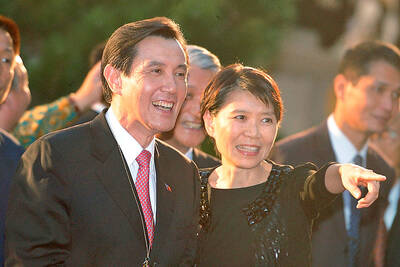
Former president Ma Ying-jeou (馬英九) yesterday expressed “shock and regret” over a statement issued by his wife without his consent, and rejected her assertion that his eldest sister, Ma Yi-nan (馬以南), would manage his medical care or act as his spokesperson amid an ongoing embezzlement probe into his foundation. Ma Ying-jeou in a statement said he was shocked by a statement by his wife, Chou Mei-ching (周美青), regarding his affairs. Ma Yi-nan “must not” be in charge of his healthcare and other personal affairs, nor can she be allowed to represent the Ma family, the former president said. He said he was also


 RSS
RSS