


Huang Po-wei (黃博煒), a 25-year-old survivor of the 2015 dust explosion incident in New Taipei City, says his raison d’etre is to bring positive thoughts to other victims of the incident.
At the Color Play Asia event on June 27, 2015, colored dust at a water park caught fire, sparking an explosion that left 508 injured and 15 dead.
Huang received third-degree burns over 95 percent of his body, leaving him in critical condition.
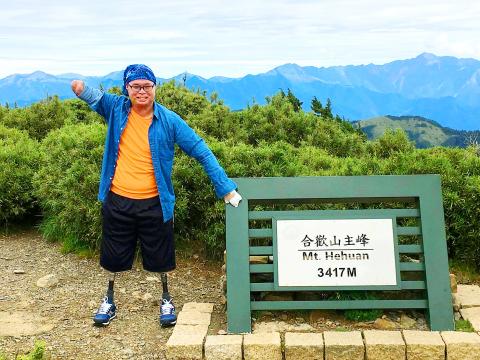
Photo courtesy of Huang Po-wei
At the hospital, his parents had asked him: “Should we abandon emergency care or should we agree to amputation with less than 10 percent chance of survival?”
Huang said he had been unable to make a sound, despite the roiling disbelief tearing him up inside as he was kept alive via intubation.
He said the thought that was running through his head was: “My life is just about to begin, why should I leave it behind?”
After high school, Huang said he had worked part-time jobs, including handing out flyers and working at beverage shops, to help pay for his own tuition and expenses.
He completed college and obtained more than 10 certificates related to computer technology and circuitry, before landing an internship at a tech company, but said he still had many things to do.
“I was not afraid of working hard; I was afraid of losing the opportunity to work hard,” Huang said.
The surgery was successful. Huang described the feeling of drinking his first cup of water a month after the surgery to be “absolutely divine, like being alive again,” but he had to wait another month to eat normally again.
What people usually take for granted now became a chore, Huang said.
Over seven months of hospitalization and physical therapy, Huang said he had to learn to become accustomed to failure.
“Failure was quite literally a constant in life,” Huang said.
However, it is only through experiencing failure that a person can accomplish more, he said.
Huang used his experience of learning how to operate an electric wheelchair as an example, saying that since he began using the chair in September last year, he is now self-sufficient when traveling or purchasing groceries.
Huang said he wants to keep bowling and hiking, adding: “It is not impossible, it just takes time.”
It took more than 40 or 50 tries before he was able to even touch one of the pins with a bowling ball, Huang said.
He had to train three to four months before he achieved his dream of climbing to the peak of Hehuanshan (合歡山), an act he had formerly thought to be impossible.
The past two years had not all been cheerful and rosy, Huang said, adding that many times he saw comments online saying that he should not “be a burden to his parents.”
One time, a woman demanded that he “move out of the way, you will scare the children,” when he went out to purchase some snacks from a street vendor, he said.
However, Huang said that he knew that for every bigoted comment or discriminatory look, there were more people who would help and encourage him.
While his outward optimism was “courage out of necessity,” Huang said that “it was a difficult path, but not as difficult as imagined.”
Wishing to share his experiences with other victims of the incident and to let the public and his doctors know that their efforts have not been in vain, Huang decided to publish a memoir.
“Those with a will never compromise,” Huang said, adding that he hopes his experiences detailed in Alive (但我想活) would give courage to other victims.

Considering that most countries issue more than five denominations of banknotes, the central bank has decided to redesign all five denominations, the bank said as it prepares for the first major overhaul of the banknotes in more than 24 years. Central bank Governor Yang Chin-lung (楊金龍) is expected to report to the Legislative Yuan today on the bank’s operations and the redesign’s progress. The bank in a report sent to the legislature ahead of today’s meeting said it had commissioned a survey on the public’s preferences. Survey results showed that NT$100 and NT$1,000 banknotes are the most commonly used, while NT$200 and NT$2,000

The Centers for Disease Control (CDC) yesterday reported the first case of a new COVID-19 subvariant — BA.3.2 — in a 10-year-old Singaporean girl who had a fever upon arrival in Taiwan and tested positive for the disease. The girl left Taiwan on March 20 and the case did not have a direct impact on the local community, it said. The WHO added the BA.3.2 strain to its list of Variants Under Monitoring in December last year, but this was the first imported case of the COVID-19 variant in Taiwan, CDC Deputy Director-General Lin Ming-cheng (林明誠) said. The girl arrived in Taiwan on

South Korea is planning to revise its controversial electronic arrival card, a step Taiwanese officials said prompted them to hold off on planned retaliatory measures, a South Korean media report said yesterday. A Yonhap News Agency report said that the South Korean Ministry of Foreign Affairs is planning to remove the “previous departure place” and “next destination” fields from its e-arrival card system. The plan, reached after interagency consultations, is under review and aims to simplify entry procedures and align the electronic form with the paper version, a South Korean ministry official said. The fields — which appeared only on the electronic form

The Ministry of Foreign Affairs (MOFA) is suspending retaliation measures against South Korea that were set to take effect tomorrow, after Seoul said it is updating its e-arrival system, MOFA said today. The measures were to be a new round of retaliation after Taiwan on March 1 changed South Korea's designation on government-issued alien resident certificates held by South Korean nationals to "South Korea” from the "Republic of Korea," the country’s official name. The move came after months of protests to Seoul over its listing of Taiwan as "China (Taiwan)" in dropdown menus on its new online immigration entry system. MOFA last week


 RSS
RSS