


In 100 years, an ink brush that was purchased at a high price for collection would still only be a brush, but if it can inspire artistic creation in the hands of an artist, it fulfills its utmost value, brushmaker and National Palace Museum consultant Chen Yao-wen (陳耀文) said in an interview.
Chen said he has spent more than 20 years searching for various kinds of animal hairs to meet artists’ needs in terms of the firmness, fineness and other aspects of brushes.
The hairs he uses to make brush tips come from tigers, springboks, spotted hyenas, giraffes, giant pandas, porcupines, peafowl and even the roots of some plants, such as the sago pondweed, he added.
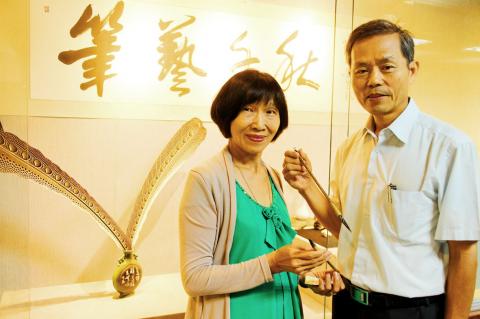
Photo: Huang Mei-chu, Taipei Times
As for the brush handle, Chen said he prefers to use bamboo.
However, he said that wood, shells, jade, stones, liquor bottles and almost anything else that can be held are also used in his creations.
Many collectors have expressed interest in his handmade ink brushes, Chen said, but added that he would rather sell them to artists at lower prices.
Chen, a second-generation brushmaker, said he believes that a proper handmade ink brush becomes not just a writing tool, but the treasure sword of an artist.
It can urge artists to create with passion and help them reach the height of their careers, he added.
Chen attributed his idea of seeing the ink brush as a sword to his long-term involvement in the artistic and literary environment at the National Palace Museum.
In 1990, the museum needed a brushmaking technical consultant, and a jade and stone expert at the museum who had admired Chen’s work thought of him, he said.
He replicated an ink brush that had been used by Qing Emperor Kangxi (康熙) found in the museum’s collection, Chen said.
Even though the only remaining part of the artifact was its handle, Chen said it is the only brush of its kind to be found on either side of the Taiwan Strait.
The Palace Museum in Beijing only has a portrait depicting Kangxi holding the brush to sign a Qing Dynasty-era imperial court document, he said.
Chen said he started the task by first spending two to three months learning how to use a lathe, then spent more than a year learning the raden technique, which involves inserting shell inlays into lacquer or wood.
Chen said he used ebony for the brush’s body and turned the wood on a lathe to create a shell pattern engraving.
He then inlaid a shell that he had ground to match the curve of the wood before repolishing the body and applying raw lacquer, he added.
Chen said that a visiting professor from Beijing wanted to collect the replica, but he declined the offer.
Chen said that one Lunar New Year, he gave his friends and relatives ink brushes with handles made from gourd-shaped bottle ornaments.
To his surprise, the gifts were widely popular, he said.
To continue the effort of combining his business of brushmaking with creativity, Chen said he has planted more than 20 types of bamboo on his rooftop and left the plants unattended so that they could absorb the effects of the environment, including insect infestation, spotting and other factors.
The second-generation owner of a brushmaking workshop in New Taipei City’s Sanchong District (三重), Chen recalled learning the craft from his father when he was eight years old.
He said that after completing his mandatory military service, he continued working in the field of brushmaking to make a living.
The younger generation today first consider whether they are interested in a certain field when pursuing their education and professional careers, Chen said.
Interest is a product of cultivation, Chen said, urging the younger generation to cultivate their interests and incorporate them into their work.

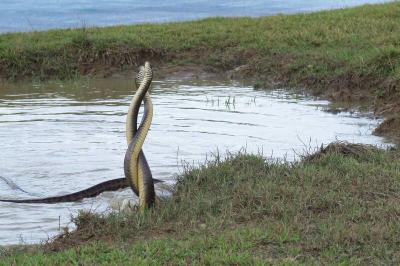
Kenting National Park service technician Yang Jien-fon (楊政峰) won a silver award in World Grand Prix Photography Awards Spring Season for his photograph of two male rat snakes intertwined in combat. Yang’s colleagues at Kenting National Park said he is a master of nature photography who has been held back by his job in civil service. The awards accept entries in all four seasons across six categories: architectural and urban photography, black-and-white and fine art photography, commercial and fashion photography, documentary and people photography, nature and experimental photography, and mobile photography. Awards are ranked according to scores and divided into platinum, gold and
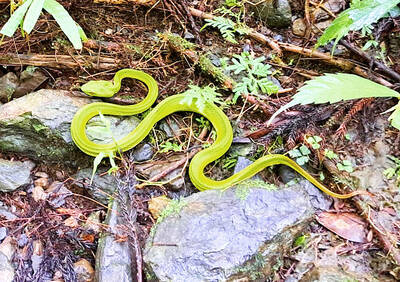
More than half of the bamboo vipers captured in Tainan in the past few years were found in the city’s Sinhua District (新化), while other districts had smaller catches or none at all. Every year, Tainan captures about 6,000 snakes which have made their way into people’s homes. Of the six major venomous snakes in Taiwan, the cobra, the many-banded krait, the brown-spotted pit viper and the bamboo viper are the most frequently captured. The high concentration of bamboo vipers captured in Sinhua District is puzzling. Tainan Agriculture Bureau Forestry and Nature Conservation Division head Chu Chien-ming (朱健明) earlier this week said that the
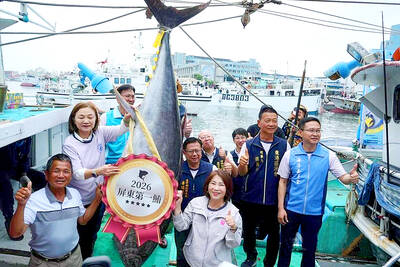
The first bluefin tuna of the season, brought to shore in Pingtung County and weighing 190kg, was yesterday auctioned for NT$10,600 (US$333.5) per kilogram, setting a record high for the local market. The auction was held at the fish market in Donggang Fishing Harbor, where the Siaoliouciou Island-registered fishing vessel Fu Yu Ching No. 2 delivered the “Pingtung First Tuna” it had caught for bidding. Bidding was intense, and the tuna was ultimately jointly purchased by a local restaurant and a local company for NT$10,600 per kilogram — NT$300 ,more than last year — for a total of NT$2.014 million. The 67-year-old skipper
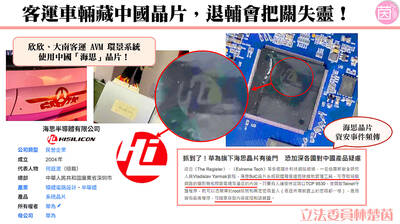
BREACH OF CONTRACT: The bus operators would seek compensation and have demanded that the manufacturer replace the chips with ones that meet regulations Two bus operators found to be using buses with China-made chips are to demand that the original manufacturers replace the systems and provide compensation for breach of contract, the Veterans Affairs Council said yesterday. Democratic Progressive Party Legislator Michelle Lin (林楚茵) yesterday said that Da Nan Bus Co and Shin-Shin Bus Co Ltd have fielded a total of 82 buses that are using Chinese chips. The bus models were made by Tron-E, while the systems provider was CYE Electronics, Lin said. Lin alleged that the buses were using chips manufactured by Huawei subsidiary HiSilicon Co, which presents a national security risk if the


 RSS
RSS