


Former Philippine vice president Teofisto Guingona Jr on Wednesday said in a keynote speech at the Yushan Forum that Taiwan and the Philippines should work together for a better future and promote technology development and economic growth.
In the speech, titled “Let’s Help Each Other,” Guingona called for Taiwanese companies to do their manufacturing in the Philippines and provide technical know-how, and for Taiwan to take advantage of the Philippines’ agricultural products and tourism resources.
The Philippines could serve as a gateway to Asia for Taiwan, because it benefits from preferential tariff systems from the EU and the US, making the country’s exports more competitive in those markets, Guingona said.
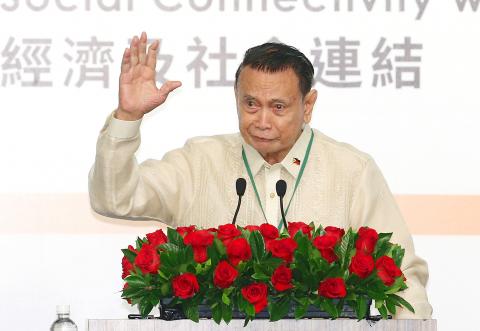
Photo: CNA
That means that Taiwanese companies manufacturing there can get duty exemptions on exports of about 5,000 products to the US and 6,274 products to the EU for up to 10 years, said Guingona, who served as vice president from 2001 to 2004.
Businesses that would benefit would be makers of footwear, headwear, umbrellas, electrical appliances, bicycles and canned tuna or processed pineapple, he said.
For instance, Taiwanese bicycle brands producing their goods in the Philippines would benefit from lower import duties when exporting to the US and Europe, Guingona said.
He also appealed for help from Taiwan in technology, research and development, design, product development, precision machinery and tool and dye making.
In agriculture, he said the Philippines is blessed with products such as coconuts, whose virtues he extolled, as its husk is a source of natural fibers and its meat is a source of coconut oil and desiccated coconut.
“We humbly offer this product to Taiwan, not only here, but also in the Philippines,” Guingona said.
He also touted two tourism destinations as possible areas of investment for Taiwanese interests — Mount Data in central Luzon and Lake Lanao on Mindanao.
Throughout his speech, Guingona described the people of Taiwan and the Philippines as brothers and sisters and close neighbors, saying that the two should “build the economic and social life for a better world, for continued happiness.”
Deputy Minister of Economic Affairs Wang Mei-hua (王美花) told the forum that the Philippines is likely to be the first of six Southeast Asian countries to renew a bilateral investment guarantee agreement with Taiwan, as the negotiations are on track to be completed by December.
Similar agreements with Indonesia, Malaysia, Vietnam, Thailand and Malaysia are expected to be renewed under the government’s New Southbound Policy to achieve enhanced cooperation, but the pace of negotiations is slower than with the Philippines, Wang said.
Taiwan signed the agreements with the six countries in the 1990s, but is seeking to renew them to forge closer business ties and better protect Taiwanese investments in those countries.
Given the Philippines’ proactive approach to trade and investment cooperation with Taiwan, Wang said she was optimistic about completing the talks by December.
The New Southbound Policy aims to not only establish and upgrade free-trade agreements with the target countries, but also to build exchanges and substantive partnerships with them in the areas of agriculture, healthcare and the cultivation of talent, Wang said.
The policy is aimed at enhancing Taiwan’s relations with countries in South and Southeast Asia, as well as Australia and New Zealand.
The two-day “Yushan Forum: Asian Dialogue for Innovation and Progress,” which opened on Wednesday in Taipei, was organized by the government-affiliated Prospect Foundation to boost Taiwan’s regional status and forge a closer relationship with nations in the Asia-Pacific region.
The conference’s main theme is “fostering economic and social connectivity with Southeast and South Asia,” as part of the government’s New Southbound Policy.
It featured speakers and participants from the Asia-Pacific region and beyond, including India, Indonesia, the Philippines, Singapore, Thailand, Vietnam, Malaysia, Japan, South Korea, the US, Belgium and Denmark.
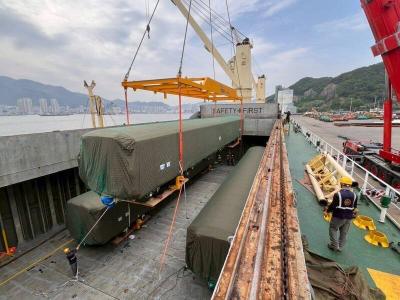
The first of 10 new high-capacity trains purchased from South Korea’s Hyundai Rotem arrived at the Port of Taipei yesterday to meet the demands of an expanding metro network, Taipei Rapid Transit Corp (TRTC) said yesterday. The train completed a three-day, 1,200km voyage from the Port of Masan in South Korea, the company said. Costing NT$590 million (US$18.79 million) each, the new six-carriage trains feature a redesigned interior based on "human-centric" transportation concepts, TRTC said. The design utilizes continuous longitudinal seating to widen the aisles and optimize passenger flow, while also upgrading passenger information displays and driving control systems for a more comfortable

Instead of focusing solely on the threat of a full-scale military invasion, the US and its allies must prepare for a potential Chinese “quarantine” of Taiwan enforced through customs inspections, Stanford University Hoover fellow Eyck Freymann said in a Foreign Affairs article published on Wednesday. China could use various “gray zone” tactics in “reconfiguring the regional and ultimately the global economic order without a war,” said Freymann, who is also a nonresident research fellow at the US Naval War College. China might seize control of Taiwan’s links to the outside world by requiring all flights and ships entering or leaving Taiwan
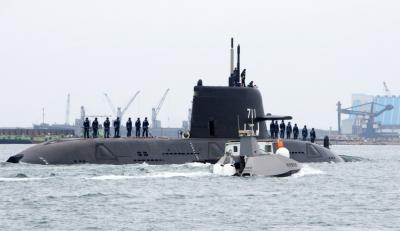
Taiwan's first indigenous defense submarine, the SS-711 Hai Kun (海鯤, or Narwhal), departed for its 13th sea trial at 7am today, marking its seventh submerged test, with delivery to the navy scheduled for July. The outing also marked its first sea deployment since President William Lai (賴清德) boarded the submarine for an inspection on March 19, drawing a crowd of military enthusiasts who gathered to show support. The submarine this morning departed port accompanied by CSBC Corp’s Endeavor Manta (奮進魔鬼魚號) uncrewed surface vessel and a navy M109 assault boat. Amid public interest in key milestones such as torpedo-launching operations and overnight submerged trials,
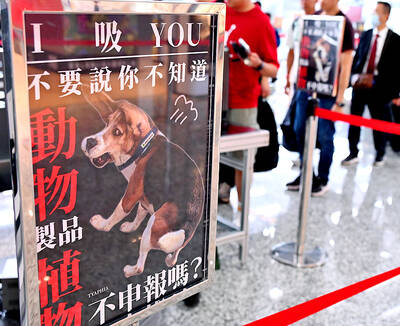
Quarantine awareness posters at Taiwan Taoyuan International Airport have gone viral for their use of wordplay. Issued by the airport branch of the Animal and Plant Health Inspection Agency, the posters feature sniffer dogs making a range of facial expressions, paired with advisory messages built around homophones. “We update the messages for holidays and campaign needs, periodically refreshing materials to attract people’s attention,” quarantine officials said. “The aim is to use the dogs’ appeal to draw focus to quarantine regulations.” A Japanese traveler visiting Taiwan has posted a photo on X of a poster showing a quarantine dog with a


 RSS
RSS